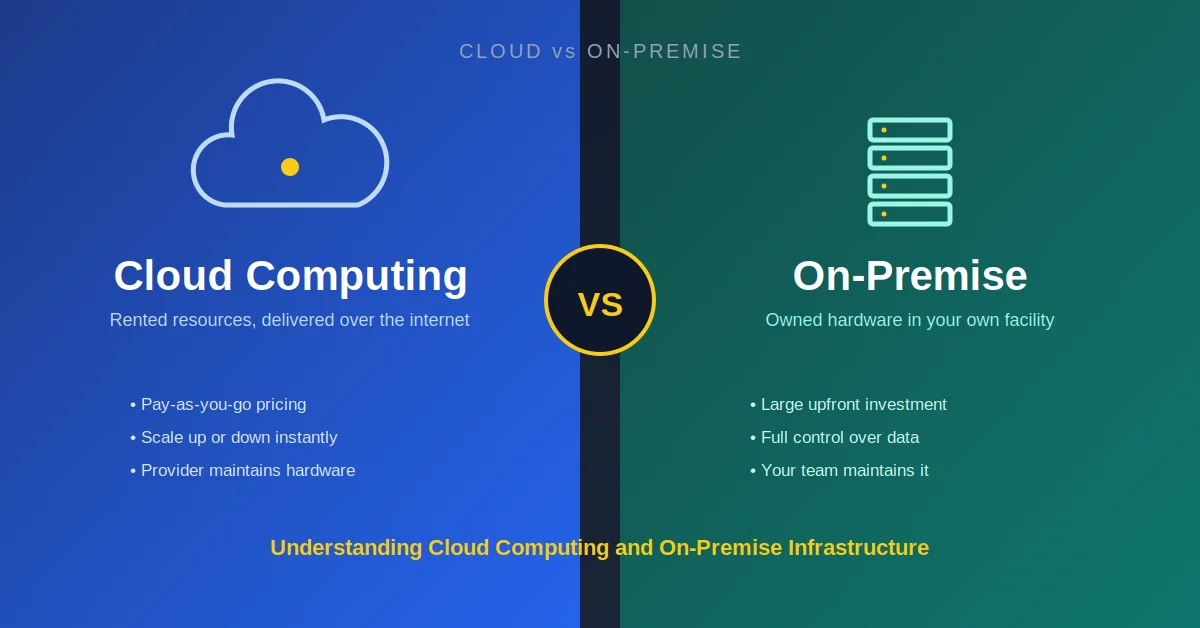
Organizations deploy their IT resources using either cloud computing or on-premise infrastructure, or a combination of both. On-premise infrastructure involves hardware and software owned, managed, and hosted directly by the organization, typically within its own facilities. Cloud computing delivers IT services—including servers, storage, databases, networking, software, analytics, and intelligence—over the internet, managed by a third-party provider.
The choice between these models impacts operational control, financial outlay, and strategic flexibility. Each approach presents distinct trade-offs for IT teams, influencing how businesses manage their digital assets and services.
Defining On-Premise Infrastructure
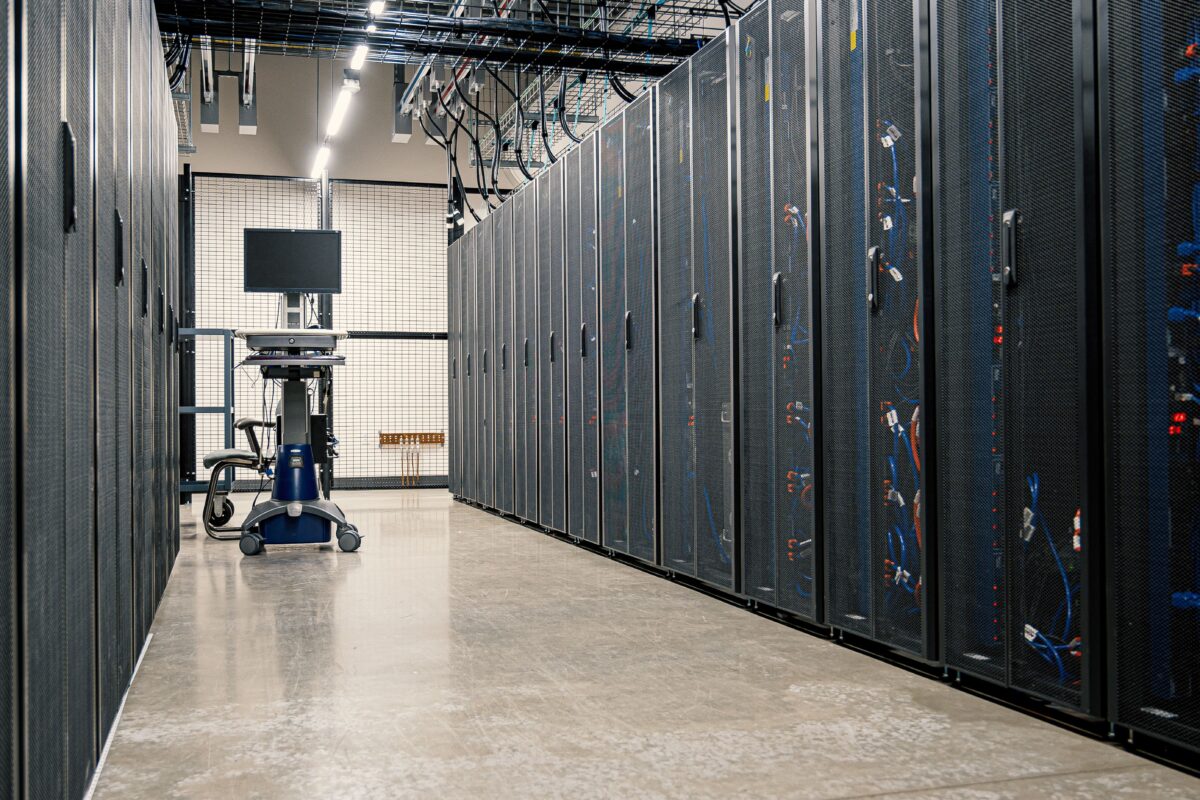
On-premise infrastructure operates on hardware that a business owns and manages. This hardware is typically hosted onsite within the company’s data center or server rooms. The organization retains full control over its data, applications, and the underlying physical infrastructure.
This model requires significant capital expenditure for hardware acquisition, software licenses, and facility setup. Ongoing operational costs include power, cooling, physical security, and dedicated IT staff for maintenance and support.
Defining Cloud Computing
Cloud computing provides IT services via the internet from a third-party cloud provider. Users access resources like virtual machines, storage, and applications on demand, paying only for what they consume. This eliminates the need for direct hardware ownership and management.
Cloud models include Infrastructure as a Service (IaaS), Platform as a Service (PaaS), and Software as a Service (SaaS). These services offer varying levels of abstraction and management responsibility, shifting much of the operational burden to the cloud provider.
Operational Models and Key Characteristics
The operational distinctions between cloud and on-premise models dictate how IT resources are provisioned, scaled, and maintained. These differences directly affect an organization’s agility and resource allocation.
Resource Provisioning and Scalability
On-premise infrastructure requires manual provisioning of hardware and software. Scaling resources involves purchasing, installing, and configuring new equipment, a process that can take weeks or months. This model suits steady-state workloads with predictable resource demands.
Cloud computing offers rapid, on-demand resource provisioning. Users can scale resources up or down programmatically within minutes, adapting quickly to fluctuating workloads. This elasticity is a primary advantage for dynamic business environments.
Management and Maintenance
With on-premise infrastructure, the organization is responsible for all aspects of management, including hardware maintenance, software updates, security patching, and network configuration. This demands dedicated IT personnel and expertise.
Cloud computing offloads much of the infrastructure management to the cloud provider. The provider handles physical hardware, networking, and often operating system maintenance, depending on the service model. This reduces the operational overhead for the client organization.
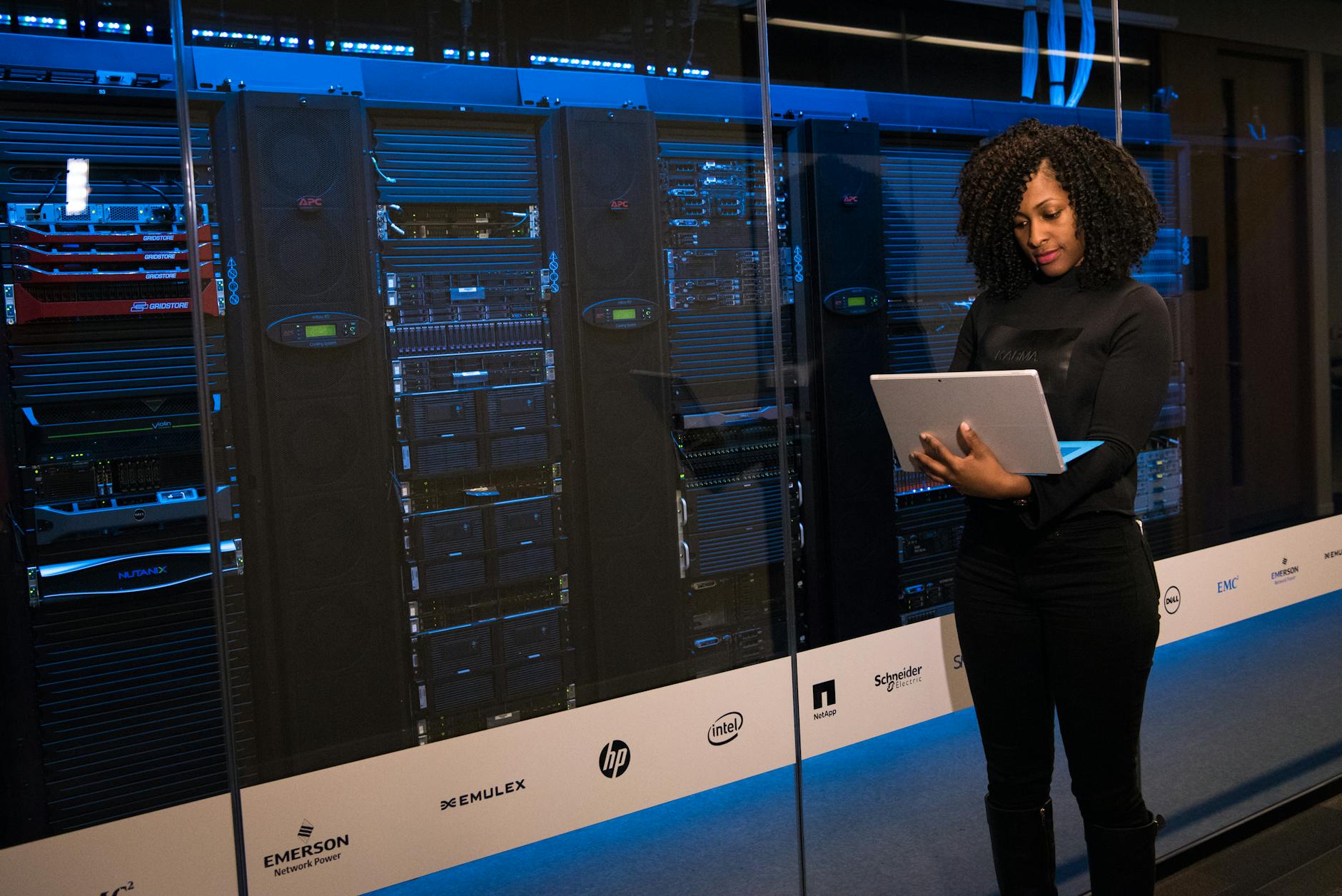
Photo by Christina Morillo on Pexels
Cost Implications and Financial Considerations
The financial models for cloud and on-premise infrastructure differ significantly, impacting budgeting and long-term expenditure. Understanding these cost structures is essential for strategic decision-making.
Capital Expenditure vs. Operational Expenditure
On-premise infrastructure primarily involves capital expenditure (CapEx). Businesses make large upfront investments in hardware, software licenses, and data center facilities. These assets depreciate over time.
Cloud computing operates on an operational expenditure (OpEx) model. Costs are incurred as services are consumed, typically on a pay-as-you-go basis. This shifts expenses from large upfront investments to ongoing, variable payments.
Total Cost of Ownership (TCO)
Calculating the Total Cost of Ownership (TCO) for on-premise includes hardware, software, power, cooling, physical security, and IT staff salaries. While hardware costs have plummeted, the associated operational expenses remain significant.
For enterprise workloads, public cloud is becoming more expensive than on-premises infrastructure in 2026-2027. This shift is attributed to rising cloud service costs compared to the decreasing expense of owning and operating hardware.
Control, Security, and Data Governance
The level of control, security posture, and data governance capabilities are primary differentiators between on-premise and cloud environments. These factors are often paramount for organizations handling sensitive information.
Data Ownership and Control
On-premise infrastructure provides organizations with complete control and ownership over their data and the underlying infrastructure. This is a top priority for businesses with stringent regulatory requirements or highly sensitive data.
In cloud computing, data resides on a third-party provider’s servers. While organizations retain data ownership, the physical control and management of the infrastructure are delegated to the cloud provider. This requires trust in the provider’s security and compliance measures.
Security and Compliance
On-premise security is entirely the responsibility of the organization. This includes physical security, network security, data encryption, and compliance with industry regulations. Organizations can implement highly customized security protocols.
Cloud providers offer robust security measures, often exceeding what individual organizations can achieve. However, security in the cloud operates on a shared responsibility model. The cloud provider secures the infrastructure “of” the cloud, while the customer is responsible for security “in” the cloud, including data, applications, and network configurations.

Photo by Brett Sayles on Pexels
Strategic Selection: Cloud, On-Premise, or Hybrid
The decision between cloud and on-premise is rarely absolute for modern enterprises. A hybrid approach, combining both models, is increasingly common, allowing organizations to leverage the strengths of each.
Choosing On-Premise
Organizations choose on-premise infrastructure when control and ownership are paramount. This model is preferred for sensitive data and steady-state workloads that require predictable performance and strict compliance. Some IT professionals prefer on-premise servers for specific functionalities like Active Directory and Group Policy management.
The ability to maintain direct oversight of all hardware and software components, coupled with the potential for lower long-term costs for stable enterprise workloads, makes on-premise a viable option for specific use cases.
Choosing Cloud Computing
Cloud computing is selected for its flexibility, scalability, and reduced management overhead. It is ideal for dynamic workloads, rapid application development, and scenarios requiring global accessibility. The pay-as-you-go model supports innovation without large upfront capital investments.
Cloud environments enable businesses to quickly adapt to market changes, experiment with new technologies, and expand operations without significant infrastructure delays.
The Hybrid Approach
For most enterprises in 2026, the answer is not exclusively cloud or on-premise; it is both. A hybrid cloud strategy allows organizations to keep sensitive data and steady-state workloads on-premise, while leveraging the cloud for flexible, scalable applications and variable workloads. This approach optimizes for both control and agility.
| Feature | Cloud Computing | On-Premise Infrastructure |
|---|---|---|
| Ownership | Third-party provider owns hardware | Organization owns hardware |
| Management | Managed by provider (shared responsibility) | Managed by organization |
| Cost Model | Operational Expenditure (OpEx) | Capital Expenditure (CapEx) |
| Scalability | Rapid, on-demand elasticity | Manual, time-consuming |
| Control | Delegated to provider | Full organizational control |
| Initial Investment | Low to none | High upfront cost |
| Data Sensitivity | Suitable for various data, requires trust | Preferred for highly sensitive data |
Real World Example
Consider a financial institution operating in 2026. This institution handles vast amounts of highly sensitive customer data and is subject to strict regulatory compliance. For its core banking systems, customer databases, and archival records, the institution maintains an on-premise infrastructure. This ensures maximum control over data security, physical access, and compliance audits, aligning with their top priorities of control and ownership.
Simultaneously, the institution develops a new mobile banking application and a data analytics platform for market trend analysis. These applications experience fluctuating user loads and require rapid deployment cycles. For these dynamic workloads, the institution utilizes cloud computing. This allows them to scale resources quickly during peak usage, leverage advanced analytics services without purchasing specialized hardware, and benefit from the cloud’s flexibility for development and testing environments. This hybrid strategy allows the financial institution to protect its most critical assets while innovating with agility.
Key Takeaways
- On-premise infrastructure provides full control and ownership, ideal for sensitive data and steady workloads.
- Cloud computing offers flexibility, scalability, and reduced management overhead through a pay-as-you-go model.
- The financial landscape in 2026-2027 shows public cloud becoming more expensive than on-premises for enterprise workloads.
- Most enterprises in 2026 adopt a hybrid strategy, combining both cloud and on-premise for optimized operations.
- Choosing between models involves weighing control, cost, scalability, and security requirements against business needs.
The prevailing trend for enterprises in 2026 is not an exclusive choice between cloud or on-premise, but rather a strategic integration of both models. This hybrid approach allows organizations to balance specific workload requirements with operational benefits.
Frequently Asked Questions
What is the primary difference in ownership between cloud and on-premise?
With on-premise infrastructure, the organization owns and manages all hardware and software. In cloud computing, a third-party provider owns the underlying infrastructure, and the organization consumes services over the internet.
Which model offers greater flexibility and scalability?
Cloud computing offers greater flexibility and rapid scalability. Resources can be provisioned and adjusted on-demand within minutes, adapting quickly to changing business requirements without significant capital investment.
Is cloud computing always more cost-effective than on-premise?
Not necessarily. While cloud computing offers a lower initial investment and an OpEx model, public cloud is becoming more expensive than on-premises for enterprise workloads in 2026-2027, especially as hardware costs have plummeted.
When should an organization prioritize on-premise infrastructure?
An organization should prioritize on-premise infrastructure when control, ownership, and strict data governance are top priorities. This is particularly relevant for highly sensitive data, steady-state workloads, and specific regulatory compliance needs.
SiliconeUpdate.com is a technology news platform that publishes updates and informational content related to silicon technology, software, artificial intelligence, and emerging technologies.
All articles published on this platform are attributed to SiliconeUpdate.com instead of individual authors. Content is presented in a neutral, informational format without personal opinions.
—
Content Publishing
SiliconeUpdate.com publishes news and updates based on publicly available information, official announcements, and industry developments. The focus is on clarity, relevance, and timely reporting.
—
Editorial Control
All editorial decisions, updates, and content management are handled at the platform level. No individual human or AI identity is presented as the author of articles.
—
Contact
For editorial communication or general queries, contact:
Email: neemasharma@gmail.com