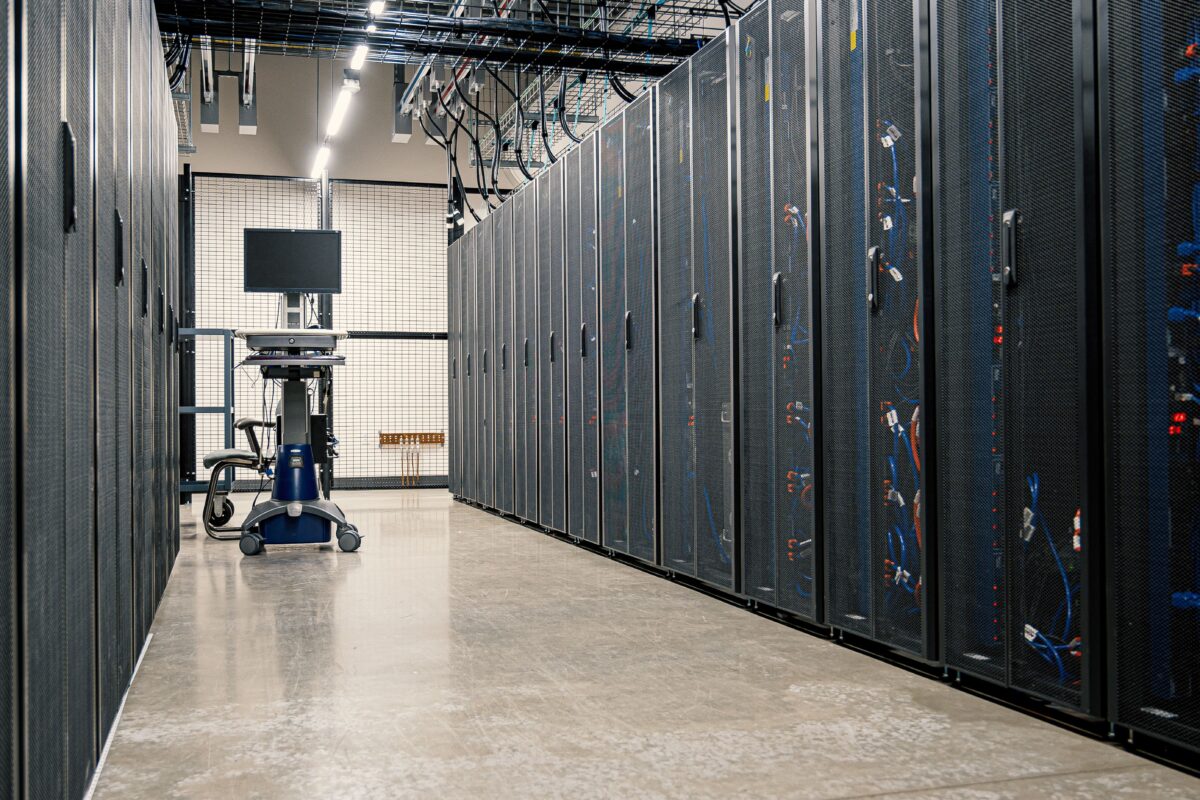
Data center networking (DCN) forms the backbone connecting diverse components within a data center. It unifies servers, storage systems, switches, routers, and virtual resources into a cohesive operational environment. This intricate network relies on a combination of hardware and software to provide the necessary connectivity and security for modern applications.
Core Components of Data Center Networks
A data center network fundamentally comprises switches, routers, and other specialized hardware. These components collaborate to facilitate data flow and ensure secure operations. Switches manage traffic within a local network segment, while routers direct traffic between different networks.
Beyond basic connectivity, DCN hardware supports advanced functions like virtualization and security policy enforcement. The selection and configuration of these components directly impact network performance and resilience.
The Role of Switches in Data Centers
Switches are central to data center operations, enabling high-speed communication between servers and other devices. They operate at Layer 2 (data link layer) or Layer 3 (network layer) of the OSI model, forwarding data frames or packets based on MAC addresses or IP addresses, respectively.
Modern data center switches offer high port densities and advanced features like low latency and wire-speed forwarding. Their performance is critical for applications requiring rapid data exchange, such as distributed databases and virtualized environments.
Fabric Architectures: Spine-Leaf and Beyond
Traditional three-tier data center architectures often suffer from bottlenecks and limited scalability. The spine-leaf architecture addresses these limitations by creating a flatter, more efficient network topology. This design offers significant advantages for modern data centers.
Spine-Leaf Advantages
The spine-leaf architecture consists of two layers: the spine layer and the leaf layer. Leaf switches connect directly to servers and storage, while spine switches interconnect all leaf switches. This full-mesh connectivity between spine and leaf layers ensures that any leaf switch can reach any other leaf switch through a single hop to a spine switch.
- Reduced Latency: Traffic between servers connected to different leaf switches traverses a maximum of two hops (leaf-spine-leaf).
- Increased Bandwidth: All links between spine and leaf switches can be active, utilizing Equal-Cost Multi-Path (ECMP) routing.
- Enhanced Scalability: Adding more spine or leaf switches can increase network capacity without re-architecting the entire network.
Evolving to AI-Optimized Compute Fabrics
Data center networking is evolving into deterministic, AI-optimized compute fabrics designed for extreme scale. This evolution is driven by the demanding requirements of AI training and inferencing operations. These fabrics prioritize predictable performance and low latency for AI workloads.
The design of AI-optimized fabrics incorporates technologies that ensure efficient data movement across the network. This includes specialized hardware and software configurations tailored for AI traffic patterns.

Photo by Omar Ashraf on Pexels
High-Performance Networking for AI
The demands of artificial intelligence workloads are fundamentally changing data center optical infrastructure. High-performance networking is paramount for efficient AI training and inferencing.
The Impact of 1.6TbE Ethernet
The arrival of 1.6TbE Ethernet (1.6 Terabit Ethernet) significantly enhances the performance of data center fabrics. This technology is particularly beneficial for AI training and inferencing operations, where massive datasets must be moved rapidly between compute and storage resources.
1.6TbE provides the necessary bandwidth to prevent network bottlenecks from impeding AI model development and deployment. Its introduction marks a new era in AI data centers, enabling faster processing and more complex AI models.
Optical Switching for Scalable AI Fabrics
MEMS-based optical switching is a key technology for scalable AI fabrics. This technology combines low optical loss with the ability to scale network capacity efficiently. Optical switching ensures the reliability and performance required for demanding AI environments.
By leveraging optical switching, data centers can build fabrics that handle the immense data flows generated by AI applications without compromising signal integrity or introducing significant latency.
Security and Policy Enforcement
Security is an integral part of data center networking, protecting sensitive data and ensuring operational integrity. Modern DCN solutions incorporate advanced security features to mitigate threats.
Microsegmentation for Threat Mitigation
Microsegmentation is a security technique that divides data center networks into isolated segments down to the individual workload level. This approach limits the lateral movement of threats within the network, even if a breach occurs in one segment.
Cisco Nexus One expands group-based policy across multiple fabrics using ESG (Endpoint Security Group) to implement microsegmentation in real time. This capability allows for immediate threat mitigation as security incidents emerge, enhancing overall data center security posture.

Photo by Brett Sayles on Pexels
Key Takeaways
- Data center networking connects servers, storage, and virtual resources, forming a unified operational environment.
- Spine-leaf architecture offers reduced latency, increased bandwidth, and enhanced scalability compared to traditional designs.
- The introduction of 1.6TbE Ethernet significantly boosts fabric performance, especially for AI training and inferencing.
- AI-optimized compute fabrics are deterministic networks built for extreme scale, crucial for modern AI workloads.
- Microsegmentation, enabled by technologies like Cisco Nexus One with ESG, provides real-time threat mitigation and enhanced security.
The rapid evolution of data center networking, particularly with 1.6TbE and AI-optimized fabrics, highlights how network infrastructure is now a direct enabler of advanced AI capabilities, not just a supporting utility.
Real World Example
Consider a large enterprise operating an AI research division that develops and trains complex machine learning models. This division requires a data center network capable of handling petabytes of data movement daily between GPU clusters and high-performance storage arrays.
The enterprise implements a spine-leaf fabric utilizing 1.6TbE Ethernet links between its leaf and spine switches. This high-bandwidth fabric ensures that data from the storage arrays can reach the GPU servers with minimal latency, accelerating the training cycles of their AI models. Furthermore, they deploy Cisco Nexus One to enforce microsegmentation, isolating different AI project environments. If a vulnerability is exploited in one project’s virtual machine, the threat is contained within that specific segment, preventing it from spreading to other critical AI workloads or sensitive data stores.
Frequently Asked Questions
What is data center networking?
Data center networking connects all components within a data center, including servers, storage, and virtual resources, into a unified environment. It uses switches, routers, and other hardware to provide connectivity and security.
Why is spine-leaf architecture preferred in modern data centers?
Spine-leaf architecture offers advantages like reduced latency, increased bandwidth utilization through ECMP, and improved scalability. It creates a flatter network topology, making data paths more efficient.
How does 1.6TbE Ethernet impact AI data centers?
1.6TbE Ethernet significantly enhances fabric performance, providing the high bandwidth necessary for demanding AI training and inferencing operations. It accelerates data movement between compute and storage resources, enabling faster AI model development.
What is microsegmentation in data center networking?
Microsegmentation is a security strategy that isolates network segments down to individual workloads. This limits the lateral movement of security threats within the data center, enhancing overall security posture and real-time threat mitigation.
SiliconeUpdate.com is a technology news platform that publishes updates and informational content related to silicon technology, software, artificial intelligence, and emerging technologies.
All articles published on this platform are attributed to SiliconeUpdate.com instead of individual authors. Content is presented in a neutral, informational format without personal opinions.
—
Content Publishing
SiliconeUpdate.com publishes news and updates based on publicly available information, official announcements, and industry developments. The focus is on clarity, relevance, and timely reporting.
—
Editorial Control
All editorial decisions, updates, and content management are handled at the platform level. No individual human or AI identity is presented as the author of articles.
—
Contact
For editorial communication or general queries, contact:
Email: neemasharma@gmail.com