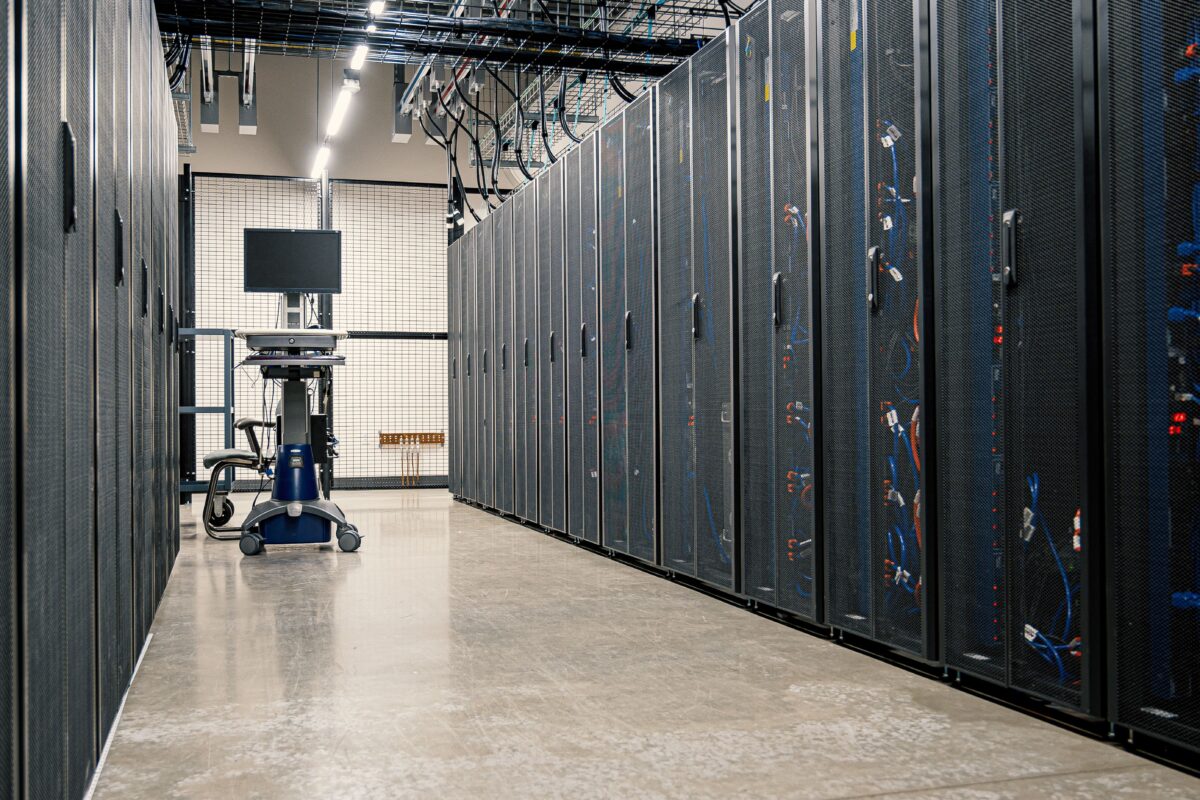
Artificial intelligence is changing more than the software that runs on computers. It is also changing the physical infrastructure underneath that software.
Traditional data centers were designed primarily around general-purpose computing. They host web applications, databases, enterprise software, storage systems, virtual machines, and a wide range of conventional workloads.
AI data centers have a different objective. They are increasingly designed around large numbers of accelerators—especially GPUs—that need to work together as a tightly connected computing system.
That difference affects almost everything inside the facility: server design, rack density, power delivery, cooling, networking, storage, physical layout, and scalability.
Modern AI infrastructure is increasingly being designed as an integrated system covering compute, networking, storage, power and cooling. NVIDIA’s AI factory infrastructure architecture is one example of this approach.
So, what exactly makes an AI data center different from a traditional data center?
What Is a Traditional Data Center?
A traditional data center is a facility that provides the physical infrastructure required to run computing systems reliably.
A simplified traditional data center looks like this:
                DATA CENTER

        ┌──────────────────────┐
        │      Applications    │
        └──────────┬───────────┘
                   │
        ┌──────────▼───────────┐
        │      CPU Servers     │
        └──────────┬───────────┘
                   │
        ┌──────────▼───────────┐
        │     Network          │
        └──────────┬───────────┘
                   │
        ┌──────────▼───────────┐
        │ Storage Systems      │
        └──────────────────────┘

       Power + Cooling + Security
These environments may run:
- Web servers
- Databases
- Business applications
- Virtual machines
- File and object storage
- Email systems
- Enterprise software
- Internal applications
- Conventional cloud workloads
The infrastructure is generally optimized for flexibility and compatibility across many different types of applications.
A CPU-based server may be able to run hundreds of different applications without requiring specialized hardware.
AI infrastructure has a very different requirement.
What Is an AI Data Center?
An AI data center is a data center designed or significantly adapted to run computationally intensive AI and machine-learning workloads.
These workloads can include:
- AI model training
- Fine-tuning
- Large-scale inference
- Generative AI
- Large language models
- Computer vision
- Recommendation systems
- Scientific AI
- AI agents
- High-performance computing
Instead of treating each server as an independent machine, large AI installations increasingly operate many accelerators as a coordinated computing system.
A simplified architecture looks like this:
                 AI WORKLOAD
                      │
             ┌────────▼────────┐
             │ AI Software     │
             └────────┬────────┘
                      │
       ┌──────────────▼──────────────┐
       │     AI Compute Cluster      │
       │                              │
       │ GPU ─ GPU ─ GPU ─ GPU       │
       │  │     │     │     │        │
       │ GPU ─ GPU ─ GPU ─ GPU       │
       └──────────────┬──────────────┘
                      │
              High-Speed Network
                      │
             ┌────────▼────────┐
             │ Fast Storage    │
             └─────────────────┘

       High-Density Power + Cooling
The key difference is that the infrastructure is designed around accelerated computing at scale.
1. CPUs vs GPUs: The Fundamental Difference
One of the biggest differences is the type of compute hardware being deployed.
Traditional data centers commonly rely heavily on CPUs. CPUs are designed to handle a broad range of workloads, including operating-system tasks, databases, web applications, business logic, and general-purpose computation.
AI workloads often benefit from GPUs because they can perform many similar mathematical operations in parallel.
A simplified comparison is:
| Traditional Data Center | AI Data Center |
|---|---|
| CPU-heavy | GPU/accelerator-heavy |
| General-purpose workloads | AI/HPC workloads |
| Individual servers | Large compute clusters |
| Moderate parallelism | Massive parallelism |
| Broad application compatibility | Specialized acceleration |
| Lower compute density | Much higher compute density |
This doesn’t mean CPUs disappear from AI data centers.
In fact, CPUs remain important for operating systems, data processing, orchestration, networking, storage, and workloads surrounding the accelerators.
The difference is that the accelerator becomes a much more important part of the overall architecture.
2. AI Data Centers Have Much Higher Compute Density
A traditional server rack may contain many CPU servers with relatively moderate power consumption per rack.
AI racks can contain significantly more computational power in the same physical space.
This happens because multiple powerful GPUs or other accelerators are packed into a relatively small number of servers and racks.
For example:
Traditional Rack

┌─────────────────────────┐
│ CPU Server              │
│ CPU Server              │
│ CPU Server              │
│ CPU Server              │
│ CPU Server              │
│ CPU Server              │
│ ...                     │
└─────────────────────────┘


AI Rack

┌─────────────────────────┐
│ GPU Accelerator System  │
│ GPU Accelerator System  │
│ High-Speed Networking   │
│ GPU Accelerator System  │
│ GPU Accelerator System  │
└─────────────────────────┘
The exact rack power depends heavily on the hardware generation and configuration. For example, NVIDIA’s current NVL72 reference architecture documents a full rack requiring up to 142 kW, illustrating how dramatically power density can increase in modern AI systems.
The NVIDIA NVL72 system architecture shows how compute, networking, storage and rack-level infrastructure are integrated into a high-density AI system.
This creates a chain reaction:
More compute → more electricity → more heat → stronger cooling → different facility design
3. Power Becomes a Major Design Constraint
Power is important in every data center, but AI changes its scale.
A conventional data center might distribute power across many servers with relatively moderate power requirements per rack.
An AI cluster can concentrate a large amount of compute into a small physical area.
That means the electrical infrastructure must support:
- Higher rack power
- Larger power distribution systems
- High-capacity transformers
- UPS systems
- Backup generation
- More sophisticated power management
- Higher-capacity electrical connections
Power availability can even influence where AI data centers are built.
Google has described how AI compute demand can exceed the space and power capacity of individual facilities, making energy availability an increasingly important part of data-center planning. Its discussion of data-center and global networks for the AI era explains how AI infrastructure requirements are changing both compute and network architecture.
The result is that AI infrastructure planning increasingly starts with a question that sounds simple:
How much power can this site actually deliver?
4. Cooling Is One of the Biggest Differences
Higher power density creates another problem:
Heat.
Every watt consumed by a processor eventually becomes heat that must be removed.
Traditional data centers have historically relied heavily on air cooling.
A simplified system looks like this:
Server
  │
  ▼
Hot Air
  │
  ▼
Cooling System
  │
  ▼
Cool Air
  │
  └──────► Server
This approach works well for many conventional workloads.
But high-density AI systems can generate substantially more heat in a small physical area.
Google notes that next-generation AI and HPC chips can exceed 1,000 watts of thermal design power, creating cooling requirements that conventional air-cooled infrastructure may not be able to handle efficiently. Google’s Brazos liquid-cooling system is designed specifically to bring liquid cooling into existing air-cooled environments.
That is why liquid cooling is becoming increasingly important.
5. Liquid Cooling Is Becoming More Important
Liquid is much more effective than air at transferring heat because of its higher heat-transfer capability.
One common approach is direct-to-chip cooling.
        GPU
     ┌────────┐
     │        │
     └───┬────┘
         │
    ┌────▼────┐
    │ Cold    │
    │ Plate   │
    └────┬────┘
         │
      Coolant
         │
         ▼
    Heat Exchanger
Instead of relying entirely on air moving through the server, a liquid loop can transfer heat directly away from high-power components.
Modern systems can also use combinations of liquid and air cooling because not every component inside a server produces the same amount of heat.
Google’s Brazos architecture is particularly interesting because it is designed as a rack-mounted closed-loop system, allowing high-density liquid-cooled equipment to be introduced into existing air-cooled environments.
This matters because operators do not always want to replace an entire data center.
They may instead retrofit specific halls or racks.
6. AI Data Centers Require Different Networking
Networking is another major architectural difference.
Traditional applications often generate a mixture of:
- User-to-server traffic
- Server-to-database traffic
- Storage traffic
- Internet traffic
AI training can generate enormous amounts of server-to-server traffic.
Consider a distributed AI model:
GPU 1 ─────┐
GPU 2 ─────┤
GPU 3 ─────┼──── High-Speed Fabric
GPU 4 ─────┤
GPU 5 ─────┤
GPU 6 ─────┘
The GPUs may need to exchange data repeatedly during training.
This means network bandwidth and latency can directly affect the performance of the entire cluster.
Google’s GPU networking architecture for AI Hypercomputer describes specialized networking between GPU machines using technologies such as RDMA over Converged Ethernet (RoCE) and high-speed GPU communication fabrics.
The network is therefore no longer just a connection between servers.
For distributed AI workloads, it becomes part of the computing system.
7. East-West Traffic Becomes Extremely Important
A useful way to understand this difference is to compare traffic directions.
Traditional data center
Internet
   │
   ▼
Servers
   │
   ▼
Database / Storage
A significant amount of traffic enters or leaves the environment.
AI cluster
GPU ─── GPU ─── GPU
 │       │       │
GPU ─── GPU ─── GPU
 │       │       │
GPU ─── GPU ─── GPU
A large amount of traffic can move between servers inside the facility.
This is called east-west traffic.
For distributed training, the network becomes part of the computing system rather than simply a connection between independent servers.
NVIDIA’s AI networking reference architecture separates GPU compute east-west networking from north-south and storage connectivity, reflecting the different communication requirements of large AI clusters.
8. AI Data Centers Are Often Designed Around Clusters or Pods
Traditional data centers can be thought of as collections of racks.
AI infrastructure is increasingly designed around groups of tightly connected racks.
For example:
        AI POD

┌────────┐  ┌────────┐  ┌────────┐
│ Rack 1 │──│ Rack 2 │──│ Rack 3 │
└────────┘  └────────┘  └────────┘
     │          │           │
     └──────────┼───────────┘
                │
          High-Speed Fabric
                │
       ┌────────┴────────┐
       │ Storage / Data  │
       └─────────────────┘
The objective is not simply to put servers next to each other.
The racks, networking, power delivery, cooling, and software are designed to operate together.
NVIDIA’s DGX SuperPOD architecture demonstrates this cluster-oriented approach by integrating high-performance GPUs and CPUs with networking, storage and cooling infrastructure.
9. Storage Requirements Also Change
AI workloads can process enormous datasets.
Training a large model may require repeatedly reading huge amounts of data.
The infrastructure therefore needs storage systems capable of supplying data to accelerators quickly enough to prevent the GPUs from waiting for input.
A simplified AI data pipeline looks like:
          Dataset
             │
             ▼
      Fast Storage
             │
             ▼
      High-Speed Network
             │
             ▼
       GPU Cluster
             │
             ▼
     Model Checkpoints
AI infrastructure can therefore use combinations of:
- Local NVMe storage
- Parallel file systems
- Object storage
- Distributed storage
- High-performance storage networks
NVIDIA’s AI infrastructure reference architecture includes resilient storage alongside GPUs and high-speed networking as part of the overall AI infrastructure design.
The important point is that faster GPUs alone do not guarantee a faster AI system.
If storage or networking cannot supply data quickly enough, expensive accelerators can sit idle.
10. AI Data Centers Need Better Coordination Between Components
Traditional infrastructure can often be optimized component by component.
AI infrastructure increasingly requires a system-level approach.
Consider:
              AI Workload
                   │
       ┌───────────▼───────────┐
       │       GPUs            │
       └───────────┬───────────┘
                   │
        ┌──────────▼──────────┐
        │     Networking      │
        └──────────┬──────────┘
                   │
        ┌──────────▼──────────┐
        │      Storage        │
        └──────────┬──────────┘
                   │
        ┌──────────▼──────────┐
        │ Power + Cooling     │
        └─────────────────────┘
A bottleneck in one layer can reduce the effectiveness of the entire system.
For example:
Fast GPU + slow network = wasted compute
Fast GPU + slow storage = stalled workload
High-density GPU + inadequate cooling = thermal limitations
Large cluster + insufficient power = unused capacity
This is why modern AI facilities are increasingly planned as integrated systems. NVIDIA’s DSX facilities infrastructure reference design explicitly connects power, cooling, connectivity and compute planning.
11. Rack Design Is Changing
Traditional racks are often optimized around standardized server dimensions and moderate power requirements.
AI racks may require:
- Higher power delivery
- Larger cooling capacity
- High-speed network connections
- Specialized accelerator systems
- More complex cabling
- Liquid-cooling infrastructure
- Rack-level monitoring
In some modern systems, the rack itself becomes an important unit of computing.
Instead of thinking:
“This rack contains servers.”
The architecture increasingly becomes:
“This rack is part of a large accelerator system.”
NVIDIA’s current NVL72 reference architecture is a clear example of rack-scale AI infrastructure, with GPUs, CPUs, networking, local storage, liquid-cooling provisions and high-capacity power integrated into the system design.
12. AI Data Centers Can Require Different Physical Layouts
Higher-density systems affect the physical design of the building.
Traditional data halls may be designed around relatively uniform rows of air-cooled racks.
AI halls can require:
- Higher-capacity electrical distribution
- Liquid-cooling piping
- Different rack arrangements
- Larger cooling infrastructure
- More powerful networking systems
- Dedicated high-density zones
This can lead to a mixed data center.
DATA CENTER

┌─────────────────────────────────────┐
│                                     │
│ Traditional IT Zone                 │
│ CPU + Air Cooling                   │
│                                     │
├─────────────────────────────────────┤
│                                     │
│ AI Zone                             │
│ GPU + Liquid Cooling                │
│ High-Density Power                  │
│ High-Speed Networking               │
│                                     │
└─────────────────────────────────────┘
This hybrid approach can allow operators to keep conventional infrastructure while introducing AI capacity where the facility can support it.
13. AI Data Centers Are More Network-Dependent
A traditional application might continue functioning if one server becomes slower or temporarily unavailable.
Large distributed AI jobs can be more sensitive to cluster-wide performance.
If hundreds or thousands of accelerators are participating in a coordinated workload, the slowest parts of the system can affect overall execution.
This makes:
- Network latency
- Network bandwidth
- Synchronization
- Congestion
- Failure handling
particularly important.
Google’s AI Hypercomputer networking documentation explains how GPU clusters can scale from individual blocks to clusters containing thousands of GPUs while maintaining high-speed communication between them.
14. AI Data Centers Are Designed for Sustained Accelerator Workloads
Another important distinction is workload behavior.
A conventional enterprise server might run a mixture of workloads throughout the day.
AI training can keep accelerators under heavy utilization for long periods.
That creates sustained:
- Electrical demand
- Heat generation
- Network traffic
- Storage activity
The facility therefore needs to remain stable under continuous high load.
This makes thermal management and power delivery more important than simply designing for occasional peaks.
15. AI Changes Power Management
Large AI clusters can also create demanding power profiles.
Modern AI systems are not simply about providing enough average electricity. Operators also need to manage changes in workload demand and maintain stable operation.
This has encouraged research and engineering around:
- Power smoothing
- Rack-level power management
- Energy storage
- Dynamic workload scheduling
- Power-aware infrastructure
NVIDIA’s DSX MaxLPS architecture describes approaches that combine facility design, dynamic power allocation and performance-per-watt optimization within a fixed site power envelope.
This illustrates a broader shift:
Power is becoming part of computing architecture.
16. AI Data Centers Are More Expensive to Build
The hardware itself is only one part of the cost.
A high-density AI deployment can require additional investment in:
- Electrical infrastructure
- Transformers
- UPS systems
- Generators
- Cooling equipment
- Liquid-cooling distribution
- High-speed networking
- Specialized racks
- High-performance storage
- Building modifications
That means converting an existing conventional facility into an AI facility is not always as simple as replacing CPUs with GPUs.
The supporting infrastructure may become the limiting factor.
NVIDIA’s current AI Factory facilities reference design illustrates how modern AI infrastructure planning connects compute requirements with power, cooling, connectivity and site infrastructure.
17. Retrofitting Existing Data Centers Is Possible—but Difficult
Not every AI deployment requires a completely new building.
Operators can retrofit existing facilities.
One approach is to introduce liquid cooling at the rack level.
Google’s Brazos liquid-cooling system is designed specifically for this type of deployment, allowing high-density liquid-cooled equipment to be introduced into existing air-cooled environments.
But retrofitting still requires evaluating:
- Available electrical capacity
- Rack floor loading
- Cooling capacity
- Network connectivity
- Plumbing
- Physical space
- Backup power
- Fire protection
- Maintenance procedures
The feasibility depends heavily on the existing facility.
18. Traditional and AI Data Centers Can Coexist
It is important not to treat AI data centers and traditional data centers as completely separate categories.
A modern facility may contain both.
                 DATA CENTER
                      │
        ┌─────────────┴─────────────┐
        │                           │
 Traditional IT                 AI Cluster
        │                           │
   CPU Servers                  GPU Servers
        │                           │
 Air Cooling                   Liquid Cooling
        │                           │
 Enterprise Apps              AI Training
 Databases                    AI Inference
 Web Services                 HPC
The infrastructure surrounding them can overlap.
Both still require:
- Power
- Networking
- Storage
- Security
- Monitoring
- Backup systems
- Physical security
- Facility management
The difference is the density and specialization of the computing environment.
19. The Network Is Becoming Part of the Computer
One of the most important architectural changes is the idea that a large AI cluster can behave more like a single distributed computer.
Imagine this:
Traditional Computing

Server A
Server B
Server C
Server D

Mostly independent systems
versus:
AI Computing

GPU ─ GPU ─ GPU ─ GPU
 │     │     │     │
 GPU ─ GPU ─ GPU ─ GPU
 │     │     │     │
 GPU ─ GPU ─ GPU ─ GPU

One coordinated compute fabric
This is why AI networking is receiving so much attention.
Google’s current AI infrastructure work describes GPU clusters using specialized high-speed networking designed to reduce communication overhead and keep accelerators focused on computation. Its GPU networking architecture provides an example of how the network is being designed as part of the accelerator system itself.
That is a significant departure from thinking about the data center as simply a building full of independent servers.
20. AI Data Centers Are Becoming More Modular
AI hardware is evolving quickly.
A facility designed around one generation of accelerators may need to support newer hardware later.
This creates a demand for modular infrastructure.
Instead of building every component as a permanent fixed design, operators increasingly want infrastructure that can adapt to:
- New GPUs
- New CPUs
- New networking hardware
- New cooling technologies
- New rack architectures
- Higher power densities
NVIDIA’s DSX reference architecture reflects this broader direction by providing generation-specific designs spanning compute, networking, storage and facilities infrastructure.
The goal is to reduce the amount of infrastructure that must be redesigned whenever the compute hardware changes.
Traditional Data Center vs AI Data Center
The major differences can be summarized as follows:
| Area | Traditional Data Center | AI Data Center |
|---|---|---|
| Primary compute | CPUs | GPUs / AI accelerators + CPUs |
| Workloads | General-purpose applications | AI training, inference, HPC |
| Compute model | Individual servers | Large coordinated clusters |
| Rack density | Moderate | High to very high |
| Power density | Lower | Much higher |
| Cooling | Primarily air in many deployments | Air, liquid, or hybrid |
| Networking | Conventional Ethernet and storage networking | High-bandwidth, low-latency fabrics |
| Internal traffic | Moderate | Extremely high in large clusters |
| Storage | General-purpose | High-throughput, parallel storage often needed |
| Physical design | Standardized racks and aisles | High-density pods/racks |
| Power management | Conventional | Increasingly power-aware |
| Scaling | Server/rack oriented | Cluster and fabric oriented |
| Infrastructure design | General purpose | Hardware/software co-designed for AI |
These are general architectural differences, not absolute rules. Traditional data centers can contain GPUs, and AI facilities still use CPUs and conventional infrastructure.
Why AI Data Centers Matter
The rise of AI is turning data-center infrastructure into a much more tightly integrated engineering problem.
A traditional data center can often be understood as:
Servers + storage + network + power + cooling
An AI data center increasingly looks like:
Accelerators + high-speed interconnects + high-performance storage + high-density power + advanced cooling + orchestration
The difference is not simply that AI data centers contain GPUs.
The deeper change is that every supporting system has to evolve around the requirements of accelerated computing.
A faster GPU is useful only when the facility can provide enough electricity to run it, enough cooling to remove its heat, enough network bandwidth to communicate with other accelerators, and enough storage performance to keep the workload supplied with data.
That is why AI infrastructure is increasingly designed as an integrated system rather than a collection of independent components.
The Future of AI Data Center Architecture
As AI models and AI applications continue to scale, several trends are becoming increasingly important.
Higher compute density
More computational capability will be packed into fewer racks and facilities.
More liquid cooling
As accelerator power densities increase, liquid cooling will become increasingly common in high-density deployments.
Faster networking
Distributed AI requires increasingly high-bandwidth communication between accelerators.
More specialized infrastructure
Instead of one universal server architecture, data centers may increasingly use specialized systems optimized for training, inference, storage, networking, or other AI workloads.
Greater power constraints
Access to sufficient electrical capacity can become one of the main limits on AI infrastructure expansion.
Larger distributed compute fabrics
AI clusters may increasingly span multiple buildings or facilities while operating as coordinated computing environments.
Google’s AI-era data-center networking architecture discusses this shift toward infrastructure that can accommodate AI workloads across larger physical and network environments.
Final Takeaway
AI data centers are not simply traditional data centers with GPUs installed inside them.
They represent a different approach to infrastructure.
Traditional data centers are generally optimized for flexible, general-purpose computing. AI data centers are increasingly optimized for dense accelerated computing, high-bandwidth communication, massive data movement, and sustained power and thermal loads.
The biggest differences appear in five areas:
- Compute: GPUs and other accelerators become central.
- Power: Much higher rack-level power requirements.
- Cooling: Liquid and hybrid cooling become increasingly important.
- Networking: High-bandwidth, low-latency accelerator communication becomes critical.
- Architecture: Racks, clusters, storage, power and cooling are increasingly designed as one integrated system.
The result is a fundamental shift in how computing infrastructure is built.
The data center is no longer just a place where computers are installed.
For large-scale AI, the facility itself becomes part of the computer.
SiliconeUpdate.com is a technology news platform that publishes updates and informational content related to silicon technology, software, artificial intelligence, and emerging technologies.
All articles published on this platform are attributed to SiliconeUpdate.com instead of individual authors. Content is presented in a neutral, informational format without personal opinions.
—
Content Publishing
SiliconeUpdate.com publishes news and updates based on publicly available information, official announcements, and industry developments. The focus is on clarity, relevance, and timely reporting.
—
Editorial Control
All editorial decisions, updates, and content management are handled at the platform level. No individual human or AI identity is presented as the author of articles.
—
Contact
For editorial communication or general queries, contact:
Email: neemasharma@gmail.com