
AI reasoning models inherently require more computational resources compared to traditional generative models. This increased demand stems from their fundamental operational paradigm, which mimics a more deliberate, “System 2” cognitive process rather than immediate, “System 1” responses.
The System 2 Paradigm
Reasoning models introduce a “System 2” approach to artificial intelligence, contrasting with the rapid, intuitive “System 1” processing of standard models. This means they engage in a more analytical and sequential thought process before generating an output. This deliberate “thinking before speaking” mechanism is a primary driver of their higher compute consumption.
The goal is to enhance accuracy, particularly for complex problems where a direct, single-pass generation might fall short. This deliberate exploration of a topic through internal token generation is what differentiates their compute profile.
Trade-offs: Accuracy Versus Speed
The elevated compute usage in reasoning models is a direct trade-off for increased accuracy. While they are slower and cost more per query, they deliver superior performance on tasks requiring deeper understanding and logical inference. These models do not aim to replace standard models but rather complement them, providing a solution for problems where precision outweighs speed.
According to Taskade’s reasoning model research, the initial investment in reasoning compute yields the most significant accuracy improvements. Beyond a certain point, additional “thinking” adds latency without proportional gains in accuracy, indicating diminishing returns.
Mechanisms of Increased Compute Consumption
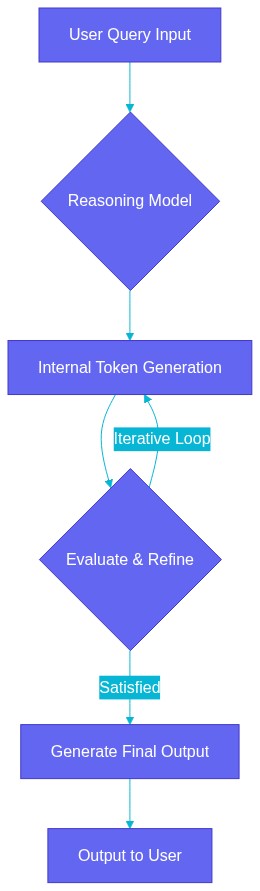
The core reason AI reasoning models consume more compute lies in their internal operational mechanisms, which involve iterative processing and self-correction loops. These processes are distinct from the single-pass inference typical of many generative models.
Iterative Token Generation
Reasoning models increase their own accuracy by utilizing more compute during runtime, primarily through generating tokens that “explore” a topic. This is not merely generating the final output, but rather internal tokens that represent intermediate thoughts, hypotheses, or steps in a logical chain. Each step in this exploratory process consumes computational cycles, memory, and energy.
This iterative generation allows the model to refine its understanding and approach to a problem. It’s akin to a human thinking through a complex problem, jotting down ideas, and evaluating different paths before arriving at a conclusion.
Exploratory Search and Self-Correction
The “thinking” process in reasoning models often involves an exploratory search within their latent space, evaluating multiple potential solutions or reasoning paths. This can include generating multiple internal “drafts” or chains of thought, then selecting the most coherent or accurate one. This self-correction capability, where the model assesses and refines its own reasoning, requires significant computational overhead.
This mechanism allows the model to identify and correct errors or inconsistencies in its internal reasoning before producing a final response. The variable nature of this thinking time also makes predicting the exact compute cost per query challenging.

Photo by Google DeepMind on Pexels
Economic Implications and Operational Challenges
The higher compute demands of AI reasoning models translate directly into significant economic and operational considerations for deployment and management.
Per-Query Cost Escalation
Reasoning models use significantly more compute per request, leading to substantially higher operational costs. For instance, reasoning models can cost 10x more per query than standard models. This cost difference is a critical factor for enterprises considering their adoption, especially for high-volume applications.
Initial deployments often overlooked these elevated costs, but as adoption scales, the economic impact becomes a primary concern. The increased compute translates to higher energy consumption and greater demand for specialized hardware.
Predictability and Resource Allocation
The variable thinking time inherent in reasoning models makes cost prediction difficult. Unlike standard models with relatively fixed inference times, reasoning models adapt their computational effort to the complexity of the query. This variability complicates resource allocation and budgeting for organizations.
Enterprises must account for this unpredictability when designing systems that incorporate reasoning capabilities. This often necessitates dynamic resource provisioning or careful workload management to optimize cost and performance.
Architectural Considerations and Scaling
The architecture of reasoning models is designed to facilitate their iterative processes, but this design also introduces specific scaling challenges related to compute utilization.
Test-Time Compute Dynamics
The concept of “test-time compute” is central to understanding reasoning models. This refers to the computational resources expended during the inference phase, specifically for the internal reasoning steps. An LLM can increase its own accuracy by using more compute during runtime, generating tokens to explore a topic.
This dynamic allocation of compute at inference time allows the model to adapt its “thinking” depth to the complexity of the input, a capability not typically found in simpler generative models.
Diminishing Returns on Compute Investment
While accuracy generally rises with increased thinking compute, this relationship exhibits diminishing returns. The initial allocation of reasoning compute provides the most substantial jump in accuracy. Beyond a certain threshold, adding more compute primarily increases latency without yielding significant further improvements in output quality.
This implies an optimal point for compute allocation where the balance between accuracy, speed, and cost is achieved. Organizations must carefully tune the reasoning depth to avoid unnecessary expenditure for marginal gains.
The economics of AI reasoning highlight the balance between performance and cost.
Research on AI reasoning models in 2026 indicates their high compute per request.
Taskade’s blog on reasoning models explains the accuracy-compute relationship.
| Feature | Standard Generative Models | AI Reasoning Models |
|---|---|---|
| Compute per Query | Lower, relatively fixed | Significantly higher, variable |
| Cost per Query | Lower | Up to 10x higher |
| Speed | Faster, lower latency | Slower, higher latency |
| Accuracy on Complex Tasks | Moderate to good | Higher, improved by “thinking” |
| Operational Paradigm | System 1 (Intuitive, direct) | System 2 (Deliberate, analytical) |

Photo by Google DeepMind on Pexels
Real World Example
Consider an enterprise application designed for complex legal document analysis, such as identifying nuanced contractual obligations or potential litigation risks. A standard generative AI model might quickly summarize documents, but it could miss subtle interdependencies or logical inconsistencies crucial for legal accuracy.
An AI reasoning model, however, would employ its higher compute to iteratively analyze clauses, cross-reference definitions, and explore logical implications across the entire document set. This “thinking” process, involving multiple internal steps of token generation and self-correction, allows it to identify specific, high-risk clauses that a standard model would overlook. While this takes longer and costs more per analysis, the enhanced accuracy in a high-stakes legal context justifies the increased computational expenditure.
Key Takeaways
- AI reasoning models use more compute due to their “System 2” approach, involving deliberate, analytical processing.
- Increased compute enables iterative token generation and exploratory search, improving accuracy on complex tasks.
- This higher compute translates to significantly increased per-query costs, potentially 10x more than standard models.
- Variable thinking time makes cost prediction and resource allocation challenging for reasoning model deployments.
- Accuracy gains from increased compute show diminishing returns, with initial compute yielding the most significant improvements.
The adoption of task-specific AI agents, including reasoning models, is projected to surge, with Gartner predicting 40 percent of enterprise applications embedding them by the end of 2026, up from less than 5 percent the previous year. This indicates a growing willingness to invest in higher compute for specialized, high-value tasks.
Relative Compute Cost per Query (2026)
Standard Generative Model: 1Relative Cost | AI Reasoning Model: 10Relative Cost — Source: Lifeboat Foundation (Approx. 2026)
Frequently Asked Questions
Why do reasoning models cost more per query?
Reasoning models cost more per query because they utilize significantly more compute during runtime. This is due to their iterative “thinking” process, which involves generating internal tokens to explore a topic and refine their understanding before producing a final answer.
Do reasoning models replace standard AI models?
No, reasoning models do not replace standard AI models; they complement them. Reasoning models trade speed for accuracy on problems that require deeper analysis and logical inference, while standard models remain suitable for tasks where speed and lower cost are priorities.
What is “test-time compute” in the context of reasoning models?
“Test-time compute” refers to the computational resources expended by an AI model during its inference phase, specifically for internal reasoning steps. For reasoning models, this compute is dynamically used to generate exploratory tokens and improve accuracy at runtime.
How does variable thinking time impact reasoning model deployment?
Variable thinking time makes cost prediction and resource allocation difficult for reasoning models. Since the compute required can change based on query complexity, organizations face challenges in budgeting and ensuring consistent performance without over-provisioning resources.

SiliconeUpdate.com is a technology news platform that publishes updates and informational content related to silicon technology, software, artificial intelligence, and emerging technologies.
All articles published on this platform are attributed to SiliconeUpdate.com instead of individual authors. Content is presented in a neutral, informational format without personal opinions.
—
Content Publishing
SiliconeUpdate.com publishes news and updates based on publicly available information, official announcements, and industry developments. The focus is on clarity, relevance, and timely reporting.
—
Editorial Control
All editorial decisions, updates, and content management are handled at the platform level. No individual human or AI identity is presented as the author of articles.
—
Contact
For editorial communication or general queries, contact:
Email: neemasharma@gmail.com