AI model quantization is a technique that reduces the precision of the numerical representations within a machine learning model. This process primarily involves converting the model’s parameters, such as weights and activations, from higher-precision data types (e.g., 32-bit floating-point numbers) to lower-precision types (e.g., 8-bit or 4-bit integers).
The core idea behind quantization is to shrink the model’s memory footprint and accelerate its execution. It operates on the principle that many numbers within an AI model do not fully utilize the precision they are initially given, allowing for a reduction without significant loss in performance.
Precision Reduction
Models are typically trained using 32-bit floating-point numbers (FP32), which offer a wide range and high precision. Quantization reduces this bit-width, for instance, to 16-bit floating-point (FP16), 8-bit integer (INT8), or even 4-bit integer (INT4) representations.
This reduction in bit-width directly translates to smaller data sizes for each number. For example, converting model weights from 16-bit to 4-bit precision can reduce memory usage by 75% for large language models (LLMs).
How AI Model Quantization Works
Quantization involves mapping a range of higher-precision values to a smaller set of lower-precision values. This mapping typically includes a scaling factor and a zero-point to preserve the original value distribution as much as possible.
The process can apply to various components of an AI model, not just its weights. Other components like activations and gradients can also undergo quantization to further optimize the model.
Weight Quantization
Weight quantization is the most common application, directly reducing the size of the stored model. By representing weights with fewer bits, the overall model file size decreases significantly.
This reduction allows larger models to fit into memory-constrained environments, such as edge devices or single GPUs. For instance, quantization enables 70B parameter models to run on a single GPU, which would otherwise require multiple high-end GPUs.
Activation and Gradient Quantization
Beyond weights, activations (the outputs of layers) and gradients (used during training) can also be quantized. Quantizing activations reduces the memory bandwidth required during inference, contributing to faster execution.
Quantizing gradients is primarily relevant during training, where it can reduce memory usage and communication overhead in distributed training setups. This broader application of quantization optimizes the entire lifecycle of an AI model.

Photo by Google DeepMind on Pexels
Why Quantization Matters: Benefits
AI model quantization addresses critical challenges in deploying and operating large AI models. Its benefits extend across memory, speed, and hardware compatibility, making advanced AI more accessible and efficient.
The technique allows developers to stop worrying about GPU memory constraints, enabling the deployment of sophisticated models on less powerful hardware.
Reduced Memory Footprint
Quantization significantly shrinks the physical size of AI models. This reduction is vital for deploying models on devices with limited memory, such as smartphones, embedded systems, or IoT devices.
A smaller memory footprint also reduces the cost of storing and transmitting models. This is particularly relevant for cloud-based inference services where memory allocation directly impacts operational expenses.
Faster Inference
By using lower-precision numbers, quantized models can perform computations more quickly. Processors can handle operations on smaller data types (like 8-bit integers) with greater efficiency than on 32-bit floating-point numbers.
This leads to reduced inference latency, meaning the model generates predictions faster. Faster inference is critical for real-time applications like autonomous driving, natural language processing, and recommendation systems.
Hardware Compatibility
Many specialized AI accelerators and edge devices are optimized for lower-precision arithmetic. Quantization makes models directly compatible with these hardware platforms, leveraging their full computational potential.
This compatibility expands the range of hardware capable of running complex AI models. It democratizes access to advanced AI capabilities beyond high-end data centers.
Types of Quantization
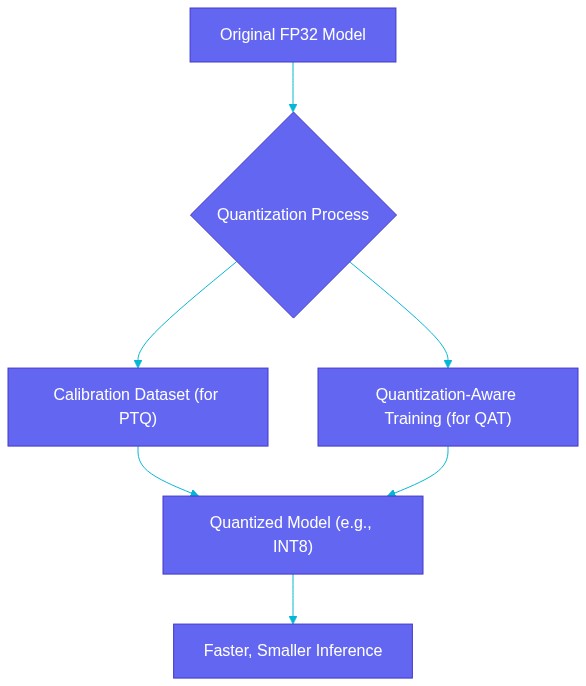
Quantization methods vary based on when and how the precision reduction occurs. The two primary approaches are Post-Training Quantization and Quantization-Aware Training, each with distinct trade-offs.
Choosing the right method depends on the desired accuracy, available computational resources, and the specific application requirements.
Post-Training Quantization (PTQ)
Post-Training Quantization involves quantizing a model after it has been fully trained in full precision. This method is straightforward to implement as it does not require retraining the model.
PTQ typically uses a small, representative calibration dataset to determine the optimal scaling factors and zero-points for quantization. While simple, PTQ can sometimes lead to a noticeable drop in model accuracy, especially for very aggressive quantization levels (e.g., 4-bit).
Quantization-Aware Training (QAT)
Quantization-Aware Training integrates the quantization process directly into the model’s training loop. During QAT, the model is trained with simulated quantization effects, allowing it to learn to compensate for the precision loss.
QAT generally yields higher accuracy than PTQ for the same quantization level because the model adapts to the lower precision during training. This method requires more computational resources and time, as it involves retraining or fine-tuning the model.
| Precision Level | Memory Footprint | Inference Speed | Typical Accuracy Impact |
|---|---|---|---|
| FP32 (32-bit float) | Baseline | Baseline | Highest (Training Standard) |
| FP16 (16-bit float) | 50% of FP32 | Faster | Minimal to Low |
| INT8 (8-bit integer) | 25% of FP32 | Significantly Faster | Low to Moderate |
| INT4 (4-bit integer) | 12.5% of FP32 | Max Speedup | Moderate to High (Potential drop) |

Photo by Brett Jordan on Pexels
Real World Example
Consider a company deploying a large language model (LLM) for real-time customer service chatbots. The original LLM, trained in FP32, requires 140GB of GPU memory, making it impossible to run on a single NVIDIA A100 GPU (which typically has 80GB).
By applying quantization, specifically converting the model weights from 16-bit to 4-bit precision, the company can reduce the model’s memory usage by 75%. This shrinks the model to approximately 35GB, enabling it to run efficiently on a single A100 GPU.
This not only reduces hardware costs but also improves inference speed, allowing the chatbot to respond to customer queries almost instantaneously. While there might be a minor, imperceptible drop in output quality for some edge cases, the operational benefits far outweigh this trade-off for the application.
Key Takeaways
- AI model quantization reduces the precision of numerical representations within a model, primarily its weights and activations.
- This technique significantly shrinks the model’s memory footprint, enabling larger models to run on resource-constrained hardware like single GPUs.
- Quantization accelerates inference speed by allowing processors to perform computations more efficiently on lower-precision data types.
- It enhances hardware compatibility, making models deployable on specialized AI accelerators and edge devices optimized for reduced precision.
- Methods include Post-Training Quantization (PTQ) for simplicity and Quantization-Aware Training (QAT) for higher accuracy.
A surprising insight from mid-2026 observations suggests that aggressive quantization (e.g., Q2 or Q3 models) can lead to a noticeable drop in the perceived “intelligence” or quality of large language models.
LLM Memory Reduction via Quantization (2025)
16-bit to 8-bit: 50% Reduction | 16-bit to 4-bit: 75% Reduction — Source: The AI Engineer 2025 (Approximate)
Frequently Asked Questions
What is the primary goal of AI model quantization?
The primary goal is to reduce the memory footprint and accelerate the inference speed of AI models. This allows for deployment on resource-constrained hardware and improves real-time performance.
Does quantization always reduce model accuracy?
Quantization can introduce a trade-off with accuracy, especially with aggressive precision reduction. However, techniques like Quantization-Aware Training (QAT) help mitigate this by allowing the model to adapt during training.
Can all AI models be quantized effectively?
Most AI models can benefit from quantization, but the degree of effectiveness varies. Models with highly sensitive weights or complex architectures might experience a more significant accuracy drop at lower bit-widths.
What is the difference between FP32 and INT8 in quantization?
FP32 refers to 32-bit floating-point numbers, the standard for training, offering high precision. INT8 refers to 8-bit integers, a quantized representation that significantly reduces memory and speeds up computation at the cost of some precision.

SiliconeUpdate.com is a technology news platform that publishes updates and informational content related to silicon technology, software, artificial intelligence, and emerging technologies.
All articles published on this platform are attributed to SiliconeUpdate.com instead of individual authors. Content is presented in a neutral, informational format without personal opinions.
—
Content Publishing
SiliconeUpdate.com publishes news and updates based on publicly available information, official announcements, and industry developments. The focus is on clarity, relevance, and timely reporting.
—
Editorial Control
All editorial decisions, updates, and content management are handled at the platform level. No individual human or AI identity is presented as the author of articles.
—
Contact
For editorial communication or general queries, contact:
Email: neemasharma@gmail.com