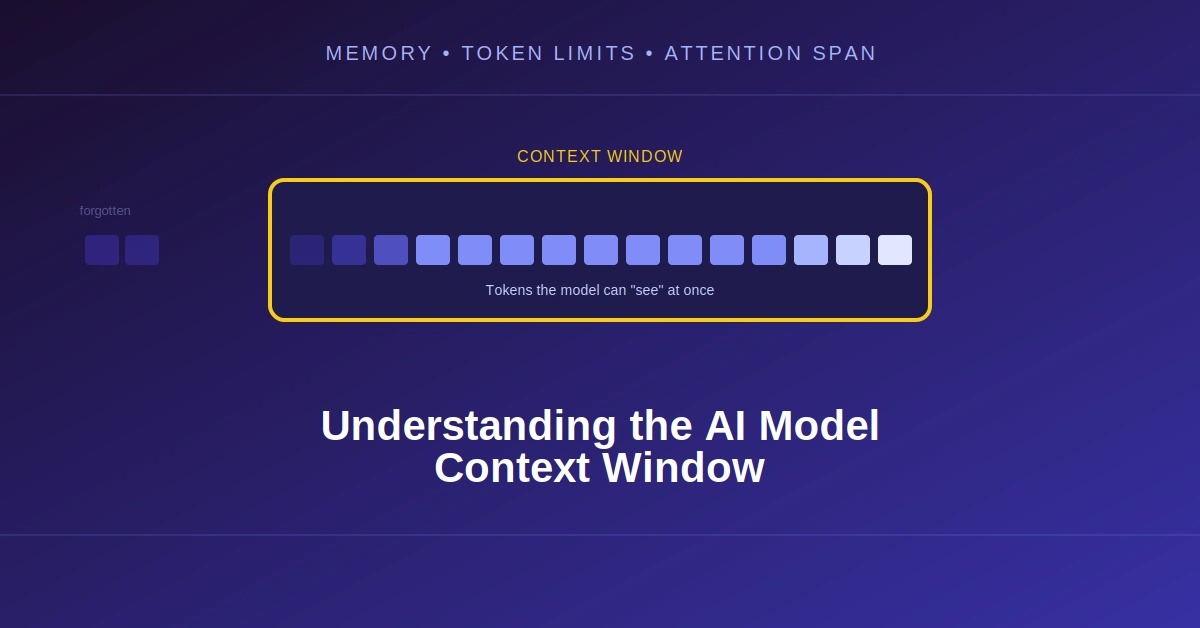
When people say that an AI model has a 128K, 200K, or 1 million token context window, it is easy to assume that the model simply has a very large memory.
That is not exactly what a context window is.
A context window defines how much information an AI model can process as part of a single interaction. It determines how much of a conversation, document, codebase, instructions, or other input can be available to the model while generating a response.
For modern AI systems, context length has become one of the important differences between models. A larger context window can make it possible to work with long documents, large codebases, extended conversations, and complex agent workflows. But simply increasing the number of tokens does not automatically mean the model will understand every piece of information equally well.
To understand why, we first need to understand tokens.
What Is a Token?

AI language models do not normally process text as complete words.
Text is broken into smaller pieces called tokens.
A token can represent a complete word, part of a word, punctuation, or other frequently occurring character sequences. For English, a rough rule is that one token is around four characters or about three-quarters of a word, although the exact number depends on the tokenizer and language.
For example, a sentence such as:
AI models process text using tokens.
might be broken into something conceptually similar to:
AI | models | process | text | using | tokens | .
The actual tokenization depends on the model.
This matters because context windows are measured in tokens, not words.
So when a model is advertised with a 100,000-token context window, that does not mean it can process exactly 100,000 English words.
For a practical explanation of how tokenization works, OpenAI provides a tokenization and token-counting guide.
What Exactly Is a Context Window?
The context window is the maximum amount of token information that a model can use within a request.
A simplified representation looks like this:
                 CONTEXT WINDOW
┌─────────────────────────────────────────────┐
│ System instructions                         │
│ Conversation history                        │
│ User prompt                                 │
│ Documents / files                           │
│ Tool information                            │
│ Other input context                         │
│                                             │
│                 +                           │
│                                             │
│ Generated output                            │
└─────────────────────────────────────────────┘
The exact accounting differs between models and APIs, but the important idea is that the context window is a finite token budget.
OpenAI describes the context window as the maximum number of tokens that can be used in a single request, with input, output, and, for some reasoning models, reasoning tokens contributing to the total.
Google similarly describes the Gemini context window as the combined limit for input and output tokens.
So if a model has a 100K context window, you cannot assume that all 100K tokens are available purely for your prompt.
You need to account for the model’s input and output requirements.
Context Window Is Not the Same as Memory
This is one of the most important distinctions in modern AI.
Suppose you have a conversation:
User:
My application uses React.

AI:
Okay.

User:
The backend is Node.js.

AI:
Got it.

User:
The database is PostgreSQL.

AI:
Understood.
If those previous messages remain inside the model’s context, the model can use them when answering the next request.
But this does not necessarily mean the model has permanently learned those facts.
The information is simply part of the current context.
A useful way to think about it is:
Long-term model knowledge
          ↓
      Model weights

Current conversation
          ↓
      Context window
The model’s trained parameters contain patterns learned during training.
The context window contains information supplied to the model for the current interaction.
This distinction becomes particularly important when working with AI applications. A developer might say that an AI assistant “remembers” a conversation, when technically the application may simply be sending previous messages back to the model.
Why Do AI Models Need a Context Window?
Language models generate text based on the information available to them.
Consider a coding assistant.
You provide:
app.js
database.js
auth.js
api.js
routes.js
and ask:
Find the authentication bug.
If the model receives all relevant files in its context, it can reason across them.
But if the relevant code is outside the available context, the model cannot directly use that code.
This is why context length matters so much for:
- coding assistants
- AI agents
- document analysis
- research tools
- customer-support systems
- long conversations
- codebase analysis
- document comparison
- retrieval systems
A larger context window gives the application more room to provide information to the model.
Context Window vs Maximum Output
Another common misunderstanding is that a model with a large context window can necessarily generate an equally large response.
It cannot.
These are separate limits.
For example, a hypothetical model might have:
Context window:       1,000,000 tokens
Maximum output:         128,000 tokens
That means the model can potentially process a very large amount of context, but its generated response can still have a much smaller maximum size.
OpenAI’s model documentation, for example, distinguishes the context window from maximum output tokens.
This distinction is important when comparing AI models.
A model advertised with a huge context window is not necessarily capable of generating an equally huge document in one response.
What Happens When the Context Gets Too Large?
Suppose an application has a context limit of 100,000 tokens.
Now imagine sending:
Conversation history       30K
Documentation              25K
Source code                35K
New user prompt             5K
Requested output            20K
                         -------
Total                     115K
The request cannot fit within a 100K context budget.
The application has to do something about it.
Possible strategies include:
- removing older messages
- summarizing previous conversation
- reducing document size
- selecting only relevant code
- reducing the requested output
- splitting the task into multiple requests
- using retrieval to provide only relevant information
This is why AI applications often need their own context management layer.
The model alone does not solve the problem.
Context Management
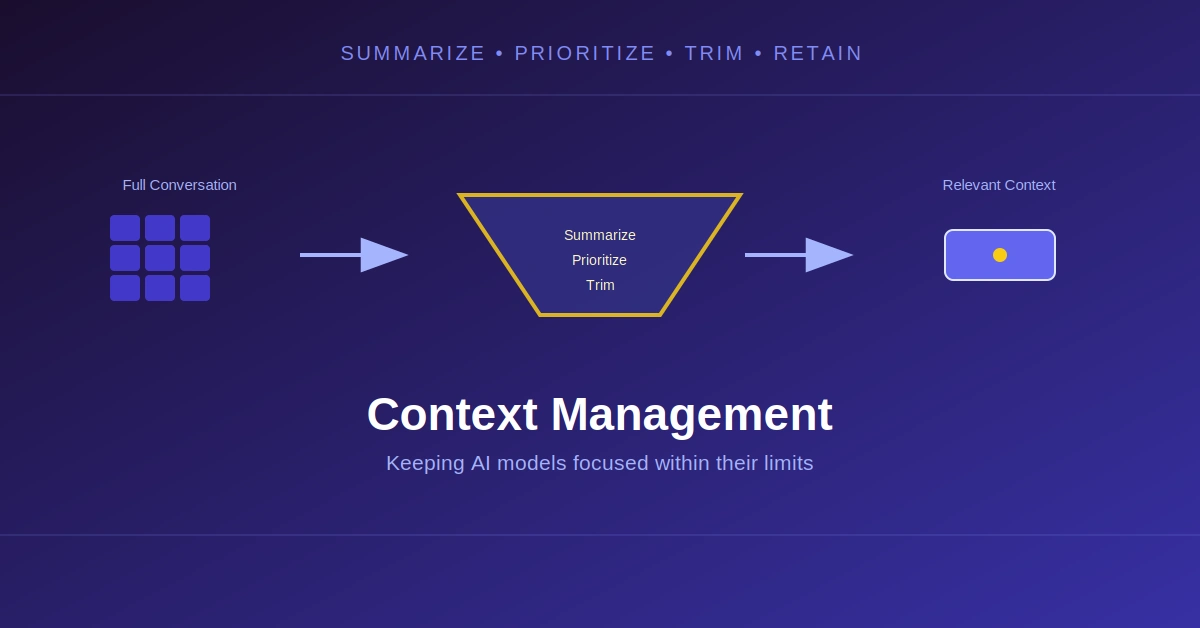
A production AI application may maintain something like:
                User conversation
                       │
                       ▼
              Context Manager
                       │
          ┌────────────┼────────────┐
          ▼            ▼            ▼
       Recent       Summary       Retrieved
       messages     memory         data
          │            │            │
          └────────────┼────────────┘
                       ▼
                  Final prompt
                       │
                       ▼
                    AI Model
The context manager decides what information should actually be sent to the model.
For a long-running conversation, an application could keep the most recent messages while summarizing older ones.
For a coding agent, it might retrieve only the files relevant to the current task.
For a document assistant, it might search a document collection and send the most relevant sections instead of sending everything.
This is one reason RAG (Retrieval-Augmented Generation) can remain useful even when models have very large context windows.
Does a Larger Context Window Mean Better AI?
Not necessarily.
A larger context window means the model can accept more information.
It does not guarantee that the model will use every piece of that information perfectly.
Imagine giving an AI:
100 pages of documentation
and hiding one important sentence somewhere in the middle.
The model may technically have access to the sentence, but retrieving and correctly using information from a very large context can still be challenging.
Anthropic documented this issue in earlier long-context research, noting that models could sometimes miss information located in the middle of long inputs.
So there are really two different questions:
Can the model accept the information?
                ↓
        Context capacity

Can the model effectively use it?
                ↓
        Long-context capability
These are not the same thing.
The “Lost in the Middle” Problem
One well-known long-context challenge is often described as lost in the middle.
The basic idea is simple.
Suppose the model receives:
Important information A
        ↓
Huge amount of information
        ↓
Important information B
A model may perform better when the relevant information is near the beginning or end than when it is buried somewhere in the middle.
This doesn’t mean modern models simply “forget the middle.”
It means that long-context retrieval and reasoning can become more difficult as the amount of information increases.
For developers, this creates an important lesson:
Having a larger context window does not mean you should blindly send everything to the model.
Good context selection can still matter.
Why Context Windows Became Much Larger
Early language models worked with relatively small amounts of context.
As transformer-based models evolved, researchers and AI companies developed different techniques for handling longer sequences.
One important part of this problem is attention.
In a transformer, attention allows tokens to interact with information from other tokens in the sequence.
Conceptually:
"The server crashed because the database connection failed."

        server
          │
          ├──── database
          │
          └──── connection
The model can use relationships between different parts of the sequence when generating its representation and predictions.
But processing very long sequences can become computationally expensive.
This is one reason researchers have developed techniques such as more efficient attention mechanisms and different positional representations for long inputs.
Positional Information Matters
A language model needs more than the words themselves.
It also needs information about their positions.
Compare:
The dog chased the cat.
with:
The cat chased the dog.
The same basic words are present, but their order changes the meaning.
Transformer architectures therefore need mechanisms that allow the model to represent token position.
Different architectures have used different approaches, including positional embeddings and relative-position techniques. Hugging Face’s transformer documentation explains how positional information affects the model’s ability to understand sequence order and long inputs.
As context lengths become larger, handling positional information effectively becomes increasingly important.
Context Window and Attention Are Different Things
These terms are sometimes mixed together.
They are related, but they are not identical.
Context window answers:
How much token information can the model process?
Attention answers, roughly:
How can tokens interact with other tokens within that information?
For example:
Context window
      │
      ▼
[ token 1 ... token 100,000 ]
      │
      ▼
Attention mechanisms
      │
      ▼
Relationships between tokens
A larger context gives the model more information to work with.
Attention and related architecture determine how that information is processed.
Long Context and Coding
Context windows are especially important for AI coding tools.
Consider a large application:
Frontend
 ├── components/
 ├── pages/
 └── hooks/

Backend
 ├── controllers/
 ├── services/
 └── database/

Infrastructure
 ├── Docker
 └── deployment
A developer might ask:
Why does changing the authentication
component break the API request?
The answer could depend on several files.
With a small context, the AI might only receive:
AuthComponent.js
With a larger context, it might receive:
AuthComponent.js
authService.js
api.js
middleware.js
database.js
That gives the model much more information to reason across.
However, sending the entire repository every time is not necessarily the best approach.
A good coding agent usually needs to select relevant context, not simply maximize context.
Context Window and RAG
RAG is another important part of the story.
Suppose you have:
10,000 documents
A model with a huge context window still may not need all 10,000 documents for every question.
Instead:
User question
     │
     ▼
Search / Retrieval
     │
     ▼
Relevant documents
     │
     ▼
AI model context
     │
     ▼
Answer
The retrieval system reduces the amount of information that needs to enter the model’s context.
This can improve efficiency and reduce unnecessary token usage.
So the future of AI systems is not simply:
Bigger context = better
It is increasingly:
Better context selection
+
Larger context when necessary
+
Better reasoning over that context
Long Context Can Increase Cost
Context windows are also closely connected to API costs.
If an application sends thousands of tokens with every request, those input tokens may contribute to usage and billing.
OpenAI’s documentation distinguishes input, cached input, output, and reasoning tokens when calculating model usage.
Consider an AI coding application:
Request 1 → 5K input tokens
Request 2 → 20K input tokens
Request 3 → 50K input tokens
Request 4 → 80K input tokens
If the application keeps resending the same large context, the token cost can grow quickly.
This is why production AI systems often use techniques such as:
- prompt caching
- summarization
- retrieval
- context pruning
- chunking
- selective file loading
- conversation compaction
The goal is not simply to maximize context.
The goal is to provide the right context.
Context Windows in AI Agents
AI agents make context management even more complicated.
A normal chatbot might have:
User → AI → User → AI
An agent can have:
User
 ↓
AI
 ↓
Tool call
 ↓
Tool result
 ↓
AI
 ↓
Another tool
 ↓
Another result
 ↓
AI
Every step can potentially add information to the working context.
For example, a coding agent might inspect:
package.json
 ↓
source code
 ↓
terminal output
 ↓
error message
 ↓
test results
 ↓
new source code
After many iterations, the context can become very large.
This is why agent systems increasingly need mechanisms for context compression and management.
OpenAI’s current API documentation, for example, describes conversation-state management and context compaction as ways of handling growing interaction history.
Does Context Window Mean the AI Can Remember Everything?
No.
This is probably the simplest way to understand the concept.
A large context window means:
The model can process a large amount of information within the supported context for a request.
It does not mean:
The model permanently remembers everything you ever told it.
A useful analogy is a desk.
Imagine an engineer working on a project.
Computer storage
      ↓
All project files

       ↓

Working desk
      ↓
Current files and notes
The entire project may exist on the computer, but only some files are on the desk at a given moment.
The context window is closer to the working desk than permanent storage.
How Large Are Modern Context Windows?
Context sizes vary significantly between models and can change as new model versions are released.
Modern systems have moved from thousands of tokens to hundreds of thousands and, in some cases, around one million tokens.
For example, Anthropic has documented models with 1-million-token context windows, while current OpenAI model documentation also lists models with very large context windows.
Google’s Gemini documentation likewise treats context length as a model-specific limit rather than one universal number across Gemini models.
This is why comparing AI models based only on their context-window number can be misleading.
You also need to consider:
- maximum output
- reasoning capability
- long-context retrieval quality
- tokenization efficiency
- latency
- pricing
- caching support
- multimodal input
- model accuracy
A Simple Example
Imagine an AI model with a:
200,000-token context window
You provide:
Conversation history:    20K
Documentation:           60K
Source code:             50K
Tool results:            20K
New prompt:               5K
                         ----
Input:                   155K
That leaves approximately:
200K - 155K = 45K
for whatever output/reasoning allocation the model and API permit.
So even though the model is advertised as having a 200K context window, you cannot simply assume that 200K tokens are available for the answer.
The context is a shared budget.
Context Window vs Knowledge Cutoff
These are also completely different concepts.
Knowledge cutoff refers to the period covered by the model’s training or built-in knowledge.
Context window refers to how much information can be supplied to the model during an interaction.
For example:
Knowledge cutoff
      ↓
What the trained model knows

Context window
      ↓
What you provide to the model now
You can potentially provide a recent document to a model through its context even if that information was not part of its original training data.
That does not change the model’s underlying training knowledge.
Why Context Windows Matter for AI Products
For developers building AI applications, context size is an architectural decision.
Suppose you’re building:
AI Customer Support
You may need:
User question
+
Conversation history
+
Customer account information
+
Product documentation
+
Relevant support articles
A naive implementation might send everything.
A better implementation could do:
User question
      │
      ▼
Relevant information retrieval
      │
      ▼
Context filtering
      │
      ▼
Compact prompt
      │
      ▼
AI model
This approach can reduce cost while keeping the model focused on information that actually matters.
The Real Challenge Is Not Just Context Size
The AI industry has spent years increasing context windows.
But the next challenge is arguably more interesting:
How effectively can a model reason over very large contexts?
There is a big difference between:
Model can accept 1,000,000 tokens
and:
Model can reliably find, connect,
and reason about the important information
inside 1,000,000 tokens.
The second problem is considerably harder.
A huge context window is useful, but it is only one component of a capable AI system.
Final Takeaway
The context window is the working information space of an AI model.
It determines how much tokenized information can participate in a model interaction, including things such as prompts, conversation history, documents, tool results, and generated output depending on the model and API.
The most important points are:
- Context windows are measured in tokens, not words.
- A context window is not permanent memory.
- Input and output can share the available context capacity.
- A larger context window does not automatically mean better reasoning.
- Long contexts can introduce retrieval and attention challenges.
- RAG and context management remain useful even with very large context windows.
- Large contexts can increase latency and token usage.
- AI agents need context management because tool calls and long workflows continuously add information.
- Context window and knowledge cutoff are completely different concepts.
The trend is clearly toward larger context windows, but the real engineering challenge is not simply putting more tokens into a model. It is deciding which information the model should see, how much of it it should see, and how reliably it can use that information.
That is what makes context management one of the most important parts of modern AI application design.

SiliconeUpdate.com is a technology news platform that publishes updates and informational content related to silicon technology, software, artificial intelligence, and emerging technologies.
All articles published on this platform are attributed to SiliconeUpdate.com instead of individual authors. Content is presented in a neutral, informational format without personal opinions.
—
Content Publishing
SiliconeUpdate.com publishes news and updates based on publicly available information, official announcements, and industry developments. The focus is on clarity, relevance, and timely reporting.
—
Editorial Control
All editorial decisions, updates, and content management are handled at the platform level. No individual human or AI identity is presented as the author of articles.
—
Contact
For editorial communication or general queries, contact:
Email: neemasharma@gmail.com