When people talk about modern artificial intelligence, one name appears repeatedly: NVIDIA.
Large language models, image-generation systems, recommendation engines, scientific AI and many other machine-learning workloads are commonly trained and deployed on NVIDIA GPUs.
But why?
It is tempting to answer with a simple statement:
NVIDIA GPUs are powerful.
That is true, but it does not explain the full story.
NVIDIA’s importance in AI comes from the combination of massive parallel computing, specialized Tensor Cores, high-bandwidth memory, fast GPU-to-GPU communication, and a mature software ecosystem built around CUDA.
The hardware and software have evolved together for years.
That combination is one of the major reasons NVIDIA GPUs became a foundational platform for modern AI.
Why GPUs Are Good at AI

A neural network performs enormous numbers of mathematical operations.
Many of these operations can be performed in parallel.
For example, imagine a workload containing thousands of independent calculations:
Calculation 1 ──┐
Calculation 2 ──┤
Calculation 3 ──┤
Calculation 4 ──┤
Calculation 5 ──┤──→ Results
Calculation 6 ──┤
Calculation 7 ──┤
Calculation 8 ──┘
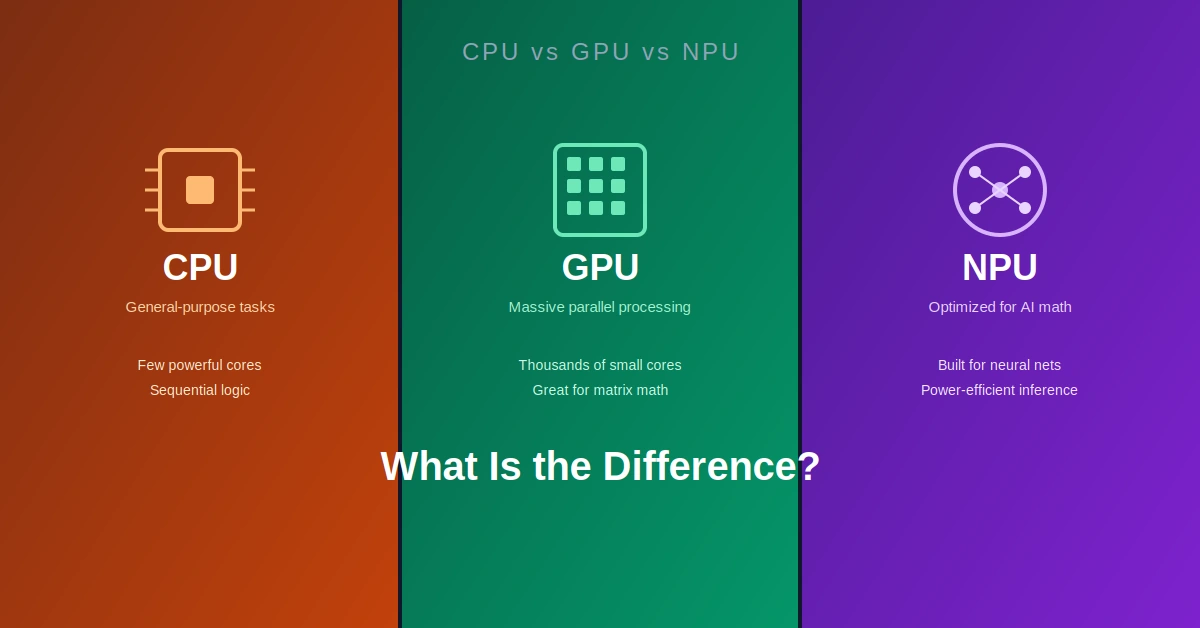
A CPU is designed to be a flexible general-purpose processor. It typically has a relatively small number of sophisticated cores that can handle many different types of work.
A GPU takes a different approach.
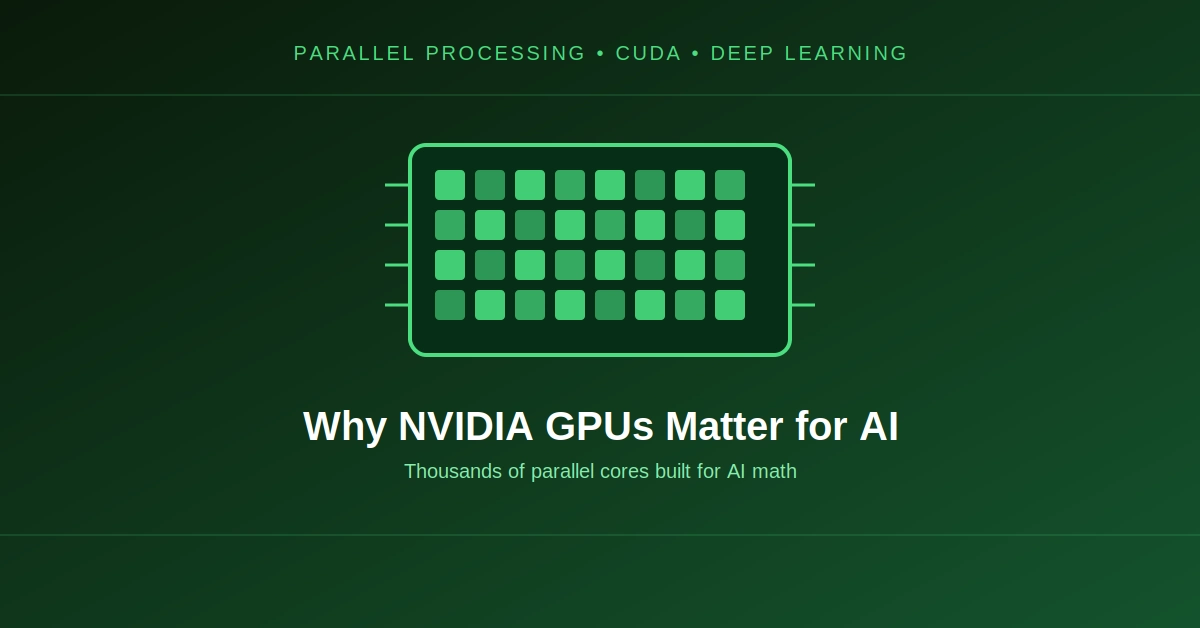
It contains a large number of simpler parallel processing resources designed to execute many operations simultaneously.
NVIDIA describes this parallel-processing capability as one of the fundamental reasons GPUs are well suited to AI workloads.
This architecture was originally developed largely around graphics, but the same mathematical parallelism is extremely useful for machine learning.
AI Is Mostly a Lot of Math
A neural network can contain millions, billions or even trillions of parameters.
During computation, those parameters are combined with input data through operations such as:
Output = Input × Weights + Bias
At scale, this becomes matrix multiplication.
For example:
Input Matrix
      ×
Weight Matrix
      ↓
Output Matrix
A large neural network performs huge numbers of these operations.
GPUs are particularly good at performing many similar mathematical operations simultaneously.
That makes them a natural fit for deep learning.
NVIDIA Did More Than Build GPUs
This is one of the most important parts of NVIDIA’s AI story.
NVIDIA did not simply take a graphics processor and wait for AI researchers to figure out how to use it.
The company built a software platform around its GPUs.
The most important component is CUDA.
CUDA allows developers to use NVIDIA GPUs for general-purpose computation rather than restricting them to graphics.
NVIDIA’s CUDA platform provides a programming model, compiler, libraries and development tools for GPU computing.
The simplified relationship is:
AI application
      ↓
PyTorch / TensorFlow / JAX
      ↓
CUDA
      ↓
NVIDIA GPU
      ↓
GPU computation
This software layer is a major part of why NVIDIA GPUs became useful outside traditional graphics.
What Is CUDA?
CUDA stands for Compute Unified Device Architecture.
It provides developers with a way to write software that executes computational workloads on NVIDIA GPUs.
Instead of treating the GPU only as a graphics device, CUDA makes it a general computing platform.
A simplified example is:
CPU:
"Run this calculation."

        ↓

CUDA:
"Execute this workload across
many GPU threads."

        ↓

NVIDIA GPU:
"Run many calculations in parallel."
The developer does not necessarily need to manually control every physical processing unit.
CUDA and its libraries provide abstractions that make GPU computing practical.
NVIDIA’s CUDA documentation describes the platform as providing the tools and programming environment required to develop GPU-accelerated applications.
CUDA Became an AI Foundation
The importance of CUDA becomes clearer when looking at modern AI frameworks.
Frameworks such as PyTorch, TensorFlow and JAX can use NVIDIA GPUs through optimized software libraries.
NVIDIA’s CUDA-X AI stack provides GPU-accelerated libraries for deep learning and supports major frameworks including PyTorch, TensorFlow and JAX.
So an AI researcher can write something conceptually simple like:
model.to("cuda")
and the framework can move computation onto a compatible NVIDIA GPU.
The underlying system is considerably more complicated, but the abstraction makes GPU acceleration accessible to a much larger developer community.
Tensor Cores Changed NVIDIA GPUs for AI
Modern NVIDIA GPUs contain specialized hardware called Tensor Cores.
Tensor Cores are designed to accelerate matrix operations that appear heavily in AI workloads.
NVIDIA introduced Tensor Cores with its Volta architecture, and later generations have expanded their supported numerical formats and capabilities.
A simplified GPU might look like:
NVIDIA GPU
┌──────────────────────────────┐
│                              │
│ CUDA processing resources    │
│                              │
│ Tensor Cores                 │
│ Tensor Cores                 │
│ Tensor Cores                 │
│ Tensor Cores                 │
│                              │
│ Cache                        │
│                              │
│ Memory controllers           │
│                              │
└──────────────────────────────┘
The Tensor Cores are particularly important for matrix multiplication and mixed-precision AI computation.
This means modern NVIDIA GPUs are not merely general-purpose GPUs being forced to run AI.
They contain hardware specifically optimized for AI mathematics.
Why Tensor Cores Matter
Consider a large matrix multiplication.
A conventional processor could calculate individual operations.
A specialized matrix engine can perform many of those operations together.
Conceptually:
Matrix A       Matrix B
   │              │
   └──────┬───────┘
          ↓
    Tensor Core
          ↓
      Matrix C
This can dramatically increase throughput for workloads that map well to matrix operations.
Modern NVIDIA Tensor Cores support several numerical formats, allowing hardware to trade precision, performance and memory usage according to workload requirements.
This is particularly useful for transformer-based AI models.
Mixed Precision
AI models do not always require every calculation to use the highest available numerical precision.
For many workloads, lower-precision arithmetic can provide much higher throughput while maintaining acceptable model accuracy.
Examples include:
FP32
TF32
FP16
BF16
FP8
INT8
Different GPU generations support different combinations of these formats.
NVIDIA’s Tensor Core architecture has progressively added lower-precision formats and techniques such as the Transformer Engine to improve AI performance.
The basic trade-off looks like:
Higher precision
      ↓
More numerical detail
      ↓
Usually more computation / memory

Lower precision
      ↓
Less data per value
      ↓
Potentially higher throughput
      ↓
Lower memory requirements
This matters enormously when running very large models.
GPUs Need More Than Fast Compute
Suppose a GPU contains thousands of compute units.
What happens if those units are waiting for data?
They cannot do useful work.
This makes memory bandwidth one of the most important parts of an AI accelerator.
A simplified data path is:
Model data
    ↓
High-bandwidth memory
    ↓
GPU cache
    ↓
Tensor / compute units
    ↓
Result
Modern data-center NVIDIA GPUs use high-bandwidth memory technologies such as HBM to supply large amounts of data to the processor.
For example, NVIDIA’s H200 platform uses HBM3e memory, while different generations have progressively increased memory capacity and bandwidth.
The exact memory configuration depends on the GPU generation and product.
Why GPU Memory Matters for AI Models
Imagine a model with billions of parameters.
The parameters have to be stored somewhere while the model is being executed.
Suppose a simplified model contains:
10 billion parameters
If every parameter required 4 bytes:
10 billion × 4 bytes
= 40 billion bytes
≈ 40 GB
That is already larger than the memory available on many consumer GPUs.
And a real AI workload may also need memory for:
- activations
- temporary tensors
- KV cache
- gradients during training
- optimizer states
- framework overhead
So AI performance is not just about computational throughput.
Can the model fit into memory?
And if it does:
Can the hardware move that data fast enough?
These questions are critical.
Training Large Models Requires Many GPUs
A very large AI model may not fit on a single GPU.
Even if it fits, training it on one GPU could take an impractical amount of time.
So data-center systems combine many GPUs.
For example:
GPU ─── GPU ─── GPU ─── GPU
 │       │       │       │
 ├───────┼───────┼───────┤
 │       │       │       │
GPU ─── GPU ─── GPU ─── GPU
The GPUs need to communicate continuously.
That creates another engineering challenge:
GPU-to-GPU communication.
Why NVLink Matters
NVIDIA developed NVLink to provide high-speed communication between GPUs and other system components.
This allows multiple GPUs to work together as a larger computing system.
A simplified view is:
GPU 1 ←──────→ GPU 2
 │              │
 ↕              ↕
GPU 3 ←──────→ GPU 4
Instead of treating every GPU as an isolated processor, a system can connect many accelerators into a larger computational environment.
NVIDIA has used NVLink and related networking technologies to scale GPU systems for large AI workloads.
This becomes particularly important for distributed training and large-scale inference.
Networking Becomes Part of AI Computing
At very large scale, GPU-to-GPU communication can extend beyond a single server.
You can have:
Server 1
GPU GPU GPU GPU
      │
      │ high-speed network
      ↓
Server 2
GPU GPU GPU GPU
      │
      ↓
Server 3
GPU GPU GPU GPU
The model is distributed across a cluster.
This requires specialized networking, communication libraries and software.
NVIDIA’s AI infrastructure therefore extends beyond GPUs themselves into networking and data-center systems.
This is an important reason why comparing AI hardware purely by the specification of a single GPU can be misleading.
NVIDIA GPUs and LLMs
Large language models are one of the biggest workloads driving AI hardware demand.
A simplified LLM pipeline looks like:
Prompt
  ↓
Tokenization
  ↓
Embeddings
  ↓
Transformer layers
  ↓
Attention
  ↓
Matrix multiplication
  ↓
Output probabilities
  ↓
Next token
  ↓
Repeat
A huge amount of numerical computation happens inside those transformer layers.
NVIDIA GPUs provide hardware optimized for this type of workload.
Tensor Cores accelerate matrix operations, GPU memory stores model data, and CUDA-based libraries provide the software layer that allows frameworks and inference engines to use the hardware efficiently.
NVIDIA’s Software Stack Is a Major Advantage
The hardware is only one part of the NVIDIA platform.
The software ecosystem includes technologies such as:
CUDA
CUDA-X
cuDNN
cuBLAS
NCCL
TensorRT
TensorRT-LLM
NeMo
NGC
These tools solve different parts of the AI computing problem.
For example:
- CUDA provides the GPU programming platform.
- cuDNN provides optimized deep-learning primitives.
- cuBLAS accelerates linear algebra.
- NCCL handles communication between GPUs.
- TensorRT provides inference optimization.
- TensorRT-LLM focuses on large-language-model inference.
- NeMo provides tools for building and customizing generative AI models.
- NGC provides containers, models and other optimized AI resources.
NVIDIA describes CUDA-X AI as a stack of GPU-accelerated libraries designed for AI workloads, while its NGC catalog provides models, containers and other resources for AI development and deployment.
This ecosystem matters because developers do not want to reinvent low-level GPU optimization for every model.
Why Software Ecosystem Creates a Network Effect

Imagine two companies produce GPUs.
Company A:
Fast hardware
Company B:
Fast hardware
+
Compiler
+
Libraries
+
Framework support
+
Optimized inference
+
Networking
+
Developer tools
+
Large developer community
The second platform can be easier for developers to adopt even if raw hardware specifications are not dramatically different.
Once developers build applications around a software ecosystem, switching hardware can require changes to:
- kernels
- libraries
- deployment systems
- optimization pipelines
- infrastructure
- testing
- performance tuning
That creates significant ecosystem inertia.
NVIDIA’s CUDA ecosystem has been developed for many years, giving developers a mature platform for GPU computing.
NVIDIA and PyTorch
One of the most important combinations in modern AI is:
PyTorch
   +
CUDA
   +
NVIDIA GPU
Researchers can develop neural networks using high-level Python APIs while the computationally intensive operations are executed on NVIDIA GPUs.
NVIDIA states that major deep-learning frameworks including PyTorch, TensorFlow and JAX are accelerated on NVIDIA GPUs through its software stack.
This separation is useful.
The researcher can think about:
model(input)
instead of manually programming every matrix multiplication at the hardware level.
The underlying framework and CUDA libraries handle much of the complexity.
Why NVIDIA GPUs Are Used for Both Training and Inference
AI has two major computational phases.
Training
Training changes the model’s parameters.
Data
 ↓
Forward pass
 ↓
Prediction
 ↓
Loss
 ↓
Backward pass
 ↓
Gradients
 ↓
Weight update
This can require enormous computational resources.
Inference
Inference uses an already trained model.
Prompt
 ↓
Model
 ↓
Prediction
 ↓
Response
Inference has different optimization requirements.
For example, an AI service may need to respond to thousands or millions of users simultaneously.
NVIDIA provides hardware and software optimized for both training and inference. Its Tensor Core and inference software stack are designed around high throughput and low latency requirements.
Why NVIDIA GPUs Are Not Only for AI
NVIDIA GPUs remain general-purpose accelerators as well.
They can be used for:
- graphics
- scientific computing
- simulations
- video processing
- data analytics
- computer vision
- robotics
- financial modeling
- AI training
- AI inference
This versatility is another important characteristic.
The same fundamental GPU platform can support different workloads through different software.
Why Consumer NVIDIA GPUs Can Run AI Models
The NVIDIA ecosystem is not limited to giant data centers.
Consumer and workstation GPUs also provide CUDA support and AI acceleration features.
For example:
Desktop GPU
     ↓
CUDA
     ↓
PyTorch
     ↓
Local AI model
This allows developers to experiment with models locally before deploying them to cloud or data-center infrastructure.
NVIDIA’s current CUDA GPU documentation covers a wide range of data-center, workstation and consumer GPU architectures.
That creates a common development path:
Developer PC
     ↓
NVIDIA GPU
     ↓
CUDA
     ↓
AI application
     ↓
Cloud / data center
     ↓
Large NVIDIA GPU cluster
The hardware may be very different at each stage, but the software ecosystem can remain familiar.
Why NVIDIA Became Important During the Generative AI Boom
Generative AI dramatically increased the amount of computing required for AI systems.
Large language models require enormous amounts of computation during training.
They also require substantial computational resources when serving millions of inference requests.
This created demand for:
More GPUs
+
More GPU memory
+
Faster networking
+
Better software
+
More efficient inference
NVIDIA was already positioned around GPU computing, CUDA and AI-specific acceleration hardware.
The rise of transformer-based models therefore increased the importance of technologies NVIDIA had been developing for years.
Tensor Cores and newer precision formats became particularly relevant as models grew larger and workloads shifted toward transformer architectures.
Is NVIDIA Important Because Its GPUs Are the Only AI Hardware?
No.
This is an important distinction.
NVIDIA is a major AI-computing platform, but it is not the only company developing AI accelerators.
Other approaches include:
Google TPUs
AMD GPUs
Intel accelerators
Amazon custom AI chips
Apple Neural Engines
Microsoft custom accelerators
Various AI startups
Different hardware architectures target different workloads and environments.
The interesting question is therefore not:
“Can AI run without NVIDIA?”
It can.
The more useful question is:
“Why did NVIDIA’s particular combination of hardware and software become such an important AI platform?”
The answer is the combination of:
GPU parallelism
       +
Tensor Cores
       +
High-bandwidth memory
       +
Fast interconnects
       +
CUDA
       +
AI libraries
       +
Framework support
       +
Developer ecosystem
The NVIDIA AI Stack
It can be visualized like this:
┌───────────────────────────────┐
│       AI Applications         │
│ Chatbots • Vision • Robotics  │
└───────────────┬───────────────┘
                ↓
┌───────────────────────────────┐
│ AI Frameworks                 │
│ PyTorch • JAX • TensorFlow    │
└───────────────┬───────────────┘
                ↓
┌───────────────────────────────┐
│ NVIDIA AI Software            │
│ CUDA • cuDNN • TensorRT       │
│ NCCL • NeMo • CUDA-X          │
└───────────────┬───────────────┘
                ↓
┌───────────────────────────────┐
│ NVIDIA Hardware               │
│ GPU • Tensor Cores • HBM      │
└───────────────┬───────────────┘
                ↓
┌───────────────────────────────┐
│ Networking / Infrastructure   │
│ NVLink • Data Center Systems  │
└───────────────────────────────┘
This is much closer to the real story than simply saying:
“NVIDIA makes powerful GPUs.”
NVIDIA has built a broad accelerated-computing platform around its GPUs.
The Main Limitation: Cost and Power
NVIDIA’s AI hardware is powerful, but large-scale AI infrastructure is expensive.
A serious AI cluster needs much more than GPUs.
It requires:
- servers
- high-speed networking
- memory
- storage
- power delivery
- cooling
- data-center space
- software infrastructure
And the GPUs themselves consume significant electrical power under heavy workloads.
This means AI infrastructure has become a major data-center engineering problem.
The challenge is increasingly:
Compute
+
Memory
+
Networking
+
Power
+
Cooling
+
Software
All of these have to work together.
What Actually Makes NVIDIA GPUs Important?
There isn’t one single feature.
It is the combination.
1. Parallel processing
GPUs can execute many suitable operations simultaneously.
2. Tensor Cores
Specialized hardware accelerates matrix and tensor operations used heavily by neural networks.
3. High-bandwidth memory
Large AI models require fast access to enormous amounts of data.
4. Multi-GPU scaling
NVLink and networking technologies allow many GPUs to cooperate on large workloads.
5. CUDA
Developers have a mature programming platform for NVIDIA GPU computing.
6. AI libraries
Optimized libraries reduce the amount of low-level GPU programming developers need to perform themselves.
7. Framework support
Major AI frameworks can use NVIDIA GPUs through the CUDA ecosystem.
8. Large developer ecosystem
Years of software development have created a substantial body of tools, code and expertise around NVIDIA GPUs.
Together, these components make the platform more useful than any individual specification suggests.
Final Takeaway
NVIDIA GPUs became important to AI because their architecture matches the mathematical structure of neural networks, but hardware alone does not explain NVIDIA’s position.
The GPU provides massive parallel computing.
Tensor Cores accelerate matrix operations.
High-bandwidth memory feeds data to the computation.
NVLink and networking connect multiple accelerators.
CUDA provides the programming foundation.
Libraries such as cuDNN, cuBLAS and NCCL optimize important operations.
Frameworks such as PyTorch and JAX can build on this stack.
The result is an ecosystem that looks roughly like:
AI Model
   ↓
AI Framework
   ↓
CUDA / Optimized Libraries
   ↓
Tensor Cores + GPU Compute
   ↓
High-Bandwidth Memory
   ↓
NVLink / Networking
   ↓
Large AI Cluster
That is the real reason NVIDIA GPUs are important for AI.
The story is not simply about having a faster graphics processor. It is about building a complete accelerated-computing platform around the hardware.
As AI models become larger and workloads become more demanding, the competition is therefore happening at multiple levels simultaneously: processor architecture, memory, networking, software, compilers, libraries and developer ecosystems.
And that is why NVIDIA’s role in AI is much bigger than the GPU sitting inside a server.

SiliconeUpdate.com is a technology news platform that publishes updates and informational content related to silicon technology, software, artificial intelligence, and emerging technologies.
All articles published on this platform are attributed to SiliconeUpdate.com instead of individual authors. Content is presented in a neutral, informational format without personal opinions.
—
Content Publishing
SiliconeUpdate.com publishes news and updates based on publicly available information, official announcements, and industry developments. The focus is on clarity, relevance, and timely reporting.
—
Editorial Control
All editorial decisions, updates, and content management are handled at the platform level. No individual human or AI identity is presented as the author of articles.
—
Contact
For editorial communication or general queries, contact:
Email: neemasharma@gmail.com