Large language models have become the technology behind many of the AI tools people use every day. Chatbots, coding assistants, writing tools, search features, and many other applications now rely on these models to understand and generate human language.
But when you type a question into an AI chatbot and receive an answer within seconds, what is actually happening behind the screen?
The answer involves a combination of huge training datasets, neural networks, tokens, transformers, attention mechanisms, and a surprisingly simple generation process: predicting what comes next.
Understanding how large language models work does not require becoming an AI researcher. Once the major pieces are understood, the process becomes much easier to follow.
What Is a Large Language Model?
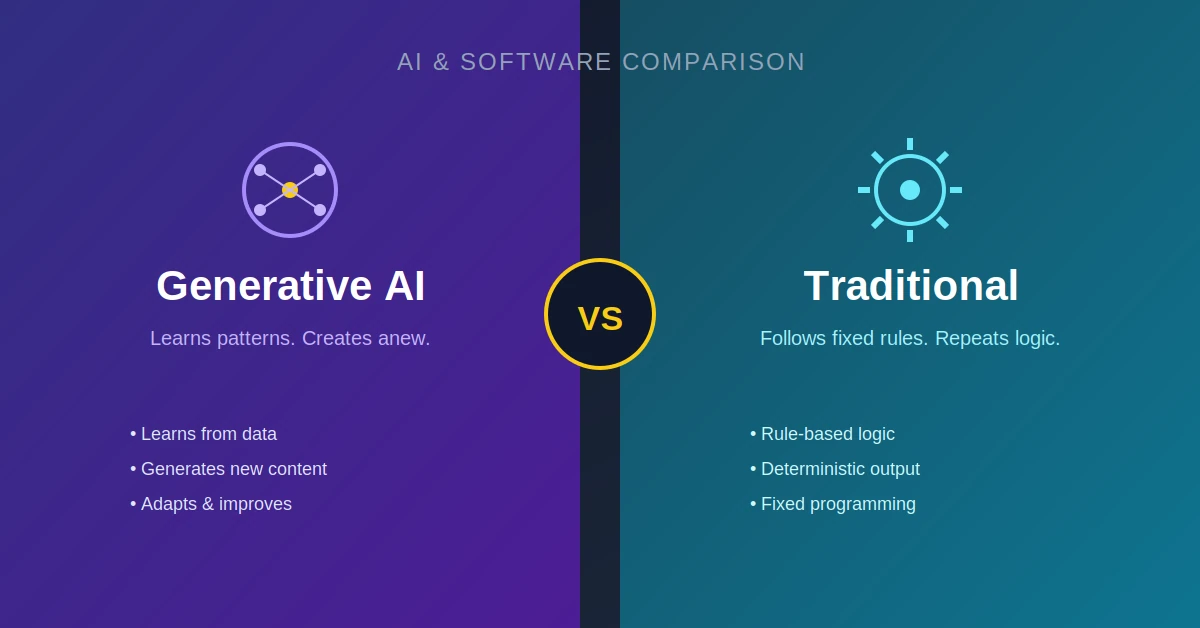
A large language model (LLM) is a machine learning model trained on a very large amount of text so it can learn patterns in language and generate text based on those patterns.
Models such as GPT and Google’s Gemini are examples of modern language models.
The word “large” refers to several things, including the amount of training data, the computational resources used during training, and the number of parameters in the model.
An LLM does not store an encyclopedia in the same way a traditional database stores records.
Instead, training changes the model’s internal parameters so that it learns statistical relationships between words, tokens, concepts, and context.
This distinction is important.
When an LLM answers a question, it generally isn’t performing a simple database lookup for a stored paragraph.
It is generating an output based on the patterns it learned during training and the context provided to it.
The Basic Idea Behind an LLM
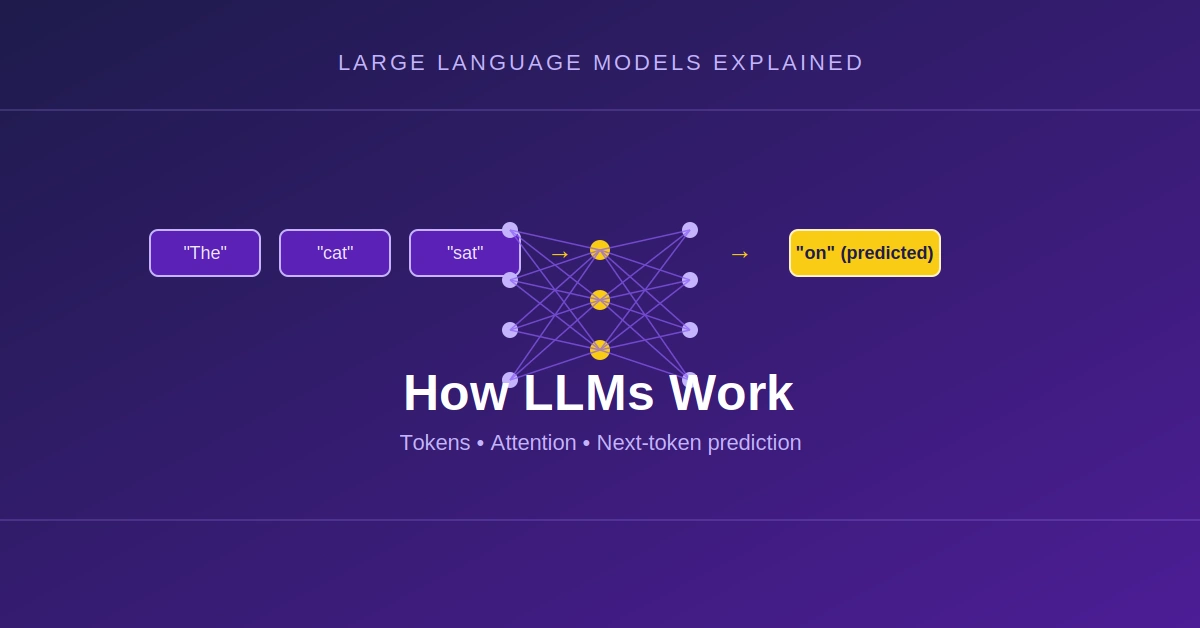
At a high level, a language model tries to predict the next token.
Consider this sentence:
The capital of France is
A language model may assign a very high probability to:
Paris
Now consider:
The weather outside is
Many different words could follow:
sunny
cold
warm
changing
The model calculates probabilities based on the context.
For a longer response, this process happens repeatedly.
Prompt
  ↓
Tokenization
  ↓
Model processes context
  ↓
Predict next token
  ↓
Add token to context
  ↓
Predict next token
  ↓
Continue
  ↓
Final response
This sounds simple, but the model performing those predictions can contain billions of learned parameters.
What Are Tokens?
One of the first things an LLM does with your input is break it into tokens.
A token is a piece of text that the model processes.
A token can be:
- A complete word
- Part of a word
- Punctuation
- A number
- A special character
For example, a sentence such as:
Artificial intelligence is changing software.
might be divided into several tokens.
The exact tokenization depends on the model and its tokenizer.
This matters because language models generally process a limited amount of context at a time, measured in tokens rather than words.
The number of tokens in a sentence is therefore not always equal to the number of words.
OpenAI provides a useful explanation of how tokens are counted and processed, although different AI models can use different tokenization systems.
Why Tokens Matter
Suppose you send a very long document to an AI model.
The model has to process that information within its available context window.
The context window determines how much information the model can consider during a particular interaction.
For example, if an application has a very large document, developers may need to split the document into smaller sections, retrieve only relevant sections, or use other techniques to manage the available context.
This is one reason modern AI applications often use retrieval systems instead of simply sending an entire database to a language model.
Training an LLM
Before a language model can generate useful responses, it needs to be trained.
Training usually involves exposing the model to a huge amount of data and repeatedly adjusting its parameters so that its predictions become more accurate.
A simplified version looks like this:
Large Dataset
     ↓
Tokenization
     ↓
Neural Network
     ↓
Prediction
     ↓
Compare With Expected Result
     ↓
Adjust Parameters
     ↓
Repeat
This process is repeated an enormous number of times.
The model gradually becomes better at predicting tokens based on the surrounding context.
This does not mean the model is simply memorizing every sentence it sees.
Training changes the numerical parameters inside the neural network, allowing the model to represent complex relationships in the data.
What Are Parameters?
Parameters are numerical values inside a neural network that are adjusted during training.
They can be thought of as learned values that influence how the model processes information.
A model with billions of parameters has an enormous number of these learned numerical values.
However, parameter count alone does not determine how useful a model is.
Architecture, training data, training methods, optimization, inference techniques, and other factors all influence the final capability of a model.
This is why comparing language models only by parameter count can be misleading.
The Transformer Changed Language Models
One of the most important developments behind modern LLMs is the Transformer architecture.
The Transformer architecture was introduced in the 2017 research paper Attention Is All You Need by researchers at Google and the University of Toronto.
The paper introduced an architecture based heavily on attention mechanisms rather than the recurrent approach that had dominated many earlier sequence models.
The original Transformer research paper is still one of the most important references for understanding the architecture behind modern language models.
Transformers made it much more practical to process large amounts of text in parallel during training.
More importantly, they introduced a powerful way for the model to determine which parts of the input are relevant to other parts.
That mechanism is called attention.
What Is Attention?
Attention allows the model to consider relationships between different tokens in the input.
Consider:
The developer put the application on the server because it was ready.
The model needs to understand what “it” refers to from the surrounding context.
Attention mechanisms allow the network to calculate relationships between tokens and determine which information should receive more weight when processing a particular token.
A simplified representation is:
The   developer   put   the   application   on   the   server
 |        |        |     |         |         |       |
 +--------+--------+-----+---------+---------+-------+
                     Attention
                         ↓
                 Contextual Meaning
The real mathematical process is much more complex, but the important concept is that the model does not treat every token independently.
It evaluates relationships between tokens.
Self-Attention
The Transformer architecture uses self-attention, where tokens in a sequence can interact with other tokens in that sequence.
For example:
The phone was placed on the table because it was charging.
Understanding the meaning of “it” requires looking at the surrounding words.
Self-attention helps the model build contextual representations by considering relationships across the input.
This becomes especially important when dealing with longer sentences and complex relationships.
From Words to Numbers
Computers do not process words in the same way humans do.
After tokenization, tokens are converted into numerical representations.
These representations allow the neural network to perform mathematical operations on the input.
A simplified pipeline looks like this:
Text
 ↓
Tokens
 ↓
Token IDs
 ↓
Embeddings
 ↓
Transformer Layers
 ↓
Probability Distribution
 ↓
Next Token
The model operates on numerical vectors rather than directly manipulating human-readable words.
What Are Embeddings?
An embedding is a numerical representation of information.
Tokens can be represented as vectors in a high-dimensional mathematical space.
Words or concepts with related meanings can end up with representations that have useful relationships to one another.
For example, the concepts behind:
king
and
queen
have different meanings but share several relationships.
Embeddings allow models and other AI systems to represent these kinds of relationships mathematically.
Embeddings are also heavily used outside the language model itself, including semantic search and retrieval systems.
How the Model Generates an Answer
After processing the input, the model produces probabilities for possible next tokens.
Suppose the model receives:
Artificial intelligence is changing
It may assign different probabilities to possible next tokens:
the       0.18
software  0.15
world     0.12
industry  0.10
technology 0.07
...
The model then selects a token according to its generation strategy.
That token becomes part of the context.
The model predicts the next token again.
This continues until the response reaches an appropriate stopping point.
So when an LLM writes a paragraph, it is not generating the entire paragraph as one single operation.
It is generating a sequence of tokens.
Why the Same Prompt Can Produce Different Answers
You may have noticed that asking an AI model the same question more than once can produce different responses.
This is partly related to the sampling strategy used during generation.
A model does not necessarily always select the single highest-probability token.
Generation settings can influence how much variation is allowed.
One commonly discussed parameter is temperature.
A lower temperature generally makes output more predictable, while a higher temperature can increase variation.
The exact behavior depends on the model and the generation system.
This is useful for creative applications where different outputs are desirable, while more deterministic tasks may benefit from lower variation.
Pretraining Is Only the Beginning
Modern language models often go through more than one stage of development.
The first major stage is generally called pretraining.
During pretraining, the model learns broad patterns from large datasets.
After that, additional training techniques can be used to make the model more useful for following instructions, interacting with users, or performing particular tasks.
A simplified pipeline might look like:
Large Dataset
     ↓
Pretraining
     ↓
Base Language Model
     ↓
Instruction / Alignment Training
     ↓
More Useful Assistant
The exact process differs between model developers.
Some systems also use human feedback, preference data, synthetic data, reinforcement learning techniques, tool-use training, and other methods.
Why LLMs Sometimes Give Wrong Answers
One of the biggest misconceptions about language models is that they always “know” whether something is true.
They don’t.
The model is fundamentally trained to learn patterns and generate likely sequences of tokens.
That means it can sometimes produce a statement that sounds highly convincing while being factually wrong.
This behavior is commonly referred to as an AI hallucination.
For example, an LLM might confidently produce a nonexistent citation or incorrectly describe a technical feature.
The problem becomes particularly important when AI is used for research, programming, medicine, finance, or other areas where incorrect information can have real consequences.
This is why many production AI systems add external retrieval, verification, structured outputs, or human review.
LLMs and Retrieval-Augmented Generation
A language model’s internal knowledge is not the same thing as having direct access to a current database.
Suppose a company wants an AI assistant that answers questions using its internal documentation.
Instead of retraining the entire model every time a document changes, developers can use retrieval-augmented generation (RAG).
A simplified RAG workflow looks like this:
User Question
      ↓
Search / Retrieval
      ↓
Relevant Documents
      ↓
LLM
      ↓
Answer
The retrieval system finds relevant information and provides it to the language model as context.
This approach can help an AI application answer questions about information that was not part of the model’s original training data.
It can also make updating knowledge much easier.
LLMs Are Becoming Part of Larger Systems
A modern AI application rarely consists of only a language model.
Developers increasingly combine LLMs with:
- Search
- Databases
- APIs
- Code execution
- File processing
- Retrieval systems
- External tools
- AI agents
This changes what the application can do.
For example, an LLM alone might explain how to query a database.
An AI application connected to a database can actually retrieve the requested information.
An agent connected to the same database might decide when it needs to query it, analyze the results, and continue working through a larger task.
This is why understanding the LLM itself is only one part of understanding modern AI software.
What Makes an LLM “Large”?
There is no single number that officially determines whether a model is a large language model.
The term generally refers to models with substantial parameter counts and training resources compared with earlier language models.
But size is only one part of the equation.
A larger model does not automatically perform better at every task.
Training quality, architecture, data quality, inference techniques, and optimization can all affect performance.
This is also why smaller specialized models have become increasingly interesting. They can sometimes provide better latency, lower operating costs, and easier deployment for specific applications.
How LLMs Are Used Today
Large language models now appear in many different products.
AI Assistants
Chatbots can answer questions, explain concepts, summarize information, and help users perform tasks.
Coding Tools
LLMs can generate code, explain existing code, suggest fixes, and create tests.
Search
Search products can use language models to summarize information and provide conversational answers alongside traditional search results.
Content Creation
Writers and marketers can use LLMs to create drafts, outlines, summaries, and variations.
Business Software
Companies can integrate language models into customer support, document processing, internal search, and workflow automation.
The model is increasingly becoming another software component rather than a standalone product.
The Future of Large Language Models
Large language models are likely to become more integrated with tools and external systems.
The next generation of AI applications is not only about generating better text.
Models are increasingly being connected to search systems, databases, code environments, browsers, APIs, and other software.
That creates a shift from:
“Ask the AI a question.”
to:
“Give the AI a task.”
The model still generates language, but the surrounding software determines what information it can access and what actions it can take.
That is also why LLMs are becoming a fundamental building block for AI agents and other AI-powered applications.
Final Thoughts
Large language models can appear complicated because they involve enormous datasets, neural networks, billions of parameters, and sophisticated architectures.
But the basic idea is easier to understand.
The model converts text into tokens, processes those tokens through a neural network, uses learned patterns to estimate what should come next, and generates an output one token at a time.
The Transformer architecture and attention mechanisms allow modern models to understand relationships across context at a scale that earlier language systems could not handle as effectively.
The result is a general-purpose technology that can generate and manipulate language, code, and other forms of information.
And the most important development may be what happens around the model.
When an LLM is connected to retrieval, tools, APIs, databases, and agents, it stops being just a text generator and becomes part of a much larger software system.
That is where much of the next stage of AI development is likely to happen.
SiliconeUpdate.com is a technology news platform that publishes updates and informational content related to silicon technology, software, artificial intelligence, and emerging technologies.
All articles published on this platform are attributed to SiliconeUpdate.com instead of individual authors. Content is presented in a neutral, informational format without personal opinions.
—
Content Publishing
SiliconeUpdate.com publishes news and updates based on publicly available information, official announcements, and industry developments. The focus is on clarity, relevance, and timely reporting.
—
Editorial Control
All editorial decisions, updates, and content management are handled at the platform level. No individual human or AI identity is presented as the author of articles.
—
Contact
For editorial communication or general queries, contact:
Email: neemasharma@gmail.com