Artificial intelligence is not a new technology. For decades, AI systems have been used to detect patterns, classify information, make predictions, and automate decisions.
What has changed recently is the rise of Generative AI.
Tools based on large language models can now write articles, generate code, create images, summarize documents, produce audio, and interact with users in natural language. This makes Generative AI look very different from the AI systems that were commonly used before the current AI boom.
But the difference is not simply that one is “old AI” and the other is “new AI.”
The two approaches solve different types of problems.
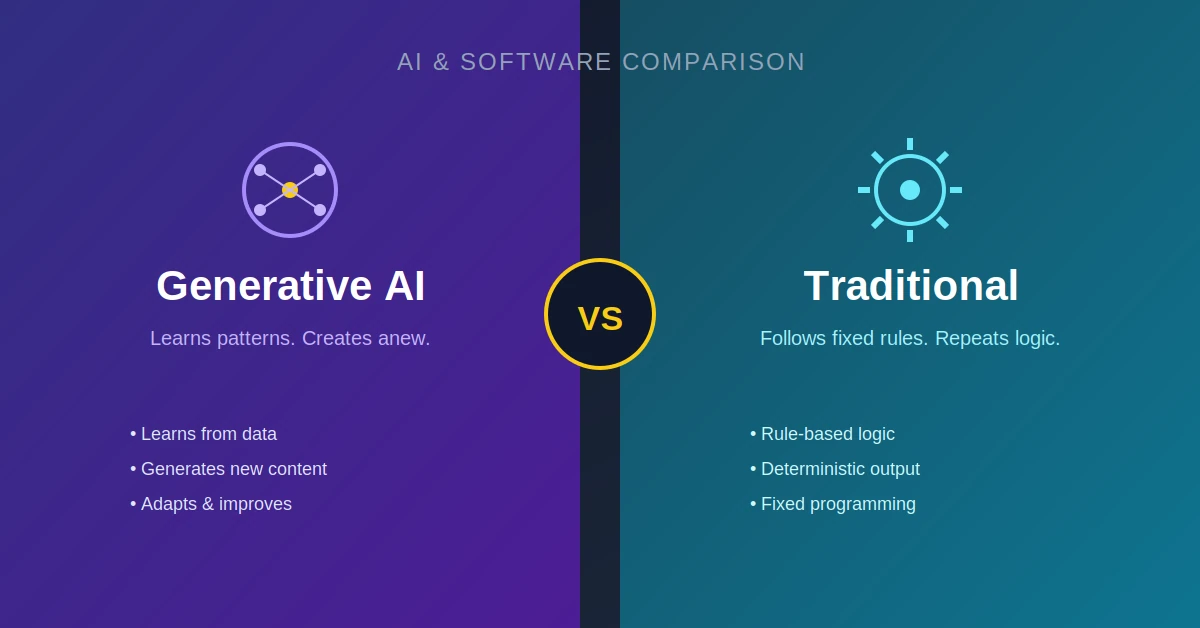
Traditional AI is generally designed to analyze existing information and produce a prediction, classification, or decision. Generative AI is designed to create new content based on patterns learned during training.
Understanding this difference helps explain why Generative AI has created so much interest across software, business, and technology.
What Is Traditional AI?
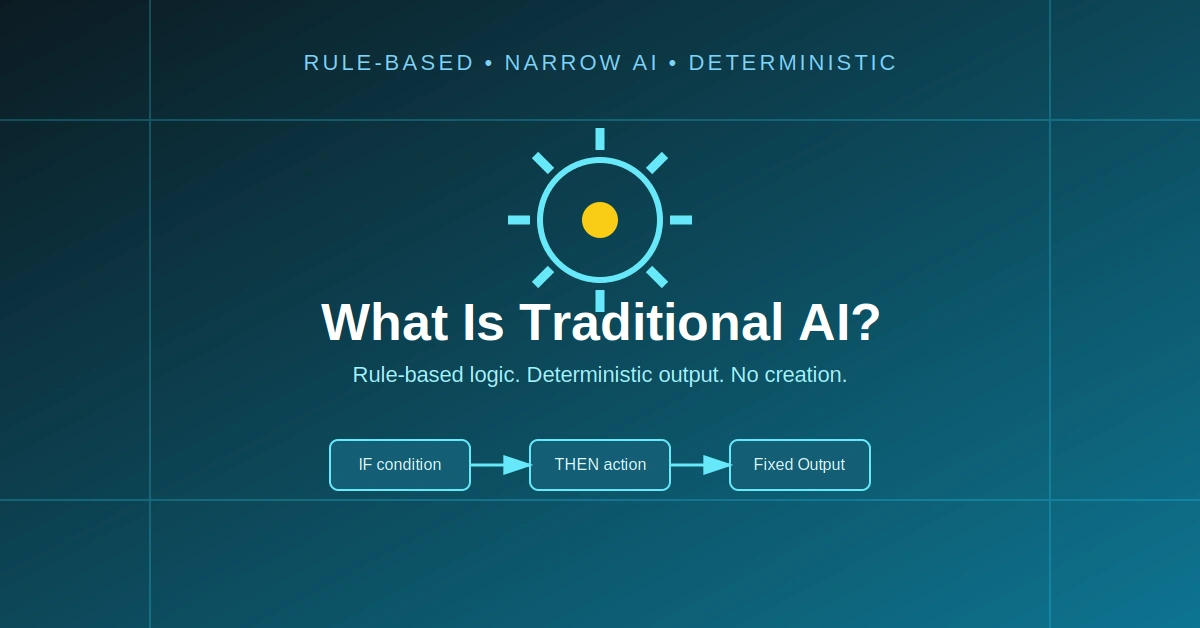
Traditional AI is a broad term used to describe AI systems that are designed to perform specific tasks such as classification, prediction, detection, or decision-making.
For example, a company could build an AI system to determine whether a transaction looks suspicious.
The system receives information such as:
- Transaction amount
- Location
- Device information
- Previous transaction history
- Account behavior
It then produces an output such as:
Likely legitimate
or
Potentially fraudulent
The system is not trying to create a new transaction or write an explanation. Its job is to analyze the available information and make a prediction.
Another example is an email spam filter.
Email
  ↓
AI Model
  ↓
Pattern Analysis
  ↓
Spam / Not Spam
This type of AI has been used in software for many years.
Traditional machine learning systems can be extremely effective when the task is clearly defined and the expected output is known.
What Is Generative AI?
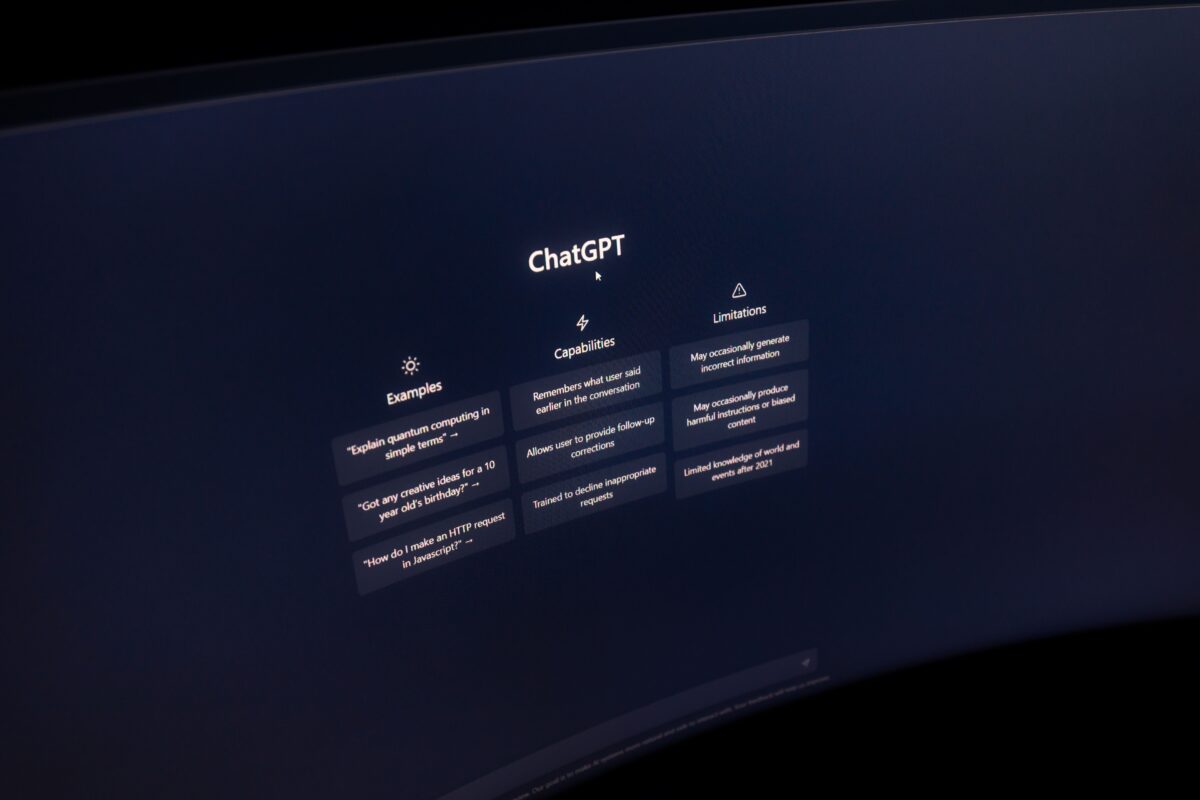
Generative AI takes a different approach.
Instead of primarily classifying or predicting an existing outcome, a generative model can create new content.
Depending on the model, that content could be:
- Text
- Images
- Audio
- Video
- Computer code
- Synthetic data
A text-based Generative AI system might receive:
Write an explanation of how cloud computing works.
Instead of returning a category or probability, it generates a new response based on patterns learned during training.
The basic idea can be represented as:
Prompt
  ↓
Generative AI Model
  ↓
Generated Content
Large language models are one of the most visible examples of Generative AI. The IBM explanation of generative AI describes the technology as AI capable of generating new content such as text, images, audio, and other media.
The Main Difference
The simplest way to understand the difference is to look at the type of output.
Traditional AI often answers questions like:
Which category does this belong to?
Is this transaction fraudulent?
What will the demand be next month?
Does this image contain a particular object?
Generative AI can answer questions such as:
Write a product description.
Generate an image of a futuristic city.
Create a Python function for this task.
Summarize this document.
The first group is mainly about analysis and prediction.
The second is about generation.
That does not mean traditional AI cannot generate anything or that Generative AI cannot make predictions. Modern AI systems can combine several capabilities.
The distinction is primarily about what the system is designed to do.
Traditional AI and Generative AI Architecture
A traditional machine learning system often follows a relatively straightforward workflow.
Input Data
    ↓
Feature Processing
    ↓
Trained Model
    ↓
Prediction
    ↓
Decision
For example, a bank could use a machine learning model to estimate the probability that a transaction is fraudulent.
Generative AI has a different workflow:
Prompt / Input
      ↓
Generative Model
      ↓
Token or Data Generation
      ↓
Generated Output
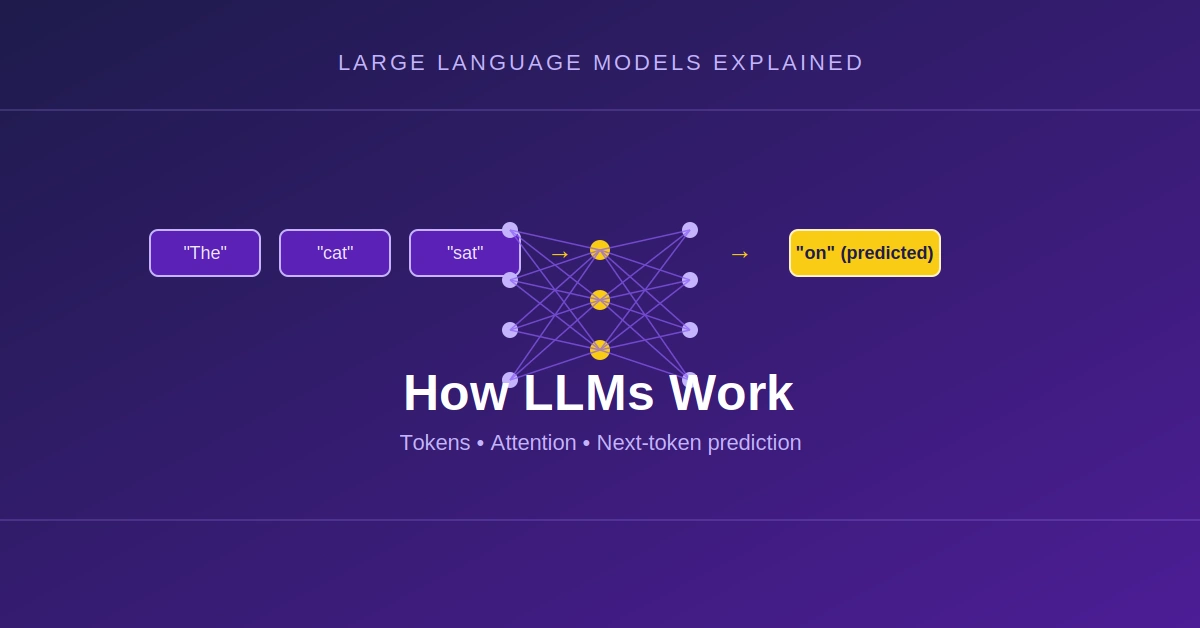
For a large language model, the system generates text one token at a time based on the context available to it.
Modern Generative AI systems can be considerably more complicated than this simplified diagram, but the basic idea remains useful.
How Traditional AI Learns
Traditional machine learning usually requires training data that represents the problem the model needs to solve.
Imagine building a model to identify whether an image contains a particular type of object.
The training process may involve a large collection of images with known labels.
Images + Labels
      ↓
Training
      ↓
Machine Learning Model
      ↓
New Image
      ↓
Prediction
The model learns patterns associated with the target categories.
Depending on the problem, different machine learning approaches can be used, including supervised learning, unsupervised learning, and reinforcement learning.
Traditional machine learning is still widely used because many business problems are fundamentally prediction or classification problems.
How Generative AI Learns
Generative AI models are generally trained to learn patterns from very large datasets.
A language model, for example, learns statistical relationships between tokens and the surrounding context.
During generation, the model predicts what should come next based on the information it has received.
A simplified example looks like this:
"The capital of France is"
                 ↓
              "Paris"
For a longer response, this process happens repeatedly.
The model generates a token, uses the updated context, predicts another token, and continues until the response is complete.
This is one reason large language models can generate surprisingly coherent text even though the underlying process involves predicting the next token.
Why Generative AI Feels Different
The biggest difference users notice is flexibility.
Traditional AI applications are usually built around a specific task.
For example:
Image → Object Detection
or:
Transaction → Fraud Prediction
Generative AI can support a much wider range of tasks through natural-language instructions.
For example, the same language model can be asked to:
- Explain a technical concept
- Rewrite an email
- Generate code
- Translate text
- Summarize a report
- Create a list
- Extract information
- Brainstorm ideas
This does not mean one model is automatically better at every task.
It means the interface is much more general.
Instead of building a separate interface for every operation, developers can allow users to describe what they want using natural language.
Generative AI Is Still Based on Traditional AI
It would be misleading to treat Generative AI and traditional AI as completely unrelated technologies.
Generative AI is itself built using machine learning and deep learning techniques.
Large language models, image-generation models, and other generative systems rely on neural networks and large-scale training.
In other words:
Generative AI is not a replacement for AI. It is one category of AI.
The term “artificial intelligence” covers a much larger field.
Machine learning is one part of AI.
Deep learning is a major approach within machine learning.
Generative AI is an application area that uses these technologies to generate new content.
The relationship is more like a hierarchy than two completely separate technologies.
Generative AI vs Traditional AI: A Simple Comparison
| Feature | Traditional AI | Generative AI |
|---|---|---|
| Main purpose | Prediction, classification, detection | Content generation |
| Typical output | Label, score, prediction, decision | Text, image, audio, code, video |
| User interaction | Usually task-specific | Often natural language |
| Training | Often focused on a specific task | Often trained on very large datasets |
| Flexibility | Usually narrower | Generally broader |
| Examples | Fraud detection, recommendation systems | Chatbots, image generators, coding assistants |
| Output variability | Often relatively constrained | Can produce different outputs |
| Human review | Often needed for important decisions | Often needed because generated output can be incorrect |
The table is a simplified comparison because modern AI systems increasingly combine these capabilities.
Where Traditional AI Still Makes Sense
Generative AI gets most of the attention today, but traditional AI remains extremely useful.
Consider a manufacturing company trying to detect defective products.
A computer vision model can inspect images from a production line and classify products as:
Pass
or
Fail
There may be no reason to use a large generative model for this task.
The same applies to many financial, industrial, medical, and operational systems where the expected output is clearly defined.
If the problem is:
“Determine whether this transaction is suspicious.”
a specialized prediction model may be more appropriate than asking a generative model to make the decision.
Traditional AI can also be easier to evaluate when there is a clearly measurable target.
Where Generative AI Makes More Sense
Generative AI becomes particularly useful when the output itself needs to be created.
For example:
Content Creation
A marketing team can use Generative AI to create first drafts of product descriptions, emails, social media posts, and other content.
Software Development
Developers can use AI coding tools to generate functions, explain code, create tests, and help investigate errors.
Customer Support
Generative AI can turn information from a knowledge base into natural-language responses.
Document Processing
A generative model can summarize long documents and extract important information into a more readable format.
Creative Work
Image, audio, video, and text generation can assist designers, writers, developers, and other creative professionals.
The important point is that the model is producing something new rather than simply selecting an existing category.
The Problem With Generative AI
Generative AI also introduces problems that are less obvious in many traditional prediction systems.
One major issue is hallucination.
A generative model can produce an answer that sounds convincing but is factually incorrect.
For example, it might invent:
- A research paper
- A website
- A statistic
- A product specification
- A quotation
- A historical detail
This happens because the model is designed to generate plausible output, not because it has a built-in guarantee that every statement is true.
This is why important applications often need additional verification systems, retrieval mechanisms, human review, or structured validation.
Traditional AI Can Also Work With Generative AI
The two approaches do not have to compete.
In many modern applications, they can work together.
For example, imagine an AI customer-support system.
A traditional machine learning model could determine whether a customer is likely to cancel a subscription.
A Generative AI model could then create a personalized response for the support employee.
The architecture could look like this:
Customer Data
      ↓
Traditional ML Model
      ↓
Prediction
      ↓
Generative AI
      ↓
Personalized Response
Another example is content moderation.
A classification model can identify potentially harmful content, while a generative model can help summarize the issue for a human reviewer.
This combination can be more useful than trying to make one model responsible for everything.
What Comes After Generative AI?
The industry is now moving toward systems that combine Generative AI with tools, external data, and software actions.
This is where AI agents become relevant.
A generative model can produce an answer.
An AI agent can potentially use that model to decide what action should happen next, call a tool, inspect the result, and continue the workflow.
That creates another progression:
Traditional AI
     ↓
Prediction and Classification
     ↓
Generative AI
     ↓
Content Generation
     ↓
AI Agents
     ↓
Reasoning + Tools + Actions
The boundaries are not absolute, but this progression helps explain why the AI industry has moved from prediction systems toward increasingly interactive software.
Which One Is Better?
There is no universal winner between Generative AI and traditional AI.
The right technology depends on the problem.
If the task is classification, fraud detection, forecasting, recommendation, or anomaly detection, a traditional machine learning approach may be appropriate.
If the task involves generating text, images, code, audio, or other content, Generative AI may be more suitable.
And for some applications, the best solution is a combination of both.
The important question is therefore not whether Generative AI has replaced traditional AI.
It hasn’t.
Instead, Generative AI has expanded what AI-powered software can do.
Traditional AI remains important for prediction and decision-making, while Generative AI provides a more flexible way to create and interact with information.
As AI systems become more capable, these technologies will increasingly be combined rather than treated as completely separate categories.

SiliconeUpdate.com is a technology news platform that publishes updates and informational content related to silicon technology, software, artificial intelligence, and emerging technologies.
All articles published on this platform are attributed to SiliconeUpdate.com instead of individual authors. Content is presented in a neutral, informational format without personal opinions.
—
Content Publishing
SiliconeUpdate.com publishes news and updates based on publicly available information, official announcements, and industry developments. The focus is on clarity, relevance, and timely reporting.
—
Editorial Control
All editorial decisions, updates, and content management are handled at the platform level. No individual human or AI identity is presented as the author of articles.
—
Contact
For editorial communication or general queries, contact:
Email: neemasharma@gmail.com