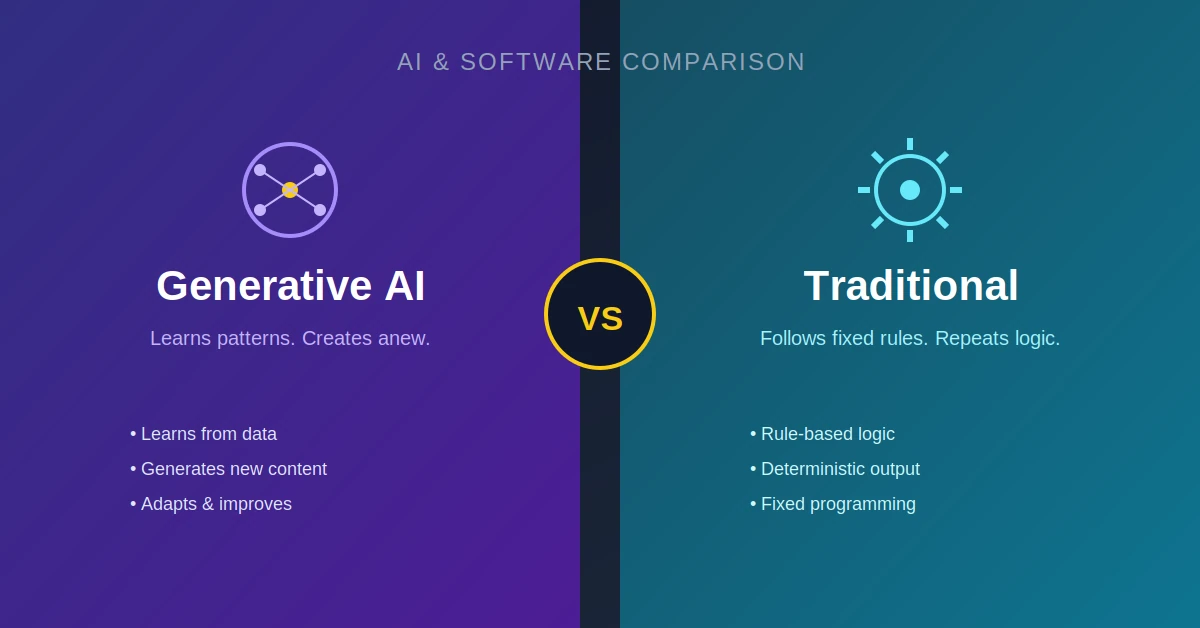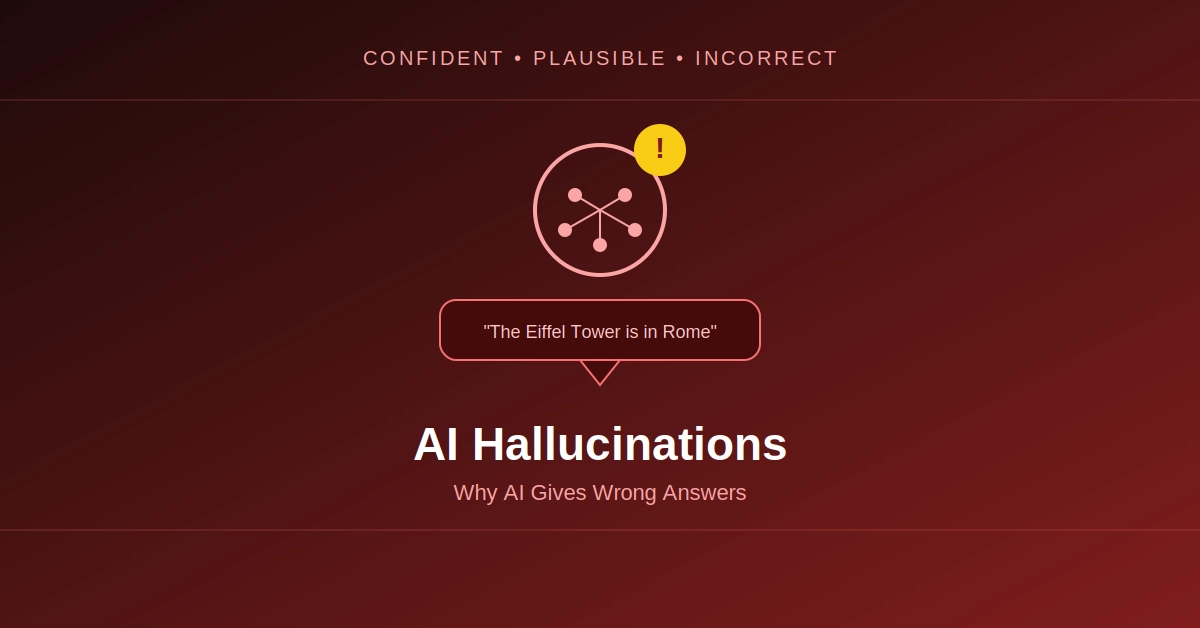
Artificial intelligence can write surprisingly convincing answers. It can explain technical concepts, summarize documents, generate code, and answer questions in seconds.
But there is a problem that has not disappeared even as AI models have become much more capable: AI can confidently give the wrong answer.
This behavior is commonly called an AI hallucination.

The problem is not simply that an AI model sometimes makes a small mistake. In some cases, a model can invent a completely fictional fact, citation, person, study, website, or technical explanation and present it as if it were true.
That creates an important question:
If AI is so good at understanding language, why does it still make things up?
The answer starts with understanding what a language model is actually trained to do.
What Is an AI Hallucination?
An AI hallucination occurs when a generative AI system produces information that is false, unsupported, or inconsistent with the available evidence.
For example, you might ask an AI:
Who wrote a particular research paper?
If the model does not have reliable information about the paper, it might still provide a name, publication date, and explanation that sounds completely reasonable.
The problem is that the information may not exist.
NIST uses the term confabulation for this behavior and describes it as a generative AI system confidently producing erroneous or false content. The term is also commonly referred to as hallucination.
This is an important distinction because the response can look perfectly normal to a human reader.
There may be no obvious grammatical mistake.
The sentence may be well written.
The explanation may even sound technical.
And yet the underlying claim can be completely wrong.
Why Does AI Make Things Up?
The simplest explanation is that a language model is not built like a traditional fact database.
A large language model learns patterns from large amounts of data and generates text based on those patterns.
During generation, the model predicts what tokens are likely to come next given the context.
That mechanism is extremely powerful for producing coherent language, but a likely sequence of words is not automatically a verified fact.
This is one of the fundamental reasons hallucinations can occur.
OpenAI’s research on language-model hallucinations explains that pretraining is based on predicting the next word or token from large amounts of text. The model learns patterns of language, but training does not give every statement a simple true-or-false label.
That difference matters.
Consider this:
The capital of France is ______
The model has seen enormous amounts of information connecting France with Paris.
The probability of “Paris” is therefore extremely high.
But now ask:
What was the exact unpublished birthday of a fictional scientist?
There may be no reliable information available.
The model still has to generate something unless the system is designed to recognize the uncertainty and abstain.
This is where hallucination can happen.
AI Does Not Always Know When It Does Not Know
One of the most confusing parts of AI hallucinations is that the model can sound confident.
Humans often associate confidence with knowledge.
AI does not work that way.
A response can be written in a confident tone even when the underlying information is uncertain.
For example:
The company was founded in 1998 by John Smith.
The sentence has a clear structure.
It sounds factual.
But the model’s confidence in the wording should not be interpreted as proof that the statement is true.
This is why users should treat confidence and accuracy as separate things when working with generative AI.
OpenAI’s research has specifically examined this issue, arguing that current evaluation practices can sometimes reward models for guessing rather than appropriately saying that they do not know.
Why Language Models Cannot Simply “Look Up” Every Fact
A common misconception is that an AI model has a giant database inside it containing every fact.
That is not how a language model works.
During training, the model’s parameters are adjusted as it learns patterns from data.
The resulting model contains learned representations and statistical relationships rather than a simple searchable collection of every original document.
This means asking a model for an obscure fact is not necessarily equivalent to querying a database.
If the model has weak or ambiguous information about something, it may still generate a plausible continuation.
This is one reason retrieval systems and web search can be useful alongside language models.
Rare Facts Are Particularly Difficult
Not every type of information is equally easy for an AI model to generate accurately.
Common patterns are generally easier to learn.
For example:
Water freezes at 0°C under standard atmospheric pressure.
This is a widely repeated fact.
But imagine asking for an obscure detail about a little-known person, a small company, or an old technical project.
The model may have very little reliable information about it.
There may also be multiple conflicting references in its training data.
OpenAI’s research points out that some facts are inherently difficult for next-token prediction because they do not follow predictable patterns. Arbitrary details, such as a person’s exact birthday, cannot be reliably inferred simply from the surrounding language.
This helps explain why AI can be excellent at explaining a general concept while simultaneously getting a very specific detail wrong.
Hallucinations Can Include Fake Sources
One of the most dangerous forms of hallucination is a fabricated source.
For example, an AI might provide:
- A paper that does not exist
- A fake DOI
- An incorrect URL
- A fictional researcher
- A real researcher attached to the wrong paper
- A real publication with an incorrect quotation
This can be particularly problematic for research and journalism.
A citation that looks professional is not necessarily a real citation.
The safest approach is to verify important references independently instead of assuming that an AI-generated citation is genuine.
Why Better Models Still Hallucinate
It is tempting to assume that hallucinations will disappear once models become sufficiently large.
Larger and more capable models can reduce many types of errors, but increased capability does not mean perfect factual reliability.
OpenAI’s current research continues to treat hallucination as an ongoing problem even in advanced models.
The problem is partly fundamental to open-ended generation.
There are questions for which:
- The answer is unknown.
- The available information is incomplete.
- Sources disagree.
- The question is ambiguous.
- The required information is not available to the model.
- The model cannot reliably determine the answer.
A system that always produces an answer can turn uncertainty into a confident-looking mistake.
A system that is allowed to say “I don’t know” can avoid some of those errors.
Hallucination vs Simple Mistake
Not every incorrect AI answer is necessarily what people mean by hallucination.
There is a useful difference.
A model might make a calculation error.
It might misunderstand the user’s question.
It might have outdated information.
Or it might fabricate an answer when it has no reliable basis for one.
The last case is especially associated with hallucination.
For users, however, the practical lesson is similar:
An AI-generated answer should not automatically be treated as verified information.
The level of verification should depend on how important the information is.
Current Information Is Another Problem
Some questions change over time.
For example:
Who is the current CEO of this company?
What is the latest price of this product?
What happened in today’s market?
What is the newest version of this software?
A model without access to current information may produce an answer based on information from its training or available context.
That answer could have been correct at one point and wrong today.
This is not exactly the same problem as fabricating information, but the result for the user can be similar: an incorrect answer.
This is why modern AI applications increasingly combine language models with web search, databases, APIs, and other sources of current information.
How Retrieval Can Reduce Hallucinations
One approach developers use to improve factual accuracy is retrieval-augmented generation, commonly called RAG.
Instead of asking the language model to answer entirely from its internal learned information, the application first retrieves relevant documents.
The retrieved information is then supplied to the model as context.
A simplified workflow looks like this:
User Question
      ↓
Search / Retrieval
      ↓
Relevant Information
      ↓
Language Model
      ↓
Generated Answer
For example, a company’s internal AI assistant could search its current documentation before answering an employee’s question.
The model does not need to remember every company policy inside its parameters.
It can retrieve the relevant policy and use that information while generating the response.
This approach can improve grounding, although it does not completely eliminate hallucinations.
The retrieved information itself can be incomplete or wrong, and the model can still misinterpret it.
Web Search Can Help, But It Is Not Magic
Giving an AI access to the web can improve its ability to answer questions about current events and changing information.
But browsing does not automatically guarantee a correct answer.
The model still has to:
- Find relevant information.
- Decide which sources are useful.
- Interpret the information correctly.
- Distinguish facts from opinions.
- Avoid combining unrelated information.
- Produce an accurate response.
If the source is wrong, outdated, misleading, or misunderstood, the final answer can still be wrong.
So the goal is not simply:
AI + Internet = No Hallucinations
It is closer to:
AI + Reliable Evidence + Verification = Better Factual Reliability
How Developers Try to Reduce Hallucinations
There is no single solution that completely eliminates hallucinations.
Instead, AI developers use several techniques.
Better Training
Models can be trained to follow instructions more reliably and to avoid unsupported claims.
Better Evaluation
Developers can test models specifically for factual errors rather than only measuring whether an answer looks fluent.
For example, OpenAI has developed SimpleQA, a benchmark designed to evaluate factuality on short fact-seeking questions.
Retrieval
Relevant external information can be provided to the model before it generates an answer.
Tool Use
The model can use calculators, databases, search systems, code execution, or APIs instead of trying to generate everything from memory.
Structured Outputs
Applications can constrain the format of an AI response so that it is easier to validate programmatically.
Human Review
For high-impact decisions, a person can verify the output before it is used.
These techniques attack different parts of the problem.
Why Saying “I Don’t Know” Matters
One of the simplest ways to reduce harmful hallucinations is surprisingly basic:
Allow the model to refuse to guess.
Imagine a question with insufficient information.
There are two possible responses:
“I don’t have enough information to determine that.”
or:
“The answer is definitely X.”
The first response is less satisfying, but it can be much safer when the information is genuinely uncertain.
OpenAI’s research argues that evaluation systems should give more consideration to appropriate uncertainty and abstention rather than rewarding models purely for attempting an answer.
This is an important shift in how AI systems are evaluated.
Accuracy should not simply mean:
Did the model answer?
It should also ask:
Did the model know when it should not answer?
Can AI Hallucinations Be Completely Eliminated?
Probably not in the absolute sense.
There will always be questions that are ambiguous, impossible to answer, or dependent on information that is unavailable.
Even a highly capable system can make mistakes.
The more realistic goal is to reduce the frequency and impact of incorrect answers, improve uncertainty handling, and provide reliable ways to verify important information.
This is also why AI reliability is not just a model problem.
It is a system-design problem.
A company building an AI assistant for internal documents can combine:
- A language model
- Document retrieval
- Source citations
- Access controls
- Validation
- Monitoring
- Human approval
The resulting system can be much more reliable than simply placing a chatbot in front of users and asking it to answer everything.
What Users Can Do to Avoid AI Hallucinations
Users can also reduce the risk.
For important information, ask the AI to distinguish between:
- Known facts
- Assumptions
- Estimates
- Uncertain information
When sources matter, ask for references and verify them.
For current information, use a system with access to current sources.
For technical work, test generated code instead of assuming it works.
For research, open the cited papers or websites.
For important decisions, independently verify the information.
The more important the consequence of being wrong, the less appropriate it is to rely on an unverified AI response.
The Bigger Problem Is Trust
AI hallucinations are not only a technical problem.
They are also a trust problem.
People naturally trust information that is:
- Clearly written
- Detailed
- Confident
- Well structured
- Supported by something that looks like a citation
Generative AI can produce all of those characteristics even when the underlying claim is wrong.
That makes hallucinations different from many traditional software errors.
A broken application may display an error message.
A hallucinating AI system may produce a perfectly readable paragraph that quietly contains false information.
This is why AI literacy is becoming increasingly important.
Users need to understand not only what AI can do, but also where its output needs verification.
Final Thoughts
AI hallucinations happen because language models are designed to generate useful and coherent outputs from learned patterns. They are not inherently fact databases, and generating a plausible statement is not the same as proving that statement is true.
Modern models are becoming better at factuality, and developers are using retrieval, tool use, improved training, evaluation, and uncertainty handling to reduce incorrect answers.
But hallucinations remain a real limitation.
The most useful way to think about AI is therefore not:
“AI always knows the answer.”
It is:
“AI can generate an answer, and the reliability of that answer depends on the model, the available information, the system around it, and the task.”
For casual brainstorming, an occasional mistake may not matter much.
For research, software development, business, finance, law, medicine, or any other high-impact area, verification matters.
The future of reliable AI will not depend only on making models larger or more capable. It will also depend on building systems that know when to use external evidence, when to verify information, and—perhaps most importantly—when to say “I don’t know.”

SiliconeUpdate.com is a technology news platform that publishes updates and informational content related to silicon technology, software, artificial intelligence, and emerging technologies.
All articles published on this platform are attributed to SiliconeUpdate.com instead of individual authors. Content is presented in a neutral, informational format without personal opinions.
—
Content Publishing
SiliconeUpdate.com publishes news and updates based on publicly available information, official announcements, and industry developments. The focus is on clarity, relevance, and timely reporting.
—
Editorial Control
All editorial decisions, updates, and content management are handled at the platform level. No individual human or AI identity is presented as the author of articles.
—
Contact
For editorial communication or general queries, contact:
Email: neemasharma@gmail.com