Artificial Intelligence models increasingly rely on high-quality, diverse data for effective training. When real-world data is scarce, privacy-sensitive, or imbalanced, synthetic data emerges as a critical solution. This generated data, created by machine learning algorithms, mimics the statistical properties and patterns of real data without containing any actual real-world information.
The primary value of synthetic data lies in its ability to enable safe and efficient AI model development. It addresses significant challenges such as data scarcity, privacy constraints, and class imbalance, which often hinder the progress and robustness of AI systems.
Defining Synthetic Data
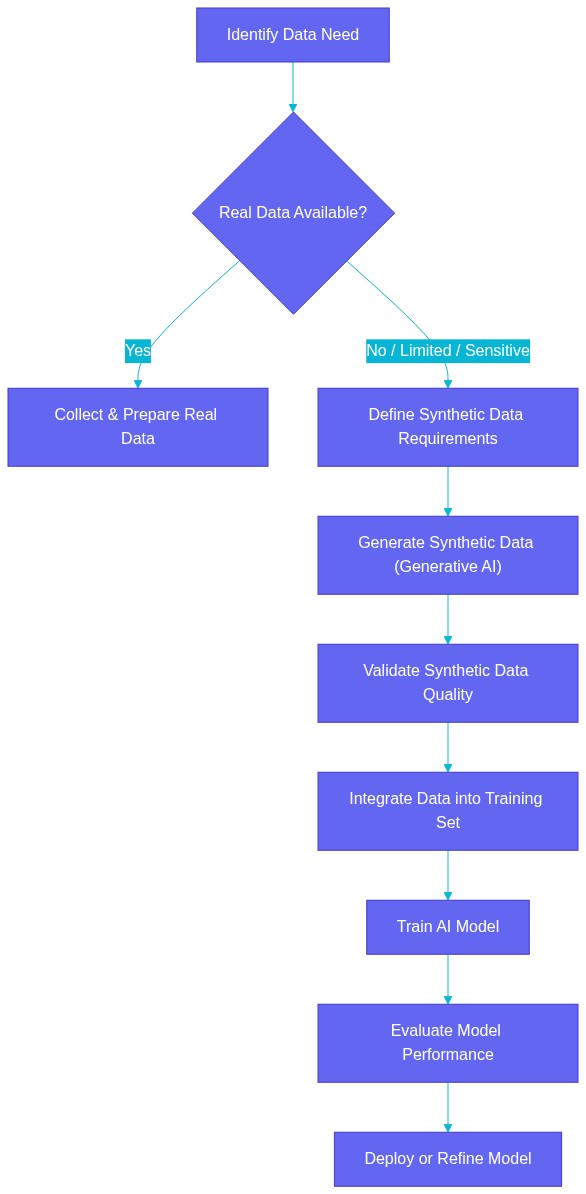
Synthetic data is artificially generated information that replicates the characteristics of real data. Generative AI, leveraging machine learning algorithms, creates this realistic data. A rules engine can further provision this data based on user-defined business policies, ensuring it meets specific requirements for AI training.
This approach allows for the creation of data that might not exist in the physical world, which is particularly beneficial for training large language models (LLMs) and other complex AI systems.
The Imperative for Synthetic Data
AI models, especially those requiring vast datasets, frequently encounter limitations with real-world data. These limitations include the high cost of data collection, the inherent privacy risks associated with personal or sensitive information, and the difficulty in obtaining sufficient examples for rare or “edge” cases.
Synthetic data directly mitigates these issues, providing a scalable and controlled source of training material. It allows developers to expand edge-case coverage and improve model accuracy and robustness without compromising privacy.
Understanding Synthetic Data Generation
The process of generating synthetic data involves sophisticated machine learning techniques to create new data points that statistically resemble an original dataset. This ensures the synthetic data maintains the underlying relationships and distributions present in real-world information.
Various methods exist, each suited for different data types and training objectives, from simple tabular data to complex images or text.
Generative AI Techniques
At the core of synthetic data generation are generative AI models. These models learn the patterns and structures within existing data and then produce new, similar data. Common architectures include Generative Adversarial Networks (GANs), Variational Autoencoders (VAEs), and more recently, diffusion models.
These algorithms analyze the input data to understand its statistical properties, then synthesize new data points that adhere to those learned properties, making them statistically indistinguishable from real data for many applications.
Controlled Data Synthesis
Beyond simply mimicking real data, synthetic data generation often incorporates rules engines and user-defined policies. This allows for the creation of specific data scenarios, such as rare events or particular demographic distributions, which are crucial for robust model training but difficult to collect in the real world.
For large language models, techniques like distillation and bootstrapping are employed to generate synthetic training and evaluation data, optimizing the learning process and addressing specific model needs.

Photo by Google DeepMind on Pexels
Mechanisms of Synthetic Data Application
AI models integrate synthetic data into their training pipelines to enhance various aspects of their performance. This integration can occur at different stages, from initial model training to fine-tuning and validation.
The goal is always to improve the model’s ability to generalize, handle diverse inputs, and perform reliably in real-world scenarios.
Augmenting Training Datasets
Synthetic data primarily serves to augment or replace real datasets. When real data is scarce, synthetic data fills the gaps, providing models with more examples to learn from. This is particularly valuable for domains with limited available data, such as specialized medical imaging or rare fraud detection scenarios.
By expanding the volume and diversity of training data, synthetic data helps models achieve higher accuracy and reduce overfitting to limited real samples.
Enhancing Model Robustness and Accuracy
One significant application involves creating synthetic data for edge cases or scenarios that are rare but critical for model performance. By training models on these synthetically generated edge cases, their robustness improves, making them less prone to errors when encountering unusual inputs in production.
This targeted data generation directly contributes to improving overall model accuracy and reliability, especially in safety-critical applications.
Accelerating Development Cycles
The ability to generate data on demand significantly speeds up AI training cycles. Instead of waiting for real-world data collection, which can be time-consuming and expensive, developers can quickly create diverse datasets for iterative model development and testing.
This agility allows for faster experimentation, quicker identification of model weaknesses, and more rapid deployment of improved AI systems.
Key Advantages for AI Training
The adoption of synthetic data in AI training is driven by several compelling benefits that address fundamental challenges in data acquisition and utilization. These advantages span privacy, data availability, and cost efficiency.
Privacy by Design
Synthetic data inherently removes privacy risks associated with using real personal or sensitive information. Since it contains no direct links to individuals, it enables safe and efficient model development without violating privacy regulations like GDPR or HIPAA.
This “privacy by design” approach allows organizations to train powerful AI models using sensitive data patterns without ever exposing actual sensitive data.
Overcoming Data Scarcity and Imbalance
Many real-world datasets suffer from scarcity or severe class imbalance, where certain categories have very few examples. Synthetic data directly solves these issues by generating additional examples for underrepresented classes or creating entirely new datasets where real data is unavailable.
This capability ensures models receive balanced training, preventing bias towards majority classes and improving performance on minority classes.
Cost and Efficiency Gains
Collecting, annotating, and preparing real-world data is often a costly and labor-intensive process. Synthetic data reduces dependence on these expensive and time-consuming activities. It can be generated programmatically, often at a lower cost and much faster pace than real data acquisition.
This efficiency translates into reduced development costs and accelerated time-to-market for AI solutions.
| Benefit Category | Description | Impact on AI Training |
|---|---|---|
| Privacy Protection | Removes direct links to real individuals or sensitive information. | Enables safe model development, reduces compliance risk. |
| Data Scarcity Resolution | Generates data where real data is limited or non-existent. | Expands training datasets, supports novel AI applications. |
| Class Imbalance Correction | Creates more examples for underrepresented categories. | Improves model fairness and performance on minority classes. |
| Edge Case Coverage | Synthesizes rare but critical scenarios. | Enhances model robustness and reliability in production. |
| Cost & Speed Efficiency | Reduces reliance on expensive, slow real data collection. | Accelerates training cycles and lowers development costs. |

Photo by Alex Knight on Pexels
Addressing Challenges and Risks
While synthetic data offers substantial benefits, its application is not without considerations. Developers must be aware of potential pitfalls to ensure the generated data genuinely improves model performance without introducing new issues.
Model Collapse Risk
A significant challenge, particularly when training large language models (LLMs) exclusively on synthetic data, is the risk of model collapse. This occurs when a model trained on synthetic data subsequently generates data that is then used to train future models, leading to a degradation of data quality and diversity over generations.
Careful monitoring and strategic integration of real data are necessary to mitigate this risk and maintain the richness of the data distribution.
Data Quality and Fidelity
The effectiveness of synthetic data hinges on its fidelity to real-world data. If the generative models fail to capture the nuances and complexities of the original data, the synthetic output may be unrealistic or contain biases, leading to models that perform poorly in real environments.
Rigorous validation and comparison against real data are essential to ensure the synthetic data accurately reflects the target domain.
Governance and Ethical Considerations
Effective governance is paramount for synthetic data. This includes establishing clear policies for its generation, use, and validation. While synthetic data reduces privacy risks, ethical considerations still apply, especially regarding potential biases inherited from the original training data or introduced during synthesis.
Organizations must implement robust frameworks to manage the lifecycle of synthetic data, ensuring its responsible and beneficial application.
Practical Applications Across Domains
Synthetic data finds utility across a wide array of industries and AI applications, demonstrating its versatility in solving diverse data-related challenges.
Large Language Model Training
For large language models, synthetic data can take the place of data that does not exist in the physical world. It is used for tasks like instruction tuning, where models learn to follow specific commands, or for generating diverse conversational examples to improve dialogue systems.
This allows LLMs to be trained on a broader range of scenarios and styles than might be available from real human-generated text alone.
Computer Vision and Autonomous Systems
In computer vision, synthetic data generates vast quantities of images and videos for training object detection, segmentation, and tracking models. This is particularly useful for creating diverse scenarios, varying lighting conditions, and rare events that are difficult or dangerous to capture in the real world, such as specific traffic accidents for autonomous vehicles.
The ability to control every aspect of the synthetic environment makes it ideal for testing and improving the robustness of vision systems.
Healthcare and Finance
In healthcare, synthetic patient data allows for the development of diagnostic AI tools without compromising patient privacy, addressing a significant barrier to innovation. Similarly, the financial sector uses synthetic transaction data to train fraud detection systems, simulating complex attack patterns that are too sensitive or rare to use with real customer data.
These applications highlight synthetic data’s role in enabling AI development in highly regulated and sensitive industries.
Key Takeaways
- Synthetic data, generated by AI, addresses data scarcity, privacy concerns, and class imbalance in AI training.
- It enables safe and efficient AI model development by providing realistic, statistically similar data without real-world identifiers.
- Generative AI techniques and rules engines create diverse datasets, including crucial edge cases, improving model robustness and accuracy.
- Key benefits include enhanced privacy by design, resolution of data scarcity, and significant reductions in data acquisition costs and training cycle times.
- Challenges like model collapse and ensuring data fidelity require careful governance and validation to maintain model performance.
A surprising insight is that synthetic data can be used to train AI models on data that literally does not exist in the physical world, enabling the exploration of hypothetical scenarios or future states.
Synthetic Data Adoption Trend (2025)
Early Adopters: 25% of AI projects | Mainstream Integration: 40% of AI projects | Widespread Use: 35% of AI projects — Source: Industry Estimates (Approximate)
Real World Example
Consider a financial institution developing an AI model to detect novel forms of credit card fraud. Real-world fraud data is inherently scarce, highly sensitive, and constantly evolving. Collecting enough diverse examples of new fraud patterns is nearly impossible before significant losses occur.
Using synthetic data, the institution can generate millions of simulated transaction records, including sophisticated, never-before-seen fraud scenarios. These synthetic datasets are crafted to mimic the statistical properties of legitimate transactions while introducing various fraudulent patterns. The AI model is then trained on this extensive synthetic data, learning to identify subtle anomalies without ever touching real customer data for these specific fraud types. This approach allows the model to be robustly trained against future threats, improving its detection capabilities significantly before new fraud schemes become widespread.
Frequently Asked Questions
What is the primary benefit of using synthetic data for AI training?
The primary benefit is addressing data scarcity and privacy concerns. Synthetic data allows AI models to be trained on large, diverse datasets without relying on sensitive real-world information, enabling development in regulated industries and for rare events.
Can synthetic data completely replace real data in AI training?
While synthetic data can significantly augment or even replace real data in many scenarios, it is often most effective when used in conjunction with real data. This hybrid approach helps mitigate risks like model collapse and ensures the synthetic data accurately reflects real-world nuances.
How does synthetic data help with class imbalance?
Synthetic data generators can specifically create more examples for underrepresented classes within a dataset. This balances the training data, preventing the AI model from becoming biased towards majority classes and improving its performance on minority or rare categories.
What is “model collapse” in the context of synthetic data?
Model collapse refers to the degradation of data quality and diversity over successive generations of models trained exclusively on synthetic data. It occurs when a model trained on synthetic data generates new synthetic data, which is then used to train the next model, potentially leading to a loss of original data richness.

SiliconeUpdate.com is a technology news platform that publishes updates and informational content related to silicon technology, software, artificial intelligence, and emerging technologies.
All articles published on this platform are attributed to SiliconeUpdate.com instead of individual authors. Content is presented in a neutral, informational format without personal opinions.
—
Content Publishing
SiliconeUpdate.com publishes news and updates based on publicly available information, official announcements, and industry developments. The focus is on clarity, relevance, and timely reporting.
—
Editorial Control
All editorial decisions, updates, and content management are handled at the platform level. No individual human or AI identity is presented as the author of articles.
—
Contact
For editorial communication or general queries, contact:
Email: neemasharma@gmail.com