Apple’s artificial intelligence strategy, termed Apple Intelligence, represents a fundamental shift towards deeply integrated, context-aware AI experiences. This approach prioritizes embedding AI capabilities directly into the operating system and existing applications, rather than offering a standalone chatbot or a separate AI service.
The core of this strategy involves making intelligence ambient, meaning AI functions operate seamlessly in the background across Apple’s ecosystem. This contrasts with traditional models where users explicitly open an AI application to interact with it.
Evolution of Apple’s AI Focus
Apple’s AI trajectory has evolved, with a significant shift towards hardware-powered intelligence becoming evident by 2026. This strategic pivot leverages the processing power of iPhones and Macs for AI workloads.
Reports from 2026 indicate that this restrained yet deeply integrated strategy is expected to yield substantial benefits. The unveiling of the next generation of Apple Intelligence and a revamped Siri in June 2026 marked a key milestone in this evolution.
Defining Apple Intelligence
Apple Intelligence is not a singular feature but a framework designed to integrate large language models (LLMs) and other AI capabilities into Apple’s existing offerings. Its purpose is to enhance user experience through system-level intelligence.
The strategy focuses on OS-level integration, ensuring AI functions are accessible across applications and system features. This design avoids the need for users to open a specific AI app for common tasks.
Core Principles of Apple Intelligence
Apple’s AI strategy is built upon several foundational principles that differentiate it within the competitive AI landscape. These principles guide its development and deployment across devices.
OS-Level Integration
A primary tenet of Apple Intelligence is its deep integration within the operating system. This means AI capabilities are woven into the fabric of iOS, iPadOS, and macOS.
Intelligence becomes ambient, allowing features to surface contextually without explicit user initiation. This design aims to make AI feel like an inherent part of the device experience.
Contextual Awareness
Apple Intelligence leverages a user’s personal context, including their data, apps, and activities, to provide relevant assistance. This contextual understanding is key to its utility.
The system uses on-device processing to understand user preferences and patterns, enhancing the personalization of AI-driven features. This approach also underpins Apple’s privacy commitments.

Photo by Luca Sammarco on Pexels
Hybrid AI Architecture
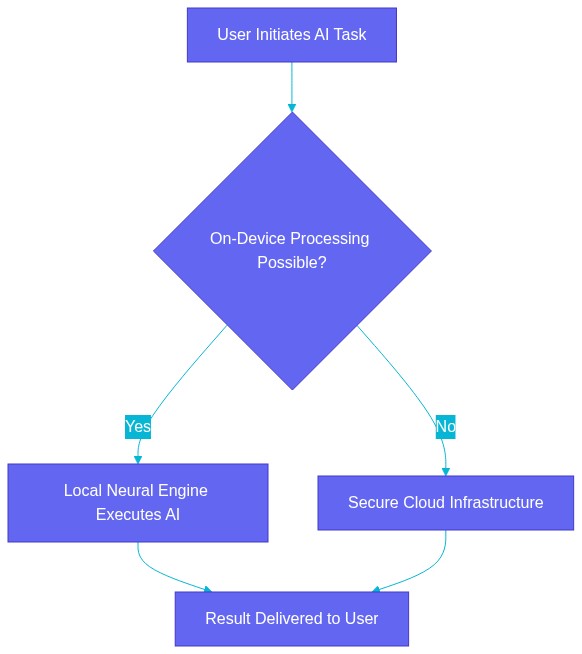
Apple employs a hybrid approach to AI, distributing workloads between on-device processing and cloud infrastructure. This architecture is a significant competitive differentiator.
On-Device Processing
Many AI workloads, particularly those involving personal data and real-time interactions, are processed directly on the iPhone or Mac. This hardware-powered intelligence is a cornerstone of the strategy.
Running AI on-device offers benefits such as enhanced privacy, reduced latency, and offline functionality. Tim Cook views this capability as a competitive advantage against peers relying solely on massive cloud data centers.
Secure Cloud Infrastructure
For more complex tasks requiring extensive computational resources, Apple utilizes its secure cloud infrastructure. This cloud component is designed to complement on-device processing, not replace it.
The hybrid model allows Apple to scale AI capabilities while maintaining a strong focus on user privacy and data security. Data sent to the cloud is typically anonymized and processed with strict privacy protocols.
Integration with Siri and Operating Systems
The evolution of Apple Intelligence is intrinsically linked to the enhancement of Siri and the broader operating system experience. Siri, in particular, receives significant upgrades through this strategy.
Revamped Siri Capabilities
The next generation of Siri, unveiled in June 2026, benefits directly from Apple Intelligence. Siri becomes more capable, understanding context better and performing more complex tasks.
This revamp moves Siri beyond simple command execution to a more proactive and intelligent assistant. Its integration with LLMs allows for more natural language interactions and personalized responses.
System-Wide Enhancements
Apple Intelligence extends beyond Siri, improving various aspects of the operating system. This includes features like enhanced parental controls and other software improvements announced in 2026.
The strategy aims to make devices more intuitive and helpful across the board, from organizing photos to drafting emails, all powered by underlying AI models.

Photo by Sanket Mishra on Pexels
Hardware-Powered Intelligence
Apple’s commitment to hardware-powered intelligence is a defining characteristic of its AI strategy. This approach leverages the custom silicon designed for its devices.
Leveraging Custom Silicon
Apple’s custom chips, such as the A-series and M-series, are engineered with dedicated Neural Engines optimized for AI and machine learning tasks. These components are essential for efficient on-device processing.
This hardware foundation enables complex AI models to run locally with high performance and energy efficiency. The tight integration between hardware and software is a core strength.
Performance and Privacy Benefits
Processing AI workloads on-device significantly enhances user privacy by minimizing data transfer to external servers. It also reduces latency, leading to faster and more responsive AI features.
The shift towards hardware-powered intelligence allows Apple to deliver advanced AI capabilities while maintaining its stringent privacy standards. This strategy is expected to pay off by 2026.
Strategic Outlook and Competitive Advantage
Apple’s AI strategy positions the company uniquely in the technology landscape, offering distinct advantages over competitors.
Competitive Differentiator
The hybrid AI approach, with its emphasis on on-device processing, provides a competitive edge. Tim Cook highlighted this as a “competitive weapon” against companies relying heavily on cloud-based AI.
This strategy allows for greater control over user data and experience, fostering trust and loyalty among its user base. The deep integration also creates a more cohesive ecosystem.
Long-Term Vision
Apple’s AI strategy is a long-term play, focusing on sustained integration and refinement rather than rapid, standalone product launches. The expectation is that this approach will yield significant returns by 2026.
The continuous development of Apple Intelligence, alongside improvements to Siri and other software, underscores a commitment to evolving the user experience through intelligent systems.
| Feature | Apple’s Hybrid AI | Cloud-Centric AI |
|---|---|---|
| Primary Processing Location | On-device (iPhone, Mac) with secure cloud augmentation | Primarily remote cloud servers |
| Data Privacy | Enhanced; personal data often stays on device | Data typically processed and stored in the cloud |
| Latency | Lower for on-device tasks, faster responses | Dependent on network speed and server load |
| Offline Capability | Significant functionality available offline | Limited or no functionality without internet connection |
| Resource Dependency | Leverages device hardware (Neural Engine) | Relies on massive data center infrastructure |
Real World Example
Consider a user drafting an email on their iPhone in 2026. As they type, Apple Intelligence, integrated directly into the Mail app, suggests rephrasing sentences for clarity or tone based on the email’s context and the user’s past writing style. This processing occurs primarily on the device, leveraging the Neural Engine, ensuring privacy.
If the user then asks Siri to summarize a lengthy PDF document stored in their Files app, Siri, powered by Apple Intelligence, might perform the initial text extraction and analysis on-device. For generating a concise summary from a very large document, a portion of the processing might securely and anonymously leverage Apple’s cloud infrastructure, with the result returned quickly to the device.
Apple’s strategy is not about creating a superior standalone AI chatbot, but rather about making AI an invisible, pervasive layer within its entire ecosystem. This ambient intelligence aims to redefine user interaction with devices.
Key Takeaways
- Apple Intelligence is an OS-level integration of AI, not a standalone application.
- The strategy employs a hybrid architecture, balancing on-device processing with secure cloud infrastructure.
- Hardware-powered intelligence, leveraging custom silicon, is central to Apple’s approach for performance and privacy.
- Siri receives significant enhancements, becoming more contextually aware and capable through Apple Intelligence.
- This strategy provides a competitive advantage by prioritizing privacy and reducing reliance on external cloud services.
Frequently Asked Questions
What is Apple Intelligence?
Apple Intelligence refers to Apple’s integrated AI strategy, embedding large language models and other AI capabilities directly into its operating systems and applications. It aims to provide ambient, context-aware assistance across the Apple ecosystem.
How does Apple’s hybrid AI approach work?
Apple’s hybrid approach processes many AI tasks directly on the device using custom silicon like the Neural Engine, enhancing privacy and speed. For more complex tasks, it securely and privately leverages Apple’s cloud infrastructure.
What are the main benefits of on-device AI processing?
On-device AI processing offers enhanced user privacy by keeping personal data local, reduces latency for faster responses, and allows for significant AI functionality even without an internet connection.
How does Apple Intelligence impact Siri?
Apple Intelligence significantly revamps Siri, making it more intelligent, contextually aware, and capable of understanding and executing complex requests. This transforms Siri into a more proactive and helpful assistant within the Apple ecosystem.

SiliconeUpdate.com is a technology news platform that publishes updates and informational content related to silicon technology, software, artificial intelligence, and emerging technologies.
All articles published on this platform are attributed to SiliconeUpdate.com instead of individual authors. Content is presented in a neutral, informational format without personal opinions.
—
Content Publishing
SiliconeUpdate.com publishes news and updates based on publicly available information, official announcements, and industry developments. The focus is on clarity, relevance, and timely reporting.
—
Editorial Control
All editorial decisions, updates, and content management are handled at the platform level. No individual human or AI identity is presented as the author of articles.
—
Contact
For editorial communication or general queries, contact:
Email: neemasharma@gmail.com