NVIDIA’s ascent to a central position within the AI industry stems from a confluence of early strategic decisions, technological innovation, and ecosystem development. The company’s foundational work in graphics processing units (GPUs) provided the parallel processing architecture inherently suited for the computational demands of modern artificial intelligence. This hardware advantage, coupled with a robust software platform, solidified its market dominance.
Early GPU Innovation and Gaming Roots
NVIDIA’s initial success was largely driven by the gaming industry, which demanded increasingly powerful GPUs for realistic graphics rendering. This demand spurred continuous innovation in GPU architecture, leading to processors capable of executing thousands of operations simultaneously. This parallel processing capability, while initially designed for graphics, proved to be precisely what neural networks and other AI algorithms required for efficient training.
The Parallel Processing Advantage
Traditional central processing units (CPUs) excel at sequential tasks, processing one instruction at a time very quickly. In contrast, GPUs are designed to handle many simple calculations concurrently, making them ideal for the matrix multiplications and tensor operations fundamental to deep learning. This architectural difference provided NVIDIA with a significant head start when AI began its rapid expansion.
The CUDA Ecosystem: A Strategic Enabler
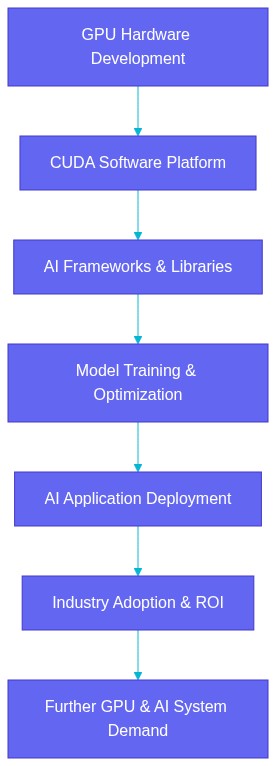
Beyond hardware, NVIDIA’s development of the CUDA (Compute Unified Device Architecture) platform was a pivotal strategic move that cemented its leadership. CUDA provided developers with a programming model and tools to harness the parallel processing power of NVIDIA GPUs for general-purpose computing, extending their utility far beyond graphics.
Unlocking GPU Potential with CUDA
CUDA offered a standardized way for programmers to write code that could run directly on NVIDIA GPUs, abstracting away much of the underlying hardware complexity. This accessibility allowed researchers and developers to experiment with and optimize AI algorithms on NVIDIA hardware. The platform’s early availability created a strong network effect, attracting a growing community of users.
Developer Adoption and Network Effects
The widespread adoption of CUDA by academic institutions and early AI startups created a self-reinforcing cycle. As more researchers used CUDA, more libraries and frameworks were built upon it, further entrenching NVIDIA’s technology as the standard for AI development. This ecosystem made it challenging for competitors to offer a comparable, fully integrated hardware and software solution.

Photo by Nana Dua on Pexels
Dominance in AI Acceleration
NVIDIA’s integrated approach to hardware and software has resulted in an unparalleled market position within the AI accelerator segment. The company’s continuous innovation ensures its products remain at the forefront of performance and efficiency.
Market Share and Performance Leadership
As of 2026, NVIDIA commands an estimated 85% to 92% share of the AI accelerator market. This dominance is a testament to the performance and reliability of its GPUs and specialized AI chips. The company consistently introduces new architectures and systems designed to meet the escalating demands of large-scale AI computing.
Hardware-Software Co-Design
NVIDIA’s strategy involves a tight integration between its hardware and software stacks, from the silicon level to high-level AI frameworks. This co-design optimizes performance, allowing for greater efficiency in training and inference of complex AI models. This synergy ensures that new hardware capabilities are immediately accessible and optimized for AI workloads through the CUDA platform and associated libraries.
Expanding Beyond GPUs: A Holistic AI Platform
NVIDIA is actively expanding its technological footprint beyond traditional GPUs to offer a more comprehensive AI infrastructure solution. This expansion aims to capture a larger share of the predicted $4 trillion in AI infrastructure spending.
Diversification into CPUs and Networking
At its 2026 developer conference, NVIDIA unveiled new chips and AI systems, indicating a strategic move beyond solely GPUs. The company is expanding into CPUs and networking solutions, aiming to provide end-to-end hardware for data centers powering AI. This diversification allows NVIDIA to offer integrated solutions that optimize performance across the entire computing stack.
Investing in Future AI Infrastructure
NVIDIA has made significant investments to ensure its technology forms the bedrock of future AI development. This includes developing advanced AI chips capable of supporting large-scale computing systems and investing in the creation of its own AI models. This forward-looking strategy positions NVIDIA to capitalize on the growing need for sophisticated AI infrastructure.
Photo by Matheus Bertelli on Pexels
Impact Across Industries
NVIDIA’s central role in AI has profound implications for various industries, enabling new applications and driving tangible business outcomes. The company’s annual “State of AI” reports highlight the widespread adoption and return on investment from AI technologies.
Driving ROI and Innovation
AI, powered by NVIDIA’s technology, is actively driving revenue growth, cutting operational costs, and boosting return on investment (ROI) across diverse sectors. Companies are leveraging AI for tasks ranging from predictive analytics to autonomous systems, demonstrating the practical value of advanced computing. This widespread adoption underscores the critical role NVIDIA plays in enabling these innovations.
The Future of AI Infrastructure Spending
NVIDIA predicts that AI infrastructure spending will reach $4 trillion, indicating the massive scale of investment expected in the coming years. This forecast highlights the ongoing demand for high-performance computing resources to develop, train, and deploy increasingly sophisticated AI applications. NVIDIA’s position as a leading provider of these resources makes it a key beneficiary of this projected growth.
| Metric | Value (2026) |
|---|---|
| AI Accelerator Market Share | 85% – 92% |
| Predicted AI Infrastructure Spending | $4 Trillion |
Key Takeaways
- NVIDIA’s early focus on GPUs for gaming provided a parallel processing architecture ideal for AI workloads.
- The CUDA software platform created a robust ecosystem, enabling developers to harness GPU power for general-purpose computing.
- NVIDIA maintains a dominant market share in AI accelerators, estimated at 85% to 92% in 2026.
- The company is expanding its offerings beyond GPUs into CPUs and networking to provide holistic AI infrastructure solutions.
- NVIDIA predicts a $4 trillion market for AI infrastructure spending, underscoring its long-term strategic investments.
NVIDIA’s strategic foresight in developing CUDA, a software layer for its GPUs, proved as impactful as its hardware innovations, creating a powerful moat against competitors. This ecosystem approach transformed a gaming component into the backbone of modern AI.
NVIDIA’s AI Accelerator Market Share (2026)
NVIDIA: 90% | Competitors: 10% — Source: intellectia.ai 2026
Real World Example
Consider a large pharmaceutical company developing new drugs using AI. This company utilizes NVIDIA’s DGX systems, which integrate multiple high-performance NVIDIA GPUs, specialized AI chips, and high-speed networking. Researchers leverage the CUDA platform and NVIDIA-optimized AI frameworks like TensorFlow or PyTorch to train complex deep learning models on vast datasets of molecular structures and patient data. This setup allows them to accelerate drug discovery processes, predict molecular interactions, and simulate clinical trials with unprecedented speed, directly impacting their research and development efficiency.
Frequently Asked Questions
What is CUDA?
CUDA, or Compute Unified Device Architecture, is a parallel computing platform and application programming interface (API) model developed by NVIDIA. It allows software developers to use NVIDIA GPUs for general-purpose processing, significantly accelerating computationally intensive tasks like AI model training.
How did gaming influence NVIDIA’s AI success?
The demand for realistic graphics in gaming drove NVIDIA to develop powerful GPUs with highly parallel architectures. This architecture, designed for rendering graphics, proved inherently suitable for the matrix operations required by AI algorithms, giving NVIDIA a significant hardware advantage.
What is NVIDIA’s market share in AI accelerators?
As of 2026, NVIDIA holds a dominant position in the AI accelerator market, commanding an estimated 85% to 92% share. This reflects the widespread adoption of its GPUs and specialized AI chips across various industries for AI workloads.
Is NVIDIA only focused on GPUs for AI?
No, NVIDIA is expanding its focus beyond just GPUs. The company is diversifying into CPUs, networking solutions, and even developing its own AI models and systems to provide a more comprehensive, end-to-end AI infrastructure platform.

SiliconeUpdate.com is a technology news platform that publishes updates and informational content related to silicon technology, software, artificial intelligence, and emerging technologies.
All articles published on this platform are attributed to SiliconeUpdate.com instead of individual authors. Content is presented in a neutral, informational format without personal opinions.
—
Content Publishing
SiliconeUpdate.com publishes news and updates based on publicly available information, official announcements, and industry developments. The focus is on clarity, relevance, and timely reporting.
—
Editorial Control
All editorial decisions, updates, and content management are handled at the platform level. No individual human or AI identity is presented as the author of articles.
—
Contact
For editorial communication or general queries, contact:
Email: neemasharma@gmail.com