The landscape of Artificial Intelligence deployment is undergoing a significant transformation, with a growing emphasis on where AI processing occurs. This article explores the technical and economic distinctions between On-Device AI and Cloud AI, examining their respective strengths, limitations, and the implications for developers and businesses in 2026.
Background & Context
On-Device AI refers to the execution of an AI model, or a segment of its processing pipeline, directly on the user’s local hardware. This contrasts with Cloud AI, where AI operations are performed remotely on centralized servers in a data center. While not a new concept, on-device AI has evolved considerably; for instance, today’s iPhones incorporate powerful and versatile on-device AI models, some featuring approximately 3 billion parameters, indicating a substantial leap in local processing capability.

Photo by Pavel Danilyuk on Pexels
Core Details
On-Device AI Characteristics
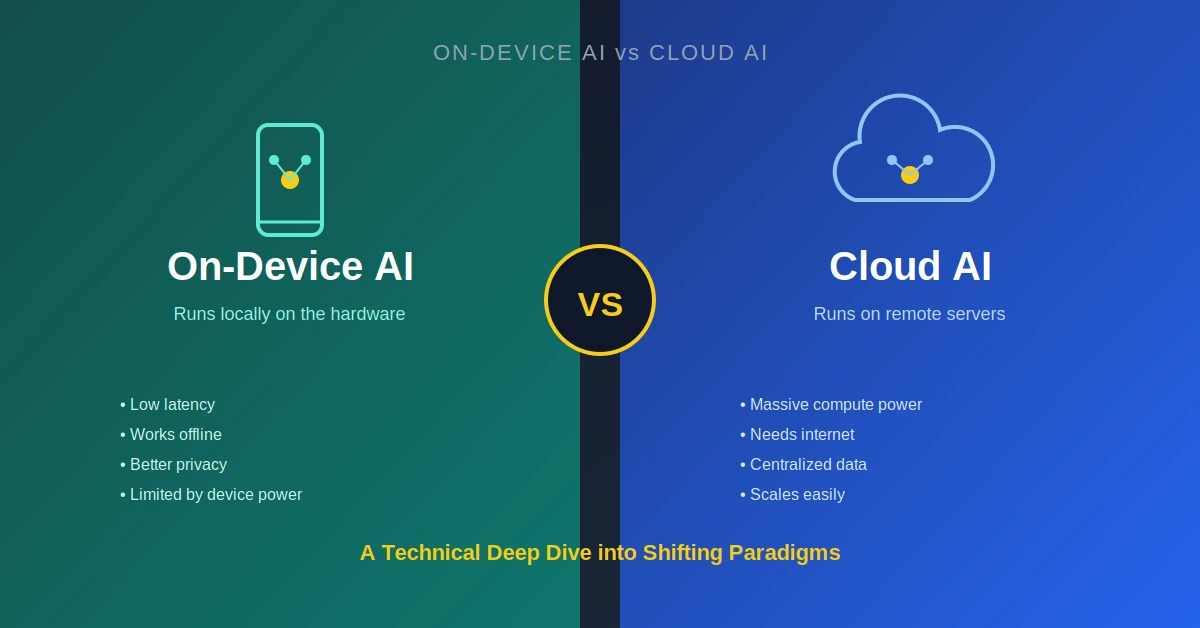
On-Device AI prioritizes speed, privacy, and operational independence. By processing data locally, it eliminates network latency, enabling instant task execution. This local processing inherently enhances data privacy, as sensitive information does not leave the device. Furthermore, on-device AI offers independence from continuous internet connectivity, ensuring functionality in offline environments. From an economic perspective, on-device AI boasts a zero marginal cost for inference, a significant advantage for scalable deployments.
Cloud AI Characteristics
Cloud AI, conversely, focuses on raw computational power and scalability. It leverages vast server farms to handle complex models and large datasets that exceed the capabilities of individual devices. This centralized approach allows for easy model updates and maintenance. However, cloud AI introduces latency due to network communication and raises privacy concerns as data must be transmitted to external servers. Economically, cloud AI inference, particularly at scale, often results in a financial loss, creating a distinct cost structure compared to on-device solutions.
Key Differences
The fundamental distinction lies in the processing location: local for on-device AI versus remote for cloud AI. This difference dictates performance metrics like latency and throughput, data privacy posture, and operational costs. On-device AI excels in scenarios demanding real-time responses and stringent data security, while cloud AI remains suitable for computationally intensive tasks requiring extensive resources or centralized data aggregation.
Data & Evidence
The economic and performance disparities between on-device and cloud AI are becoming increasingly pronounced in 2026. The shift towards local processing is driven by tangible benefits in cost, speed, and privacy.
| Feature | On-Device AI | Cloud AI |
|---|---|---|
| Primary Focus | Speed, Privacy, Independence | Power, Scalability |
| Marginal Cost (Inference) | Zero | Loses money at scale |
| Latency | Minimal (instant) | Dependent on network |
| Data Privacy | High (data stays local) | Lower (data transmitted) |
| Example Model Size | ~3 billion parameters (e.g., iPhone) | Significantly larger models |
The economic gap between these two approaches is substantial for developers and businesses. While cloud AI inference incurs costs that can lead to losses at scale, on-device AI offers a zero marginal cost model, fundamentally altering the economic calculus for AI application development. This economic shift is a primary driver behind the increasing adoption of on-device solutions.

Photo by Jakub Zerdzicki on Pexels
Real World Example
Consider a modern smartphone, such as an iPhone, which integrates a powerful on-device AI model with approximately 3 billion parameters. This local AI engine enables features like advanced photo processing, predictive text, and voice recognition to operate instantly and securely without sending user data to external servers. For instance, when a user edits a photo, the AI adjustments are processed directly on the device, ensuring immediate feedback and maintaining privacy. In contrast, a large language model chatbot, requiring immense computational resources, typically operates as a Cloud AI service. User prompts are sent to remote servers, processed, and then the response is transmitted back to the device. This cloud-based approach allows the chatbot to leverage vast, frequently updated models, but introduces network latency and necessitates data transmission.
Implications
The growing prominence of On-Device AI has profound implications for the AI industry. The shift towards local processing fundamentally alters the economics for developers and businesses, particularly due to the zero marginal cost of on-device inference compared to the scaling losses of cloud AI. This economic advantage positions on-device AI as a potential “killer app” that could render many datacenter-bound AI tools without a sustainable business model. Furthermore, it promises significantly better privacy for users, as sensitive data remains on the device, and reduces reliance on constant internet connectivity and external service providers. This paradigm shift encourages innovation in edge computing and specialized hardware for AI acceleration.
The economic advantage of on-device AI, specifically its zero marginal cost for inference, represents a disruptive force against the traditional cloud AI model which often loses money at scale.
Key Takeaways
- On-Device AI prioritizes speed, privacy, and operational independence by processing data locally.
- Cloud AI offers superior computational power and scalability for complex models, but incurs network latency and privacy considerations.
- The economic model for On-Device AI features a zero marginal cost for inference, contrasting with cloud AI’s potential for financial losses at scale.
- Modern devices, such as iPhones, already deploy powerful On-Device AI models with approximately 3 billion parameters.
- The shift towards On-Device AI is driven by economic advantages, enhanced privacy, and reduced reliance on external infrastructure, impacting future AI application development.
Frequently Asked Questions
What is the primary benefit of On-Device AI?
The primary benefit of On-Device AI is its ability to deliver instant processing, enhanced data privacy, and operational independence by performing AI tasks directly on the user’s device, eliminating network latency and external data transmission.
Why is the marginal cost of AI inference important?
The marginal cost of AI inference is important because it dictates the scalability and profitability of AI applications. On-Device AI offers a zero marginal cost, making it economically favorable for widespread deployment compared to Cloud AI, which can incur losses at scale.
Can On-Device AI handle complex tasks?
While Cloud AI generally handles the most complex, resource-intensive tasks, modern On-Device AI models, like those with 3 billion parameters found in iPhones, are increasingly capable of performing sophisticated functions such as advanced image processing and natural language understanding locally.
What are the privacy implications of each approach?
On-Device AI significantly enhances privacy because data remains on the user’s device, preventing transmission to external servers. Cloud AI, conversely, requires data to be sent to remote data centers, which can introduce privacy concerns depending on data handling policies.

SiliconeUpdate.com is a technology news platform that publishes updates and informational content related to silicon technology, software, artificial intelligence, and emerging technologies.
All articles published on this platform are attributed to SiliconeUpdate.com instead of individual authors. Content is presented in a neutral, informational format without personal opinions.
—
Content Publishing
SiliconeUpdate.com publishes news and updates based on publicly available information, official announcements, and industry developments. The focus is on clarity, relevance, and timely reporting.
—
Editorial Control
All editorial decisions, updates, and content management are handled at the platform level. No individual human or AI identity is presented as the author of articles.
—
Contact
For editorial communication or general queries, contact:
Email: neemasharma@gmail.com