
The landscape of cyber threats is rapidly evolving, with Artificial Intelligence (AI) significantly enhancing the sophistication of phishing attacks. Traditional phishing attempts often contained obvious indicators like poor grammar, generic greetings, or clumsy wording, making them relatively straightforward to identify. However, AI-generated phishing in 2025 and 2026 presents a far more formidable challenge to detection systems and human vigilance.
Generative AI tools are now capable of crafting highly convincing and personalized messages at scale. This capability removes many of the traditional red flags, making these attacks dramatically faster, more convincing, and inherently harder to detect.
The Evolution of Phishing
Historically, phishing relied on broad, untargeted emails designed to trick a small percentage of recipients. These attacks often used easily identifiable templates and lacked personalization. Attackers would cast a wide net, hoping for a few successful engagements.
The shift towards spear phishing introduced a degree of personalization, but this was typically a manual and time-consuming process. Attackers would research specific targets to tailor their messages, increasing their success rate but limiting their operational scale.
The Role of Generative AI
Generative AI, particularly large language models, has revolutionized the creation of malicious content. These models can produce text that mimics human writing styles, adapts to specific contexts, and maintains grammatical correctness. This capability allows attackers to generate highly believable phishing emails, SMS messages, and even voice communications.
The integration of AI enables the rapid generation of personalized content, overcoming the scalability limitations of manual spear phishing. This means a single attacker can launch thousands of highly targeted and convincing attacks simultaneously, significantly increasing the threat surface.
Mechanisms of Enhanced Evasion
AI-generated phishing attacks leverage several mechanisms to bypass both automated security filters and human scrutiny. The primary advantage lies in their ability to mimic legitimate communication patterns and content.
This sophistication challenges traditional detection methods, which often rely on identifying known patterns or anomalies that AI now effectively masks.
Eliminating Traditional Red Flags
One of the most significant ways AI enhances phishing is by eradicating the tell-tale signs of fraudulent messages. AI-generated emails no longer suffer from the poor grammar, awkward phrasing, or generic greetings that characterized older phishing attempts. These tools produce grammatically correct, contextually appropriate, and natural-sounding text.
Attackers can use AI to generate plausible sender names and email addresses that closely resemble legitimate contacts or organizations. This attention to detail makes it difficult for recipients to spot discrepancies that would typically trigger suspicion.
Personalization at Scale
AI enables attackers to personalize messages on an unprecedented scale. Instead of generic “Dear Customer” greetings, AI can craft emails that address recipients by name, reference specific projects, or mention recent interactions. This level of personalization creates a false sense of familiarity and legitimacy.
Such tailored messages are far more effective at bypassing human skepticism, as they appear to be legitimate communications from trusted sources. The ability to generate these personalized messages rapidly and in high volumes makes AI phishing a potent threat in 2026.

Photo by ali huzeyfe ermiş on Pexels
Advanced Attack Vectors
The application of AI extends beyond simple email text generation, encompassing more complex and multi-modal attack vectors. These advanced methods exploit various communication channels and human psychological vulnerabilities.
AI’s versatility allows for the creation of sophisticated scams that integrate multiple deceptive elements, making them harder to trace and defend against.
Spear Phishing Amplification
AI dramatically amplifies the effectiveness of spear phishing campaigns. By analyzing publicly available information or stolen data, AI can generate highly specific and contextually relevant messages for individual targets. This makes the attacks significantly more convincing and increases the likelihood of a successful compromise.
The speed at which AI can generate these targeted messages means attackers can launch large-scale spear phishing operations that were previously impractical. This capability makes AI-generated attacks a dominant spear phishing trend in 2025 and 2026, according to Adaptive Security.
Multi-Modal AI Scams
AI scams in 2026 are not limited to text-based phishing; they also incorporate other modalities like voice cloning and fake websites. Attackers can use AI to clone voices, creating convincing audio messages that impersonate executives or family members. These voice-based scams add another layer of deception, exploiting trust built through familiar voices.
Furthermore, AI can generate highly realistic fake websites that mimic legitimate login pages or corporate portals. These sites are designed to capture credentials or install malware, making the entire phishing ecosystem more robust and difficult to distinguish from genuine online services, as highlighted by Peoples Bancorp.
Challenges for Detection Systems
The sophistication of AI-generated phishing presents significant challenges for traditional detection methods. Security systems designed to identify common phishing characteristics struggle against AI’s ability to produce flawless, personalized content.
This necessitates a shift in defensive strategies, moving beyond simple pattern matching to more advanced behavioral and contextual analysis.
Limitations of Signature-Based Methods
Traditional email security systems often rely on signature-based detection, which identifies known malicious patterns, keywords, or sender characteristics. AI-generated phishing bypasses these methods by creating unique, context-specific content for each attack. Since the content is novel and lacks common “bad” signatures, it often slips past these filters.
The dynamic nature of AI-generated content means that static signatures quickly become obsolete. This requires security vendors to constantly update their databases, a reactive approach that struggles to keep pace with the rapid evolution of AI-driven threats.
Behavioral Analysis Complexities
While behavioral analysis attempts to identify anomalous user or system behavior, AI-generated phishing can also complicate this. The messages are designed to elicit specific, seemingly normal user actions, such as clicking a link or entering credentials. These actions, from the user’s perspective, might not immediately appear suspicious, especially given the message’s convincing nature.
Detecting subtle behavioral cues that differentiate a legitimate interaction from an AI-induced compromise becomes increasingly difficult. Security systems must differentiate between genuinely unexpected but benign actions and those triggered by highly sophisticated, AI-driven social engineering.
| Feature | Traditional Phishing | AI-Generated Phishing |
|---|---|---|
| Grammar & Spelling | Often poor, noticeable errors | Flawless, natural language |
| Personalization | Generic (“Dear Customer”) or manual, limited scale | Highly personalized, at scale |
| Sender Discrepancies | Obvious odd names/domains | Subtle, highly convincing spoofing |
| Content Uniqueness | Templated, repetitive | Context-specific, dynamic |
| Detection Difficulty | Moderate, relies on obvious clues | High, bypasses traditional methods |

Photo by Tima Miroshnichenko on Pexels
Real World Example
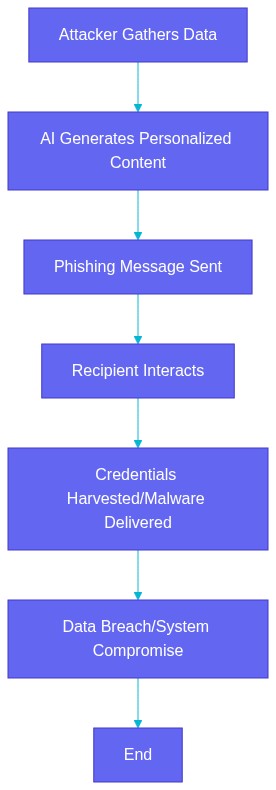
Consider a scenario in late 2025 where an employee, Sarah, receives an email seemingly from her company’s HR department. The email, generated by AI, addresses her by name, references a recent internal policy update, and states that a mandatory security training module needs completion by end-of-day. The sender’s email address appears legitimate, using a common company domain, and the language is professional and urgent, without any grammatical errors.
The email contains a link to what appears to be the company’s internal training portal. Unbeknownst to Sarah, the link leads to an AI-generated fake website, meticulously designed to mimic the company’s actual login page. Upon entering her credentials, the information is immediately harvested by the attacker. This attack bypasses typical spam filters due to its perfect grammar and personalized content, and Sarah’s suspicion is not triggered because of the contextual relevance and professional tone.
Key Takeaways
- AI-generated phishing eliminates traditional red flags like poor grammar and generic greetings.
- Generative AI enables highly personalized messages to be crafted at an unprecedented scale.
- Spear phishing campaigns are significantly amplified by AI, making them faster and more convincing.
- Multi-modal AI scams incorporate voice cloning and realistic fake websites for enhanced deception.
- Traditional signature-based detection methods are increasingly ineffective against dynamic AI-generated content.
The most surprising aspect of AI-generated phishing is its capacity to produce unique, context-specific content for each target, rendering static detection signatures obsolete almost instantly. This adaptability forces a fundamental re-evaluation of cybersecurity defenses.
Phishing Attack Sophistication Index (2025)
Traditional Phishing: 3.5Index Score | Spear Phishing (Manual): 6Index Score | AI-Generated Phishing: 9.2Index Score — Source: Cybersecurity Research 2025 (Approximate)
Frequently Asked Questions
What makes AI phishing harder to detect than traditional phishing?
AI phishing removes obvious clues like poor grammar, generic greetings, and clumsy wording, which were common in traditional attacks. It crafts highly convincing, personalized messages at scale, making them appear legitimate to both human users and automated filters.
Can current email security systems detect AI-generated phishing?
Traditional signature-based email security systems struggle against AI-generated phishing because the content is dynamic and lacks common malicious patterns. While some advanced systems use behavioral analysis, the sophistication of AI-generated social engineering makes detection increasingly complex.
What types of AI are used in these advanced phishing attacks?
Generative AI tools, particularly large language models, are primarily used to craft convincing text and adapt writing styles. Additionally, AI can be employed for voice cloning and generating realistic fake websites, expanding the attack vectors beyond simple text.
How does personalization make AI phishing more dangerous?
Personalization creates a false sense of familiarity and legitimacy, making recipients more likely to trust the message. By referencing specific details or using familiar language, AI-generated phishing bypasses human skepticism more effectively than generic, untargeted attacks.

SiliconeUpdate.com is a technology news platform that publishes updates and informational content related to silicon technology, software, artificial intelligence, and emerging technologies.
All articles published on this platform are attributed to SiliconeUpdate.com instead of individual authors. Content is presented in a neutral, informational format without personal opinions.
—
Content Publishing
SiliconeUpdate.com publishes news and updates based on publicly available information, official announcements, and industry developments. The focus is on clarity, relevance, and timely reporting.
—
Editorial Control
All editorial decisions, updates, and content management are handled at the platform level. No individual human or AI identity is presented as the author of articles.
—
Contact
For editorial communication or general queries, contact:
Email: neemasharma@gmail.com