
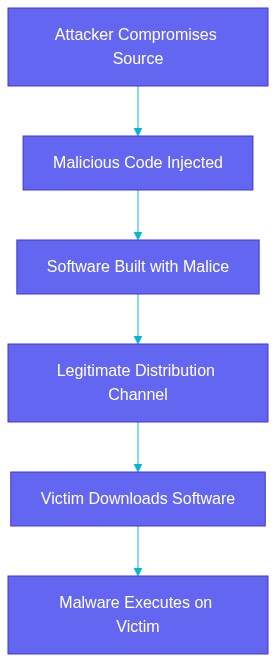
Software supply chain attacks represent a sophisticated threat where adversaries compromise software at any point before it reaches the end-user. This method allows attackers to inject malicious code into legitimate software artifacts, leveraging trusted channels to distribute malware widely. The objective is to infect as many victims as possible by subverting the integrity of software components or distribution mechanisms.
What Defines a Software Supply Chain Attack?
A software supply chain attack occurs when threat actors inject malicious code into software packages or applications. This can involve a vendor pushing an automatic update containing malware or compromising a dependency used within a larger software project. The attack exploits the inherent trust in the software development and distribution ecosystem.
The Scope of Compromise
Threat actors have demonstrated an alarming ability to compromise various elements within the software supply chain. This includes targeting software packages, continuous integration/continuous delivery (CI/CD) pipelines, developer tools, and even analytics vendors. GTIG tracked compromises in 2025 and early 2026 that specifically involved code repositories, software dependencies, and developer tools, categorized under T1195.001.
Mechanisms of Software Supply Chain Attacks
Compromising software through its supply chain involves several distinct mechanisms, each targeting different stages of the software lifecycle. These methods often exploit vulnerabilities in development practices, infrastructure, or third-party components. A modern supply-chain attack might initiate with a code compromise, such as a software vulnerability in a library, then escalate via valid accounts or tokens.
Malicious Code Injection
Attackers directly inject malicious code into legitimate software artifacts. This can happen during the development phase, where compromised developer accounts or tools introduce harmful code into source repositories. The injected code then propagates through the build process, becoming part of the final software product.
Compromising Development Infrastructure
Threat actors target the infrastructure used to build and distribute software. This includes CI/CD pipelines, which automate the software release process, and developer tools. By compromising these systems, attackers can modify source code, inject backdoors, or alter build scripts to include malicious components without direct interaction with the source code itself.
Exploiting Dependencies and Libraries
Software projects frequently rely on numerous third-party libraries and dependencies. Attackers can compromise these external components, either by injecting malicious code into popular open-source libraries or by creating malicious packages that mimic legitimate ones. When developers incorporate these compromised dependencies, the malicious code becomes part of their application.

Photo by Tima Miroshnichenko on Pexels
Common Attack Vectors and Targets
The diverse nature of the software supply chain presents multiple entry points for attackers. Identifying these common vectors is essential for understanding how compromises occur and for developing effective defenses. Attacks in 2026 have shown a focus on specific areas within the software ecosystem.
Software Packages and Repositories
Public and private software repositories, such as npm, PyPI, or Maven Central, are prime targets. Attackers can upload malicious packages, compromise maintainer accounts, or exploit vulnerabilities in the repository infrastructure. This allows them to distribute tainted software directly to developers who pull these packages into their projects.
CI/CD Pipelines and Developer Tools
CI/CD pipelines automate the build, test, and deployment stages of software. Compromising these pipelines allows attackers to inject malicious code into compiled binaries or deployment artifacts. Developer tools, including IDEs or version control systems, also serve as potential vectors if compromised, enabling the insertion of backdoors or data exfiltration.
Vendor Updates and Distribution Channels
Many organizations rely on commercial software vendors for critical applications. Attackers can compromise a vendor’s update mechanism or distribution channels to push malicious updates to their customers. This method leverages the inherent trust users place in official software updates, making detection challenging.
Mitigation Strategies for Software Supply Chain Security
Preventing software supply chain attacks requires a multi-faceted approach, implementing controls across the entire software development lifecycle. Effective mitigation involves proactive measures at each stage, from initial dependency selection to runtime monitoring.
Pre-Build Dependency Vetting
Organizations must rigorously vet all third-party dependencies before integration. This involves scanning for known vulnerabilities, analyzing package origins, and verifying the integrity of downloaded components. Establishing a clear policy for dependency approval reduces the risk of introducing compromised libraries.
Securing the Build Process
The build environment itself must be hardened against compromise. This includes securing CI/CD pipelines, implementing strict access controls for build servers, and ensuring the integrity of build scripts. Immutable build environments and reproducible builds help detect unauthorized modifications.
Post-Build Artifact Verification and Runtime Monitoring
After software is built, its artifacts must be verified for integrity and authenticity using digital signatures and checksums. Continuous monitoring of deployed applications at runtime can detect anomalous behavior indicative of a supply chain compromise. This final layer of defense helps identify threats that bypass earlier controls.

Photo by cottonbro studio on Pexels
Real World Example
Consider a scenario where a popular open-source library, widely used across numerous applications, becomes compromised. An attacker gains access to a maintainer’s account or exploits a vulnerability in the library’s build system. They then inject a subtle backdoor into a new version of the library. When developers update their projects to this seemingly legitimate new version, the malicious code is incorporated into their applications. This backdoor could allow remote access, data exfiltration, or further system compromise once the applications are deployed in production environments. The widespread adoption of the library amplifies the attack’s reach, affecting potentially thousands of downstream users without their immediate knowledge.
| Attack Vector | Primary Target | Compromise Mechanism | Detection Challenge |
|---|---|---|---|
| Malicious Package Injection | Public/Private Repositories | Upload of tainted packages, account compromise | Volume of packages, trust in repository |
| CI/CD Pipeline Compromise | Build/Deployment Infrastructure | Altering build scripts, injecting into binaries | Complexity of pipelines, automation |
| Developer Tool Exploitation | Developer Workstations/Tools | Malware in IDEs, compromised plugins | Endpoint security, developer trust |
| Dependency Tampering | Third-party Libraries | Injecting code into upstream projects | Nested dependencies, transitive trust |
Key Takeaways
- Software supply chain attacks inject malicious code into legitimate software artifacts, leveraging trusted distribution channels.
- Attackers target various components, including software packages, CI/CD pipelines, developer tools, and code repositories.
- Compromise mechanisms range from direct code injection to exploiting vulnerabilities in third-party dependencies or development infrastructure.
- Mitigation requires a multi-stage approach: vetting dependencies, securing the build process, and verifying artifacts.
- Continuous runtime monitoring is essential for detecting post-deployment anomalies indicative of a supply chain compromise.
A surprising aspect of supply chain attacks is their ability to bypass traditional perimeter defenses by leveraging the inherent trust in legitimate software updates and components. This makes them particularly insidious, as the malicious code often arrives signed and from a trusted source.
Hypothetical Malicious Package Downloads (2025)
Package A: 150000downloads | Package B: 80000downloads | Package C: 30000downloads — Source: Hypothetical Data (2025)
Frequently Asked Questions
What is the primary goal of a software supply chain attack?
The primary goal is to inject malicious code into legitimate software components or applications. This allows attackers to infect a broad base of victims by leveraging trusted software distribution channels and the inherent trust users place in official updates.
Which parts of the software development lifecycle are most vulnerable?
Vulnerabilities exist across the entire software development lifecycle, but key targets include code repositories, third-party dependencies, CI/CD pipelines, and developer tools. Compromising any of these stages can lead to the widespread distribution of malicious software.
How can organizations detect a supply chain attack?
Detection involves rigorous vetting of dependencies, securing build environments, verifying the integrity of software artifacts, and continuous runtime monitoring. Anomalous behavior in applications or unexpected changes in build outputs can indicate a compromise.
Are open-source components more susceptible to these attacks?
Open-source components are frequently targeted due to their widespread use and the distributed nature of their development. Attackers can inject malicious code into popular libraries, affecting numerous downstream projects that incorporate these dependencies.
SiliconeUpdate.com is a technology news platform that publishes updates and informational content related to silicon technology, software, artificial intelligence, and emerging technologies.
All articles published on this platform are attributed to SiliconeUpdate.com instead of individual authors. Content is presented in a neutral, informational format without personal opinions.
—
Content Publishing
SiliconeUpdate.com publishes news and updates based on publicly available information, official announcements, and industry developments. The focus is on clarity, relevance, and timely reporting.
—
Editorial Control
All editorial decisions, updates, and content management are handled at the platform level. No individual human or AI identity is presented as the author of articles.
—
Contact
For editorial communication or general queries, contact:
Email: neemasharma@gmail.com