The rapid advancement of artificial intelligence necessitates architectures capable of handling increasingly complex and diverse tasks without prohibitive computational costs. Mixture-of-Experts (MoE) architecture addresses this challenge by enabling AI models to scale effectively while maintaining efficiency. MoE is an AI model architecture that utilizes multiple, specialized submodels, known as “experts,” to process tasks more efficiently than a single, monolithic model. This approach is becoming essential for developing next-generation AI systems that are both powerful and practical, particularly in 2026.
What is Mixture-of-Experts?
Mixture-of-Experts (MoE) is a model architecture technique designed to enhance AI inference speed by dynamically routing tasks to the most capable part of the model. Instead of a single, large network processing all inputs, an MoE model comprises a set of specialized sub-networks, or “experts,” embedded within a larger framework. A lightweight gating mechanism determines which expert or combination of experts should process a given input token or task.
This selective activation means that for any specific input, only a fraction of the model’s total parameters are engaged. This contrasts sharply with traditional dense models, where every parameter is typically involved in every computation. The result is a significant reduction in computation costs and an improvement in scalability, making MoE models a cornerstone for advanced AI development in 2026.
The Challenge of Monolithic AI Models
Traditional large AI models, often referred to as dense models, activate all their parameters for every input. While these models can achieve high performance, their computational demands grow proportionally with their size. As AI models expand to billions or even trillions of parameters to capture more intricate patterns and knowledge, the inference and training costs become astronomical.
This full activation paradigm leads to inefficiencies, especially when different parts of the model might specialize in distinct types of data or tasks. A single, general-purpose model struggles to be optimally efficient across a wide spectrum of inputs, leading to wasted computation on irrelevant parameters for specific tasks. The need for more efficient architectures that can handle diverse workloads without constant full activation has become paramount.
How Mixture-of-Experts Architecture Works
The operational principle of an MoE model revolves around its ability to selectively engage specialized components. This mechanism allows for a model with a vast number of parameters to operate with a significantly smaller active parameter count during inference, leading to efficiency gains.
Gating Mechanism and Expert Routing
At the core of an MoE model is the gating network, also known as a router. This component takes the input and learns to determine which expert or experts are most suitable for processing it. Typically, the gating network outputs a probability distribution over the available experts, and the top-k experts (e.g., top 1 or 2) are selected to process the input.
For instance, if an input query is about programming, the gating network might route it to an expert specialized in code generation or debugging. If the query is about creative writing, a different expert might be activated. This dynamic routing ensures that computational resources are directed precisely where they are most effective, minimizing redundant calculations.
Specialized Experts and Conditional Computation
Each “expert” in an MoE architecture is a sub-network, often a feed-forward layer or a small transformer block, trained to excel at specific types of data or tasks. These experts are not isolated; they are part of a larger model and contribute to its overall capabilities. The training process for MoE models involves learning both the parameters of the individual experts and the parameters of the gating network.
The concept of conditional computation is central here: computation is performed only when necessary. This allows MoE models to achieve better scalability by activating only the required experts for each token, which directly reduces computation costs. This efficiency is a key reason MoE is reshaping AI in 2026, making powerful models more practical.
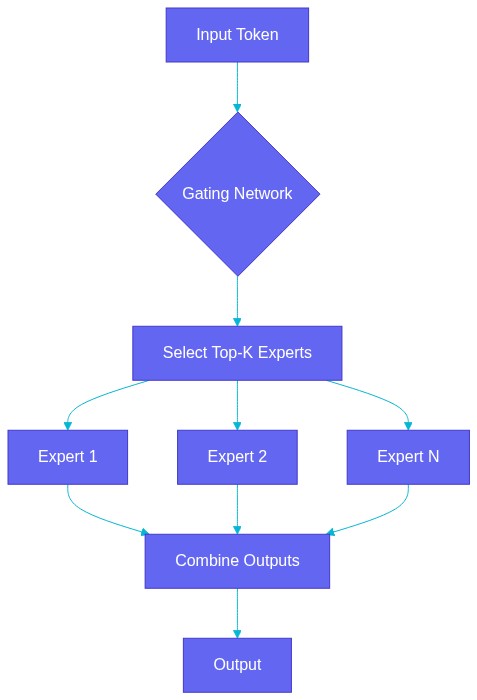

Photo by Google DeepMind on Pexels
Advantages of Mixture-of-Experts
The adoption of MoE architecture is driven by several compelling advantages that address the limitations of traditional dense models, particularly concerning scalability and efficiency.
Enhanced Scalability and Efficiency
MoE models offer superior scalability compared to dense models. By activating only a subset of parameters for each input, they can achieve a much larger total parameter count without a proportional increase in computational cost during inference. This allows for the creation of models with a vast capacity for knowledge and diverse capabilities, while keeping inference latency and energy consumption manageable.
The ability to scale model size without linearly increasing compute requirements is critical for developing next-generation AI systems. This efficiency translates into faster inference times and lower operational costs, making advanced AI more accessible and deployable in real-world applications.
Improved Performance and Generalization
Beyond efficiency, MoE models often exhibit improved performance and generalization capabilities. The specialization of experts allows the model to learn more nuanced and specific representations for different data modalities or task types. This can lead to higher accuracy and better handling of diverse inputs that a single, generalist model might struggle with.
The architecture inherently supports a form of modularity, where different experts can learn distinct patterns. This modularity can contribute to better generalization by preventing a single set of parameters from being over-optimized for one type of task at the expense of others. This makes MoE models powerful for handling complex, multi-faceted problems.
A surprising insight is that MoE models can achieve higher quality results with fewer active parameters than dense models of comparable active parameter count, due to the increased total parameter count and specialized learning.
Comparative Analysis: MoE vs. Dense Models
Understanding the fundamental differences between Mixture-of-Experts and traditional dense models highlights why MoE is becoming the preferred architecture for advanced AI systems.
Architectural and Computational Differences
Dense models process every input through all their layers and parameters, leading to high computational costs as model size increases. In contrast, MoE models employ conditional computation, where only a fraction of their total parameters are activated for any given input. This fundamental difference in activation strategy is key to MoE’s efficiency.
The total parameter count in an MoE model can be significantly larger than a dense model while maintaining a similar or even lower active parameter count during inference. This allows MoE models to possess a greater capacity for learning without incurring the prohibitive computational burden of a fully dense model of equivalent total size.
Scalability and Practical Implications
The scalability of MoE models is a primary driver for their adoption. As AI models grow to handle more complex tasks and larger datasets, dense architectures quickly become computationally unfeasible for both training and inference. MoE provides a pathway to build models with trillions of parameters that can still be trained and deployed efficiently.
This practical advantage means that organizations can develop and utilize more powerful AI systems without requiring exponentially increasing hardware resources. For example, models like Deepseek have demonstrated the practical benefits of MoE in real-world applications, showcasing its ability to deliver high performance at manageable costs.
| Feature | Mixture-of-Experts (MoE) | Dense Model |
|---|---|---|
| Parameter Activation | Subset of parameters (experts) activated per input | All parameters activated per input |
| Computational Cost (Inference) | Lower, scales with active parameters | Higher, scales with total parameters |
| Total Parameter Count | Can be very high (trillions) | Limited by computational feasibility |
| Scalability | High, efficient scaling to large models | Moderate, scaling leads to high costs |
| Specialization | High, experts specialize in specific tasks/data | Lower, generalist approach across all tasks |
| Energy Consumption | Lower per inference | Higher per inference |

Photo by Google DeepMind on Pexels
Real World Example
Consider a large language model designed to serve a wide array of user queries, from complex scientific explanations to creative storytelling and coding assistance. A traditional dense model would activate its entire network for every single query, regardless of its nature. This means the same parameters responsible for understanding physics might also be engaged when generating a poem, leading to inefficient resource utilization.
With an MoE architecture, this model would have specialized experts. When a user asks for a Python code snippet, the gating network routes the query to a “coding expert” and perhaps a “technical documentation expert.” If the next query is to write a short story, the gating network activates a “creative writing expert” and a “narrative structure expert.” Only the relevant experts are engaged, significantly reducing the computational load for each individual query while leveraging the full capacity of the model across diverse tasks. This allows the model to be both powerful and responsive, handling a broad spectrum of requests efficiently.
Estimated MoE Model Adoption Rate (2025)
Large Language Models: 65% of New Deployments | Multimodal Models: 20% of New Deployments | Specialized AI Tasks: 15% of New Deployments — Source: Industry Estimates 2025
Key Takeaways
- Mixture-of-Experts (MoE) architecture uses specialized submodels (“experts”) and a gating mechanism to process tasks efficiently.
- MoE addresses the computational and scalability limitations of traditional dense AI models by activating only a subset of parameters per input.
- The gating network dynamically routes inputs to the most relevant experts, enabling conditional computation and reducing inference costs.
- MoE models achieve superior scalability, allowing for models with trillions of parameters to be developed and deployed practically.
- This architecture leads to improved performance and generalization by enabling experts to specialize in distinct types of data or tasks.
Frequently Asked Questions
What problem does MoE primarily solve?
MoE primarily solves the problem of scaling AI models to very large parameter counts without incurring prohibitively high computational costs for inference and training. It enables efficiency by activating only a fraction of the model’s parameters for any given input.
Is MoE only for large language models?
While MoE has gained significant traction in large language models (LLMs), its principles are applicable to other AI domains. It can be beneficial for any AI system that needs to handle diverse inputs or tasks, such as multimodal models or specialized AI tasks, where different components can specialize.
Does MoE make models faster to train?
MoE can make models faster to train in terms of wall-clock time for a given model capacity, as it allows for a larger total parameter count with a similar active parameter count compared to dense models. However, the training process itself involves learning both expert and gating network parameters, which adds complexity.
What are the main challenges with MoE models?
Challenges with MoE models include load balancing across experts to prevent some experts from becoming overloaded or underutilized, and the increased complexity in implementation and optimization compared to dense models. Effective gating network design and training stability are also important considerations.

SiliconeUpdate.com is a technology news platform that publishes updates and informational content related to silicon technology, software, artificial intelligence, and emerging technologies.
All articles published on this platform are attributed to SiliconeUpdate.com instead of individual authors. Content is presented in a neutral, informational format without personal opinions.
—
Content Publishing
SiliconeUpdate.com publishes news and updates based on publicly available information, official announcements, and industry developments. The focus is on clarity, relevance, and timely reporting.
—
Editorial Control
All editorial decisions, updates, and content management are handled at the platform level. No individual human or AI identity is presented as the author of articles.
—
Contact
For editorial communication or general queries, contact:
Email: neemasharma@gmail.com