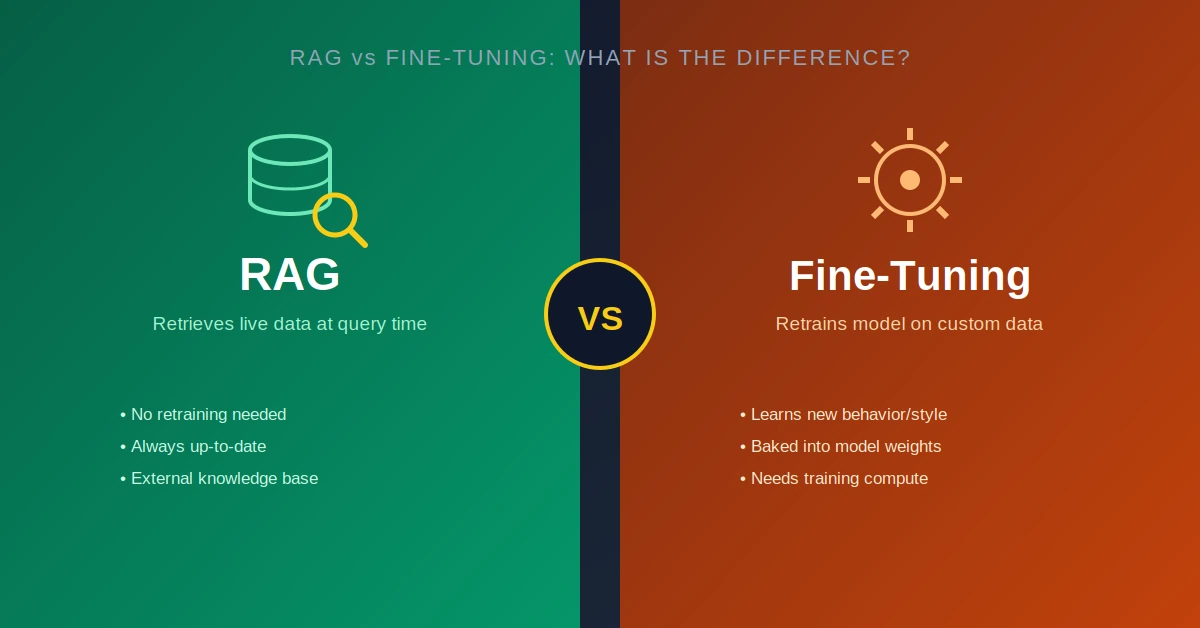
When building an AI application, one question comes up very quickly:
Should you use Retrieval-Augmented Generation (RAG), or should you fine-tune the AI model?
Both approaches can customize an AI system, but they solve different problems.
RAG gives a language model access to external information at the time it generates an answer. Fine-tuning changes the model itself by training it on a specific dataset.
That difference sounds simple, but it has major consequences for how an AI application is designed.
For example, suppose you are building an AI assistant for a company.
The company has thousands of internal documents, product manuals, policies, and support articles. You want the assistant to answer questions using that information.
You could fine-tune a model, but that does not necessarily mean fine-tuning is the right solution.
A RAG system could instead search the company’s documents for relevant information and provide that information to the model before generating the answer.
This is why understanding RAG vs fine-tuning is important before choosing an AI architecture.
What Is RAG?
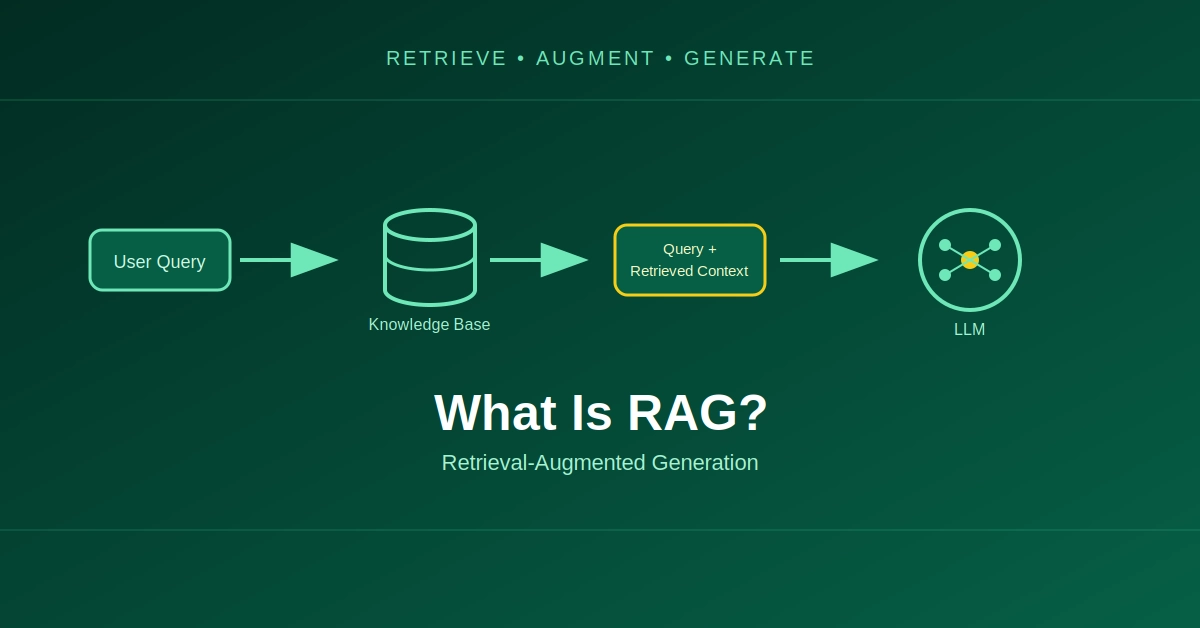
RAG stands for Retrieval-Augmented Generation.
The basic idea is straightforward:
Instead of expecting the model to know everything internally, retrieve relevant information from an external knowledge source and give it to the model as context.
NIST defines RAG as a system where a generative AI model is paired with a separate information-retrieval system or knowledge base. The retrieved information is then provided to the model as context.
A simplified RAG architecture looks like this:
User Question
      |
      v
Query Processing
      |
      v
Search / Retrieval System
      |
      v
Relevant Documents
      |
      v
Context + User Question
      |
      v
LLM
      |
      v
Generated Answer
Imagine a user asks:
What is our refund policy for enterprise customers?
The language model itself may not know the company’s internal refund policy.
A RAG system can search the company’s documentation, find the relevant policy, and send something like this to the model:
Company Policy:

Enterprise customers can request a refund within
30 days of purchase under the following conditions...
The model then uses that retrieved information to construct the response.
The original RAG research introduced the concept of combining a language model’s internal parametric memory with an external non-parametric memory.
What Is Fine-Tuning?
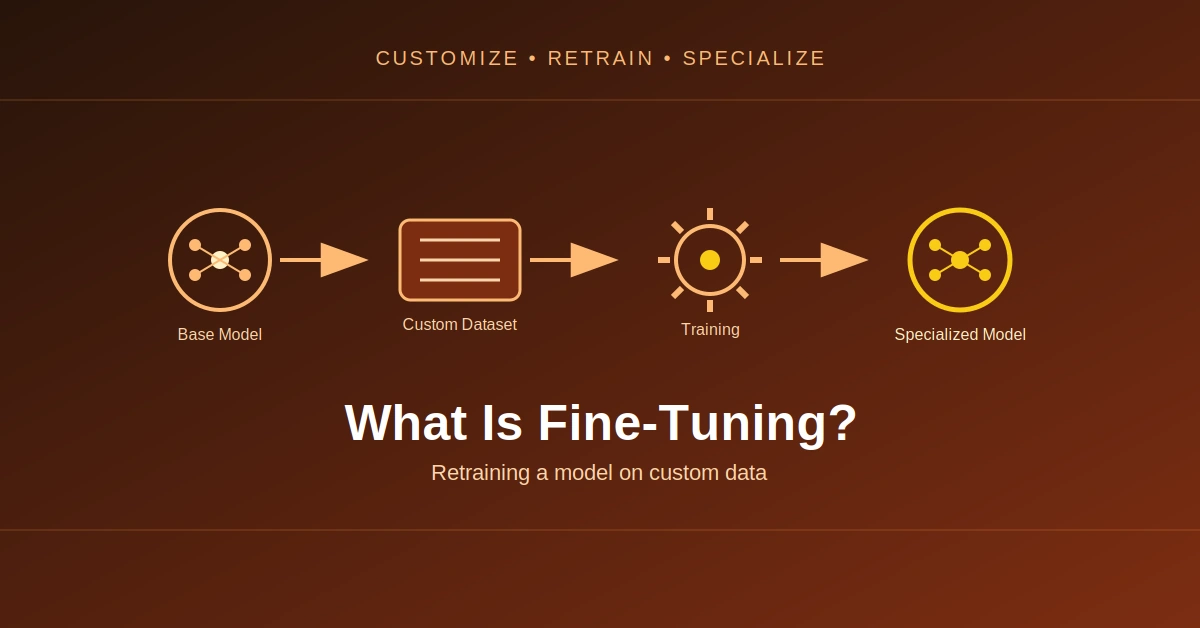
Fine-tuning works differently.
Instead of retrieving information during a user’s request, you train an existing model further using your own examples.
The training data can contain examples showing the desired behavior, format, style, or task.
A simplified process looks like this:
Base Model
    |
    v
Training Dataset
    |
    v
Fine-Tuning
    |
    v
Customized Model
    |
    v
User Request
    |
    v
Response
For example, imagine you want an AI model to consistently generate customer-support responses in a particular format.
Your dataset might contain:
User:
My order arrived damaged.

Assistant:
I'm sorry your order arrived damaged.
Please provide your order number so we can
help arrange a replacement.
You provide many examples like this during training.
The goal is not simply to give the model a document to read. The goal is to change how the model behaves.
Modern fine-tuning systems generally start with a base model and train it further using a dataset prepared for that purpose. For example, OpenAI’s fine-tuning API describes creating a new model from a supplied training dataset.
RAG vs Fine-Tuning: The Core Difference
The easiest way to understand the difference is:
RAG changes what the model can access.
Fine-tuning changes how the model behaves.
Consider this example.
You have an AI assistant for a software company.
The company has:
- 10,000 documentation pages
- product manuals
- internal policies
- API documentation
- support tickets
- frequently changing pricing information
If you use RAG, the documents remain outside the model.
When the user asks a question, the system searches those documents and provides the relevant information to the model.
With fine-tuning, the training process uses examples to modify the model’s behavior.
That means these approaches are not really competitors in every situation.
They can also be used together.
RAG Is Better Suited to Frequently Changing Information
One of the biggest advantages of RAG is that the knowledge base can be updated without retraining the underlying language model.
Suppose your company changes its pricing every month.
With a RAG architecture:
Pricing Database
      |
      v
Retrieval System
      |
      v
LLM
You can update the pricing information in the database.
The model can retrieve the new information during the next request.
NIST specifically notes that RAG allows the internal knowledge available to a generative AI model to be modified without retraining the model.
This makes RAG particularly useful for:
- company documentation
- product documentation
- knowledge bases
- support systems
- internal databases
- frequently changing policies
- technical documentation
- current information
Fine-Tuning Is About Behavior
Fine-tuning becomes more interesting when the problem is not simply “the model doesn’t know this information.”
Instead, the problem might be:
“The model knows enough, but I want it to perform this task in a particular way.”
For example, imagine an application that converts customer messages into structured JSON.
You want every response to follow a specific format:
{
  "category": "billing",
  "priority": "high",
  "summary": "Customer was charged twice"
}
You can provide many examples of inputs and desired outputs during fine-tuning.
The objective is to make the model more consistent with that task.
Fine-tuning can therefore be useful for things such as:
- consistent output formats
- specialized task behavior
- particular writing styles
- classification
- structured responses
- domain-specific behavior
- following specialized patterns
This is fundamentally different from giving the model access to a document database.
Think of RAG as Giving the AI a Library
A useful analogy is a human employee.
Imagine hiring a new employee who is already highly capable but doesn’t know your company’s internal information.
You could give that employee a library.
Whenever they receive a question, they search the library and use the relevant documents.
That is similar to RAG.
AI Model = Employee
Knowledge Base = Company Library
Retriever = Librarian
The employee doesn’t have to memorize every document.
They just need a reliable way to find the right information.
Fine-Tuning Is More Like Training the Employee
Now imagine the employee already knows how to perform a particular job, but you want them to follow your company’s process.
You show them hundreds or thousands of examples.
For example:
Customer request
      ↓
Company-specific process
      ↓
Expected response
After training, they become more consistent with that process.
That’s closer to fine-tuning.
So:
RAG:
"Here is the information you need."

Fine-tuning:
"Here is how we want you to behave."
This is not a perfect analogy, but it captures the architectural difference.
Does RAG Add Knowledge to the Model?
Not exactly.
This is an important distinction.
Suppose your RAG system contains:
Document A
Document B
Document C
Document D
The language model isn’t necessarily learning those documents permanently.
Instead, relevant portions are retrieved and placed into the model’s context during a request.
For example:
User Question
     |
     v
Retrieve Documents
     |
     v
Relevant Context
     |
     +------------------+
     |                  |
     v                  v
Question + Context ---> LLM
                           |
                           v
                        Answer
Once the request is finished, that retrieved information isn’t automatically turned into permanent model knowledge.
This is one of the fundamental differences between RAG and training.
Does Fine-Tuning Store Your Documents?
Fine-tuning also shouldn’t be thought of as simply uploading a knowledge base into the model.
This is a common misunderstanding.
Suppose you have a 5,000-page company handbook.
Simply fine-tuning the model on the handbook is not necessarily the best way to make the model answer questions about exact passages from that handbook.
Why?
Because fine-tuning is primarily about learning patterns from training examples.
If you need the model to reliably retrieve a particular sentence, policy, number, or document section, an external retrieval system may be much more appropriate.
This is why RAG and fine-tuning often solve different problems.
RAG Architecture in More Detail
A production RAG system can be much more complicated than simply “search a PDF.”
A typical pipeline might look like this:
Documents
   |
   v
Document Processing
   |
   v
Chunking
   |
   v
Embeddings
   |
   v
Vector Database
   |
   v
User Query
   |
   v
Query Embedding
   |
   v
Similarity Search
   |
   v
Relevant Chunks
   |
   v
Reranking
   |
   v
LLM
   |
   v
Answer
Let’s break this down.
1. Document ingestion
The system first collects information.
This could include:
- PDFs
- HTML pages
- Word documents
- databases
- support tickets
- product documentation
- internal wiki pages
2. Chunking
Large documents are usually divided into smaller pieces.
For example:
100-page document
        |
        v
     Chunk 1
     Chunk 2
     Chunk 3
     ...
     Chunk 500
The size and boundaries of these chunks matter.
Bad chunking can cause the retrieval system to return incomplete or irrelevant information.
3. Embeddings
The chunks can be converted into numerical representations called embeddings.
These representations allow the retrieval system to compare the semantic relationship between a question and stored content.
For example:
"What is your refund policy?"
might retrieve a document containing:
"Customers may request reimbursement within 30 days..."
even though the words aren’t identical.
4. Retrieval
The system searches the knowledge base and selects potentially relevant content.
5. Reranking
More sophisticated systems can use a second stage to improve which retrieved passages are actually most relevant.
6. Generation
Finally, the selected information is passed to the language model.
The model uses the retrieved context to generate the answer.
Modern RAG research increasingly treats retrieval as a multi-stage problem involving retrieval, ranking, query processing, and generation rather than a simple vector search operation.
Fine-Tuning Architecture
Fine-tuning has a different pipeline.
Training Examples
       |
       v
Dataset Preparation
       |
       v
Base Model
       |
       v
Fine-Tuning
       |
       v
Customized Model
       |
       v
Inference
The quality of the training dataset becomes extremely important.
Suppose you provide poor examples:
Input → Bad response
Input → Inconsistent response
Input → Wrong format
The resulting model may learn undesirable patterns.
A good fine-tuning dataset should contain examples that clearly represent the behavior you want.
This means fine-tuning isn’t simply a matter of throwing as much data as possible at a model.
Training data quality matters.
RAG vs Fine-Tuning: A Practical Comparison
| Factor | RAG | Fine-Tuning |
|---|---|---|
| Main purpose | Provide external knowledge | Change model behavior |
| Knowledge updates | Easy to update externally | Requires additional training |
| Uses external database | Usually | Not required |
| Changes model parameters | No | Yes |
| Good for private documents | Yes | Sometimes |
| Good for changing information | Yes | Less suitable |
| Good for output style | Limited | Stronger fit |
| Good for specialized behavior | Limited | Stronger fit |
| Can provide retrieved sources | Yes | Not inherently |
| Requires retrieval infrastructure | Yes | No |
| Requires training process | No | Yes |
The important point is that neither column automatically wins.
The correct architecture depends on what problem you’re trying to solve.
RAG Example: Customer Support Bot
Imagine an e-commerce company.
It has:
10,000 products
5,000 support articles
Refund policies
Shipping policies
Warranty documents
A customer asks:
“Can I return this laptop after 20 days?”
The RAG system could retrieve:
Laptop Return Policy
--------------------
Laptops can be returned within 30 days
provided the product meets the return conditions.
The model then generates an answer using that context.
If the policy changes from 30 days to 15 days, the company can update the knowledge base.
There is no need to retrain the language model simply because the policy changed.
Fine-Tuning Example: Consistent Support Responses
Now consider a different problem.
The company wants every support response to follow a specific format:
1. Acknowledge the problem
2. Explain the solution
3. Give the next action
4. End with a short confirmation
The problem isn’t primarily missing knowledge.
The company wants consistent behavior.
Fine-tuning could be useful here.
The model can be trained using many examples representing the desired response style and structure.
Can You Use RAG and Fine-Tuning Together?
Yes.
In many real-world systems, they can complement each other.
For example:
                 Company Knowledge
                        |
                        v
                  RAG Retrieval
                        |
                        v
User Question ---> Context
                        |
                        v
                Fine-Tuned Model
                        |
                        v
                     Answer
The RAG system provides the relevant information.
The fine-tuned model provides specialized behavior.
For example, an enterprise support assistant could:
- retrieve the latest company policy
- follow a specific response structure
- classify the customer’s issue
- produce structured output
- use company-specific terminology
In such a system, RAG and fine-tuning aren’t competing technologies.
They are different components solving different problems.
RAG Does Not Automatically Eliminate Hallucinations
This is another important point.
RAG can improve grounding, but it doesn’t magically make an AI system perfectly accurate.
There are several ways a RAG system can fail.
For example:
User Question
      |
      v
Poor Retrieval
      |
      v
Wrong Documents
      |
      v
LLM
      |
      v
Wrong Answer
Or:
User Question
      |
      v
Correct Documents
      |
      v
LLM misunderstands them
      |
      v
Wrong Answer
The quality of the retrieval system therefore matters.
NIST research and RAG evaluation work emphasize retrieval quality, relevance, groundedness, and the challenge of evaluating complete RAG pipelines.
A RAG system can only be as useful as the information it retrieves and the way the model uses that information.
Fine-Tuning Does Not Automatically Make a Model More Factual
Fine-tuning has a different limitation.
If you fine-tune a model on your company’s information, you should not assume that the model has become a perfect database of that information.
The model is still generating responses.
Fine-tuning can improve behavior for a particular task, but it isn’t a replacement for a reliable information retrieval layer when the application needs access to changing or precise external knowledge.
This distinction becomes especially important in enterprise AI systems.
What About Cost?
Cost depends heavily on the implementation.
A RAG system introduces infrastructure such as:
- document processing
- embeddings
- vector storage
- retrieval
- reranking
- additional model calls
But updating the knowledge base can be relatively straightforward.
Fine-tuning introduces:
- dataset preparation
- training jobs
- evaluation
- model management
- retraining when the desired behavior or training data changes
The exact economics depend on the model provider, dataset size, traffic, storage, retrieval architecture, and how often the system needs to be updated.
So saying “RAG is always cheaper” or “fine-tuning is always cheaper” would be misleading.
What About Latency?
RAG can introduce additional steps during inference.
Instead of:
User → LLM → Answer
you may have:
User
 ↓
Query processing
 ↓
Retrieval
 ↓
Reranking
 ↓
LLM
 ↓
Answer
That additional work can affect latency.
Fine-tuning can simplify the inference path because the customized model doesn’t necessarily need to retrieve external documents.
However, real-world latency depends on the complete architecture.
A poorly optimized RAG pipeline can be slow, while a well-designed retrieval system can be quite efficient.
What Should You Use for Private Company Data?
This depends on what you want the AI to do with the data.
If your goal is:
“I want the AI to answer questions using our current documents.”
RAG is usually the architecture to investigate first.
If your goal is:
“I want the AI to consistently perform a particular task according to our examples.”
Fine-tuning may be more relevant.
And if you need both:
“Use our current company information and follow our specialized response behavior.”
A combination of RAG and fine-tuning may make sense.
RAG vs Fine-Tuning for an AI SaaS
This distinction becomes particularly important when building an AI SaaS product.
Imagine you’re building an AI writing platform.
Your customers want to upload their own documentation and generate content from it.
A possible architecture is:
Customer Documents
       |
       v
Document Processing
       |
       v
Embeddings / Index
       |
       v
Customer Knowledge Base
       |
       v
RAG
       |
       v
LLM
       |
       v
Generated Content
You don’t need to create a new trained model for every customer.
Instead, each customer can have a separate knowledge base.
For example:
Customer A
   └── Knowledge Base A

Customer B
   └── Knowledge Base B

Customer C
   └── Knowledge Base C
The same underlying model can be used while the retrieved context changes for each customer.
This can make RAG a very practical architecture for multi-tenant AI applications.
When Fine-Tuning Makes More Sense
Fine-tuning becomes more attractive when you have a stable task and a strong dataset of examples.
For example:
Specialized classification
Customer message
       ↓
Fine-tuned model
       ↓
Billing / Technical / Refund / Sales
Structured output
Input
 ↓
Fine-tuned model
 ↓
Predictable JSON structure
Specialized writing behavior
Input
 ↓
Fine-tuned model
 ↓
Specific style / format
Domain-specific task behavior
If the model needs to repeatedly perform a particular task according to examples, fine-tuning can be useful.
When RAG Makes More Sense
RAG is particularly useful when your application needs access to information that exists outside the base model.
Examples include:
- internal company documentation
- product catalogs
- legal or policy documents
- technical documentation
- support knowledge bases
- research databases
- private files
- frequently changing information
The key characteristic is that the information itself matters.
A Simple Decision Framework
Before choosing an architecture, ask one question:
“Is my problem knowledge or behavior?”
If the problem is:
“The AI doesn’t have access to this information.”
Consider RAG.
If the problem is:
“The AI doesn’t behave the way I want.”
Consider fine-tuning.
If the problem is:
“The AI needs current information and specialized behavior.”
Consider RAG + fine-tuning.
A simple way to remember it:
Need external / changing knowledge?
              |
             YES
              ↓
             RAG


Need specialized behavior?
              |
             YES
              ↓
        Fine-Tuning


Need both?
              |
             YES
              ↓
       RAG + Fine-Tuning
RAG vs Fine-Tuning Is Not Really an Either-Or Choice
One of the biggest mistakes when designing AI applications is treating RAG and fine-tuning as two competing versions of the same technology.
They are not.
RAG is primarily an information access architecture.
Fine-tuning is primarily a model customization technique.
RAG allows a model to work with external information without changing the underlying model’s parameters.
Fine-tuning changes the model through additional training.
That distinction affects everything from system architecture and data management to updating information and evaluating results.
For a company knowledge assistant, RAG can provide a path to current external information.
For a specialized task where behavior needs to become more consistent, fine-tuning may be appropriate.
And for more advanced AI products, the two approaches can be combined.
The important part isn’t choosing the technology that sounds more advanced.
It’s identifying what the AI system actually needs to change.
If it needs more information, retrieval may be the answer.
If it needs different behavior, training may be the answer.
And if it needs both, there is no reason to limit the architecture to only one approach.
SiliconeUpdate.com is a technology news platform that publishes updates and informational content related to silicon technology, software, artificial intelligence, and emerging technologies.
All articles published on this platform are attributed to SiliconeUpdate.com instead of individual authors. Content is presented in a neutral, informational format without personal opinions.
—
Content Publishing
SiliconeUpdate.com publishes news and updates based on publicly available information, official announcements, and industry developments. The focus is on clarity, relevance, and timely reporting.
—
Editorial Control
All editorial decisions, updates, and content management are handled at the platform level. No individual human or AI identity is presented as the author of articles.
—
Contact
For editorial communication or general queries, contact:
Email: neemasharma@gmail.com