A phone can now recognise a face, suggest a faster route to work, translate a conversation and filter unwanted messages. Most people use these features without thinking much about the technology behind them. Artificial intelligence is already part of ordinary routines, often working quietly in the background.
Its value becomes clearer when it solves a problem that would otherwise take time or effort. Someone who struggles to understand a language can use an AI translation tool. A student can ask for another explanation of a difficult topic. A person with limited mobility may use voice commands to control devices around the house.
These are practical changes, not science fiction. AI is making certain tasks easier, although it does not always get things right.
How Artificial Intelligence Is Changing Everyday Life
Artificial intelligence allows computer systems to perform tasks that normally require some form of human intelligence. These include recognising patterns, understanding language, processing images, making predictions and generating content.
People often associate AI with chatbots, but its use goes much further. Navigation apps use prediction models to estimate traffic. Email services identify suspicious messages. Streaming platforms suggest content based on viewing habits.
Many of these systems have been around for years. Generative AI has brought more attention to the field because people can now interact with powerful models using ordinary language.
Instead of learning complicated software or searching through dozens of websites, users can describe what they need and receive a response. That does not make every answer reliable, but it has changed how people approach certain everyday tasks.
1. AI Makes Learning More Accessible
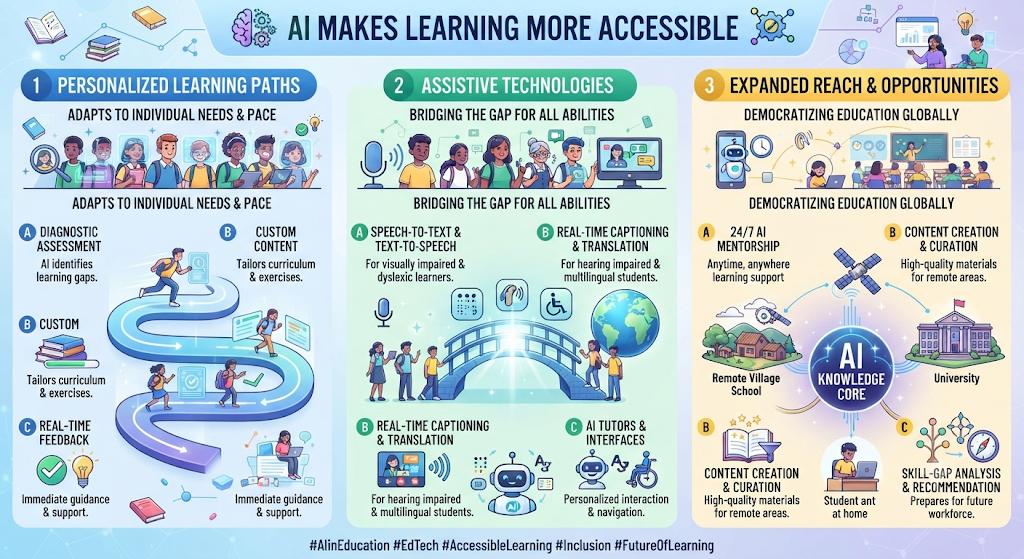
A student reading a difficult chapter may understand some parts but get stuck on a particular concept. In a traditional classroom, the student might have to wait until the next lesson to ask for help.
An AI assistant can explain the same concept in simpler language, provide another example or break a complicated process into smaller steps.
This is useful when learning subjects such as mathematics, programming, science and languages. A beginner learning JavaScript, for example, can ask why a particular function returns an unexpected result and request an explanation of the code.
AI can also help people practise. Language learners can use conversational tools to improve vocabulary, while students can generate practice questions from their study material.
There is a limit, though. An AI-generated explanation can contain mistakes or leave out important details. Students should use it to support their learning rather than treat every response as a correct answer. Understanding a concept still requires practice and independent thinking.
2. Better Access to Healthcare Information
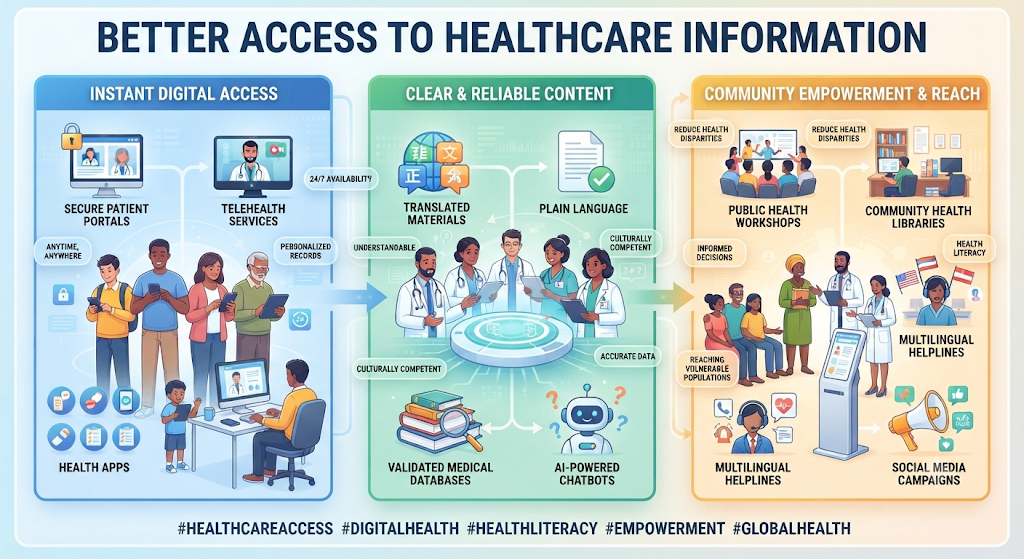
Healthcare is another area where AI can make a practical difference.
Medical professionals already use AI-based systems in areas such as medical image analysis, clinical research and administrative work. These systems can help identify patterns in large amounts of information and support certain tasks that would otherwise take considerable time.
For patients, AI tools can make medical information easier to understand. Someone reading a complicated medical report may use an AI assistant to explain unfamiliar terms or prepare questions for a doctor.
Wearable devices also use algorithms to analyse activity, sleep patterns and other measurements. These features can help users notice changes in their routine.
However, there is an important distinction between understanding health information and receiving a medical diagnosis. AI cannot reliably replace a qualified healthcare professional. Medical decisions need proper examination, patient history and clinical judgment.
Used carefully, AI can help people become better informed and make more productive use of their appointments.
3. AI Helps People Manage Their Time
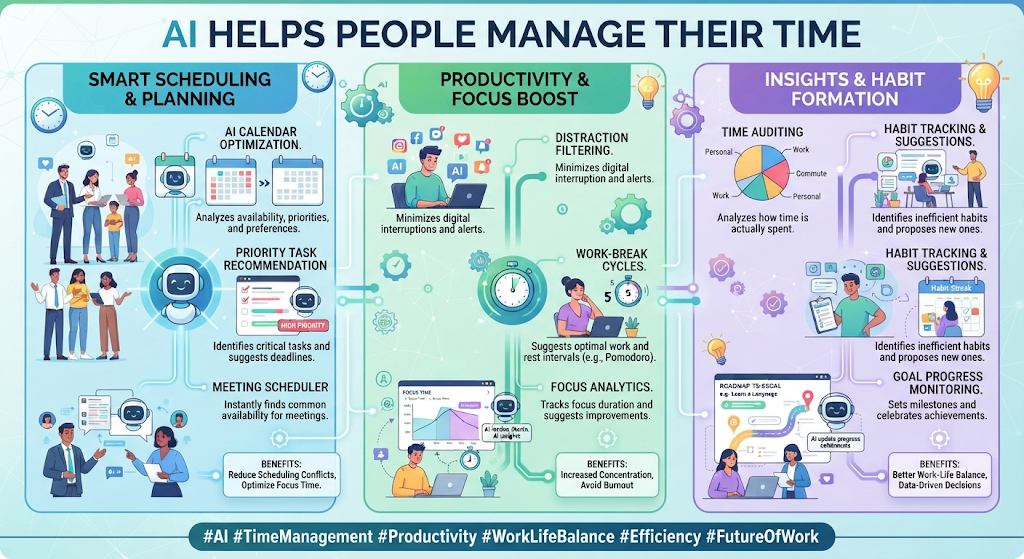
Small tasks can take up a surprising amount of time during the day. Writing routine emails, organising information, preparing meeting notes and searching through documents are common examples.
AI tools can reduce the effort involved in some of this work.
A professional can use an AI assistant to turn rough notes into a readable email. A business owner can organise product information or prepare an initial draft of a report. Someone planning a trip can compare different routes and create a rough schedule.
AI can also help summarise long documents, extract important information and organise unstructured notes.
The important part is knowing what to delegate. AI is useful for preparing a first draft or handling repetitive work, but the result still needs to be checked. Sending an inaccurate email or relying on an incorrect summary can create more work than the original task.
4. Making Homes More Convenient
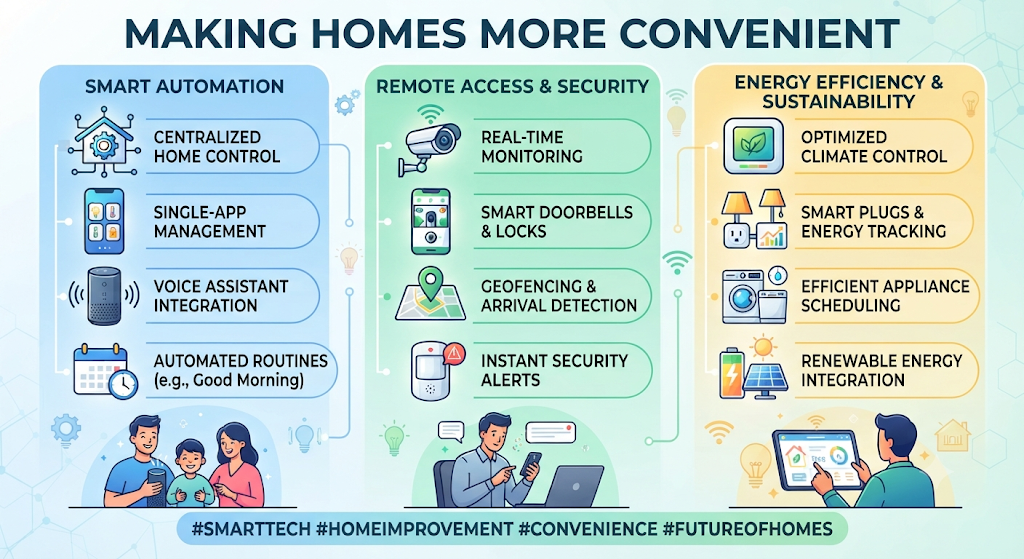
Smart home devices use AI and automation to respond to people’s habits and instructions.
A smart speaker can answer questions, set reminders and control compatible devices. Some home security systems use image recognition to distinguish between people, animals and other movement. Smart thermostats can learn temperature preferences and adjust heating or cooling automatically.
These features are particularly useful when several household tasks need to be managed together.
For example, a person can use a voice assistant to switch off lights, check the weather and set an alarm without opening separate applications.
Not every smart device needs advanced AI, however. Some products rely mainly on fixed automation rules. The distinction is worth understanding because a device advertised as smart does not necessarily use machine learning.
Privacy is another consideration. Smart devices may collect voice recordings, images or information about household activity. Users should check what data is collected, where it is stored and how it can be deleted.
5. AI Improves Communication
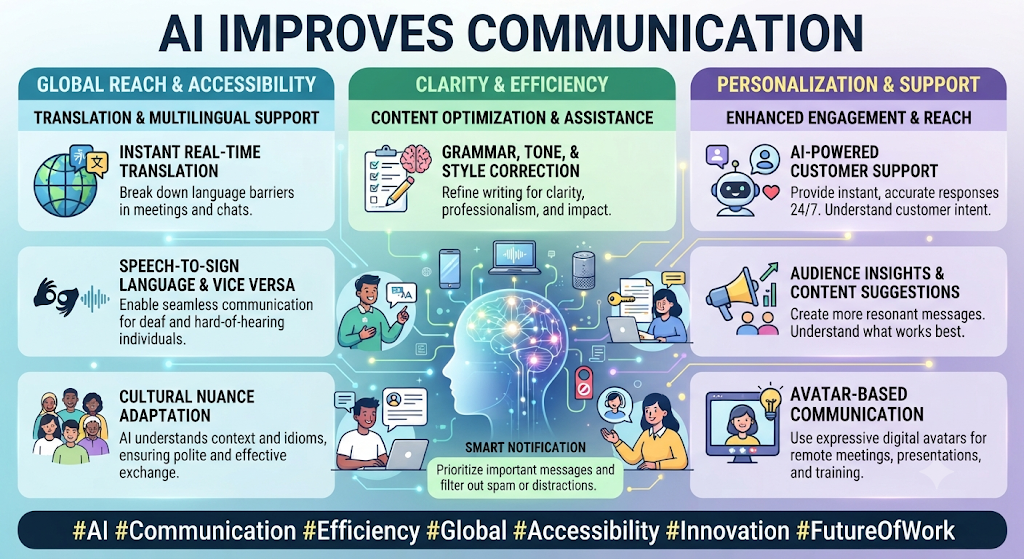
Language differences can make everyday communication difficult, especially when people work, study or travel across different countries.
AI-powered translation tools can translate written messages, websites and spoken conversations. Modern systems can also consider context, which helps produce more natural translations than simple word-for-word conversion.
Writing assistants offer another practical use. They can help people correct grammar, improve sentence clarity and understand unfamiliar expressions.
For someone who is not confident writing in English, this can make communication easier at work or in education.
Still, translation is not always straightforward. Idioms, humour and culturally specific expressions can lose their meaning. Important legal, medical or business documents should be reviewed by someone qualified to check the translation.
6. Helping People With Disabilities
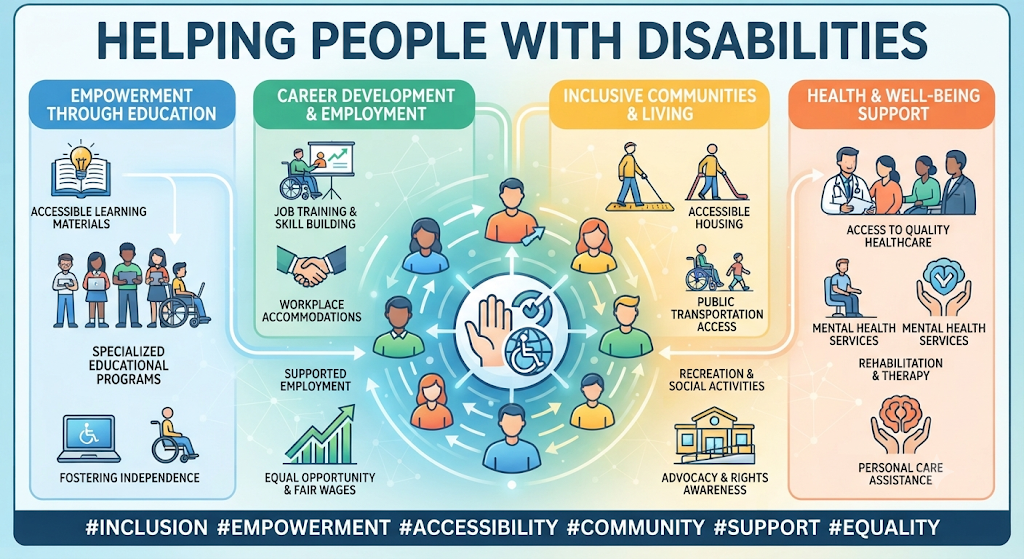
Some of the most meaningful uses of AI involve accessibility.
Speech recognition allows people to control devices using their voices. Text-to-speech systems can read digital content aloud. Image recognition tools can describe objects and surroundings for people with visual impairments.
AI-powered captions can make videos and online meetings easier to follow for people who are deaf or hard of hearing.
There are also tools that convert spoken language into text, recognise different types of input and help people interact with computers in ways that suit their needs.
These technologies do not remove every accessibility barrier. Recognition errors, poor internet connections and expensive devices can still create problems. But they give many people additional ways to access information and use digital services.
7. AI Creates New Opportunities for Small Businesses
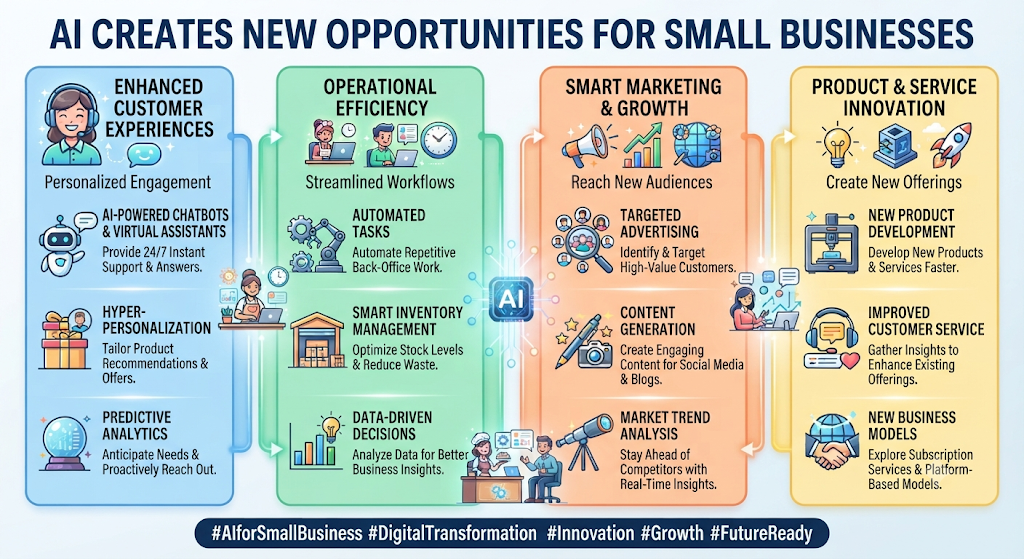
Small businesses often work with limited staff and budgets. Hiring someone for every specialised task is not always possible.
AI tools can help with some of the work involved in running a business.
A small online store can use AI to draft product descriptions, organise customer enquiries and analyse sales information. A freelancer can prepare a first version of a proposal or organise project notes. A local business can use AI to create content ideas for its website and social media pages.
Developers can also use AI coding assistants to understand unfamiliar code, generate test cases and identify possible errors.
These tools can reduce the time needed for routine work, but they do not remove the need for business knowledge. A generated marketing message may sound convincing while containing incorrect product information. Code may run successfully but still have security or performance problems.
The business owner or developer remains responsible for checking the work.
8. AI Can Make Transportation More Efficient
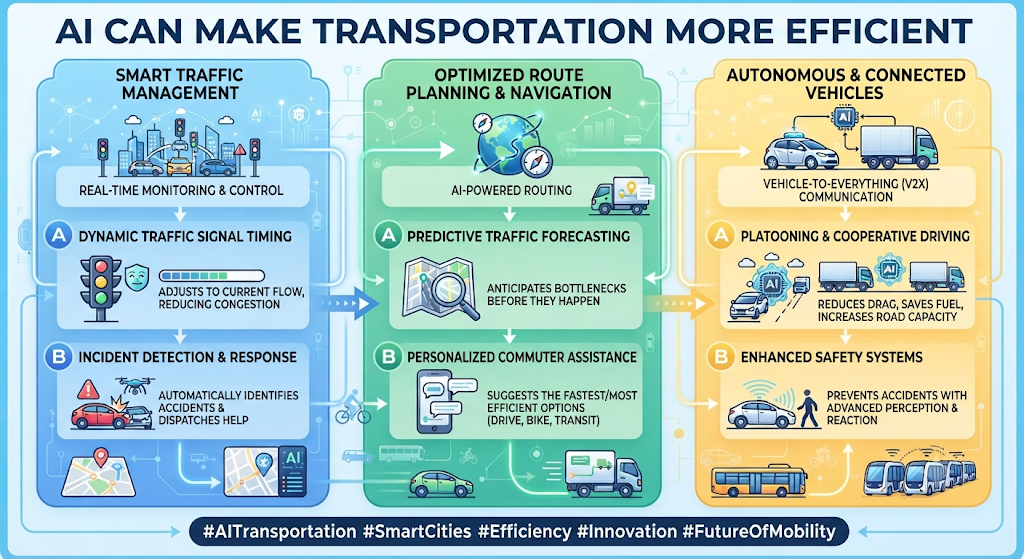
Navigation applications are a familiar example of AI in daily life.
They analyse traffic information, road conditions and historical travel patterns to estimate journey times. When an accident or traffic jam appears, the application may suggest another route.
Transportation companies use related technologies to plan routes, manage fleets and predict maintenance requirements.
In newer vehicles, driver-assistance systems can detect nearby objects, help maintain distance from other vehicles and warn drivers about potential hazards.
These systems can improve convenience and support safer driving, but they have limitations. Weather, road markings, unexpected obstacles and sensor problems can affect their performance. Driver-assistance features should not be confused with fully autonomous driving.
9. AI Supports Creativity
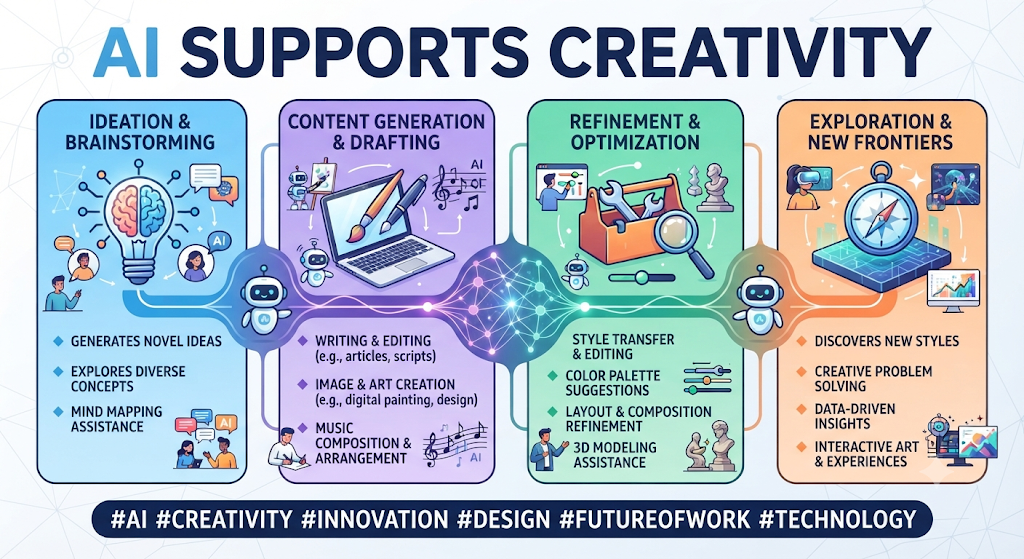
AI has also changed how people approach creative work.
Image generators can turn written descriptions into visual concepts. Audio tools can assist with music production. Writing assistants can help organise ideas, while video tools can automate certain editing tasks.
For beginners, this can make creative software less intimidating. Someone with an idea for a website illustration can describe the concept to an image-generation tool instead of starting with a blank design canvas.
Experienced professionals can use similar tools to explore alternatives or speed up early stages of a project.
But generating something is not the same as creating something meaningful. Good design still depends on understanding the audience, choosing the right visual direction and making thoughtful decisions. AI can assist with the process, but the person using it needs to judge the result.
Can Artificial Intelligence Make Life Worse?
AI offers useful capabilities, but its impact depends on how people and organisations use it.
One concern is misinformation. AI can generate realistic images, audio and text, making false information harder to recognise. People may also receive confident answers that are factually incorrect.
Privacy is another issue. Some AI services process personal information, documents, photographs or conversations. Uploading sensitive information without understanding the service’s data policies can create unnecessary risks.
There are also concerns about employment. Automation may reduce the need for certain repetitive tasks, while creating demand for different skills. The effect will vary across industries and occupations.
Bias deserves attention too. AI systems learn from data, and that data may contain existing social or historical biases. As a result, automated decisions can be unfair, particularly in areas such as recruitment, lending and public services.
These problems do not mean AI should be avoided. They mean that convenience should not come at the cost of privacy, accuracy or accountability.
How to Use AI in a Responsible Way
Getting useful results from AI requires more than knowing which application to open.
A few habits can make a difference:
- Check important information: Verify facts before using AI-generated answers for medical, financial, legal or professional decisions.
- Protect personal data: Avoid sharing passwords, financial details and confidential documents with services you do not trust.
- Understand the output: Do not copy generated code, reports or recommendations without reviewing them.
- Keep learning: Use AI to understand difficult subjects rather than relying on it to do all the thinking.
- Choose tools based on the task: A simple calculator or search engine may be more suitable than an AI assistant for some problems.
- Stay involved in decisions: Let AI provide information and suggestions, but use your own judgment when the decision matters.
The goal is not to use AI for everything. It is to recognise where it genuinely helps.
What Does the Future of AI Mean for Everyday Life?
AI is likely to become more closely connected with the software and devices people already use.
Personal assistants may become better at understanding context. Healthcare systems may use AI more extensively to support research and clinical workflows. Educational platforms may offer more flexible learning experiences, while businesses may automate larger parts of their routine operations.
The direction of development is already visible, but its results are not guaranteed. Technical progress alone does not determine whether a technology improves people’s lives. Cost, accessibility, privacy, regulation and public trust will all influence how widely these systems are adopted.
The most useful developments may not be the ones that attract the most attention. A tool that helps someone understand a document, communicate across a language barrier or complete a difficult task can have a meaningful effect without looking particularly impressive.
Conclusion
Artificial intelligence is useful when it helps people do something that was previously difficult, time-consuming or inaccessible.
It can support learning, improve communication, assist healthcare professionals, simplify business tasks and make digital services easier to use. It can also introduce new risks when people trust its output without checking it.
A better life does not come from using more AI. It comes from using the technology where it makes a real difference, while keeping human judgment, responsibility and common sense in the process.
OpenAI Restarts Frontier AI Training Amid Security Overhaul, Reveals Software Flaw
Neema Sharma is a former software engineer and technology writer at SiliconUpdate. She covers technology news, artificial intelligence, software development, cybersecurity, cloud computing, and emerging innovations in the tech industry. Drawing on her software engineering background, she focuses on explaining complex technical concepts, reporting on technology developments, and creating informative content that helps readers understand the latest trends in computing and digital technology. Her work aims to make technology accessible to developers, IT professionals, and tech enthusiasts.
Explore her technical articles: Neema Sharma on DEV Community
Email: neemasharma@gmail.com