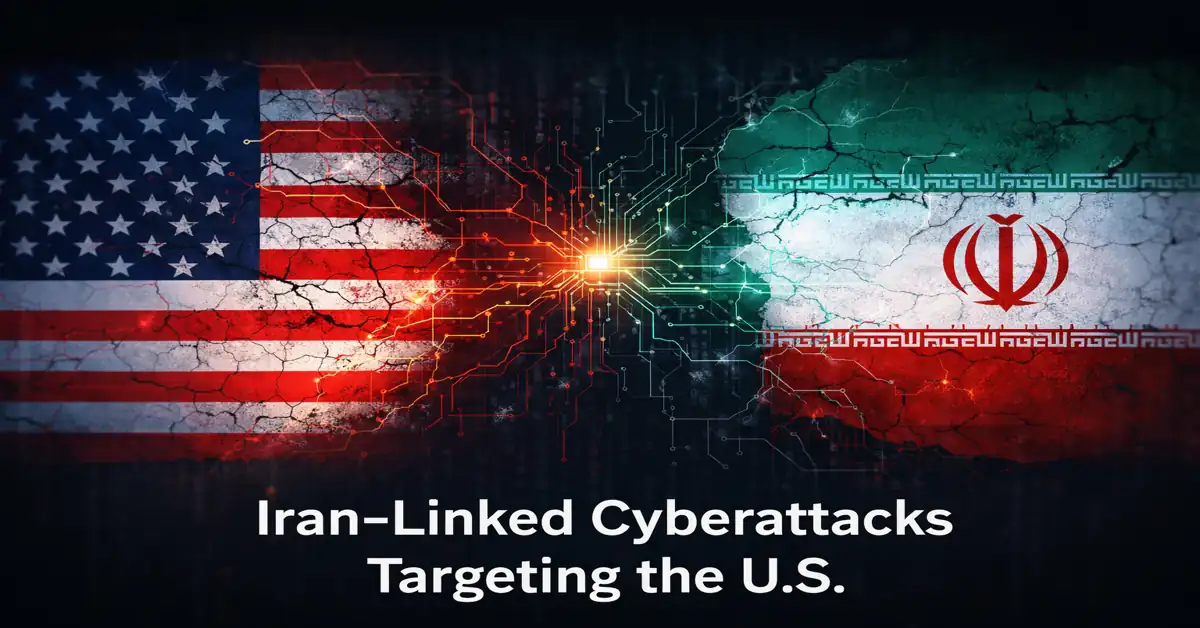
The first wave of cyberattacks linked to the ongoing Iran conflict is offering a clear look into how Iran plans to target the United States in digital warfare.
Early signals
Initial attacks show that Iranian-linked hackers are already inside U.S. networks. Security researchers identified backdoors planted in multiple American companies even before large-scale escalation.

This suggests preparation started weeks in advance, not as a reaction but as a planned cyber campaign.
Target strategy
Iran’s approach focuses on high-impact civilian and private-sector targets rather than direct military systems.
Key targets include:
- Technology companies
- Healthcare systems
- Critical infrastructure (power, water, utilities)
- Government-linked networks
The goal is disruption, not just data theft.
Real-world attack example
A major cyberattack hit a U.S.-based medical company, disrupting operations globally. Systems went offline, internal networks were affected, and employees were locked out.
This type of attack highlights Iran’s strategy:
- Cause operational chaos
- Create psychological pressure
- Show visible impact on everyday systems
Playbook breakdown
Experts say Iran’s cyber playbook includes:
- Pre-positioning access (backdoors inside networks)
- Targeting soft infrastructure (private companies)
- Using proxy hacker groups for plausible deniability
- Combining cyberattacks with propaganda campaigns
Iran is also leveraging influence operations, including bot networks and online messaging, to amplify the impact of attacks.
Why it matters
Unlike traditional warfare, cyberattacks allow Iran to strike inside the U.S. without physical escalation.
Businesses—not just governments—are now frontline targets.
This shifts cybersecurity from an IT issue to a national security concern.
Bigger picture
The cyber dimension of the war is growing alongside physical conflict. Early attacks are likely just the beginning of a longer campaign.
Experts warn that more advanced attacks could follow, including:
- Data destruction (wiper attacks)
- Infrastructure disruption
- Coordinated multi-sector attacks
Conclusion
The first cyberattacks are not random—they are a preview of Iran’s strategy.
The focus is clear: long-term access, civilian disruption, and psychological impact.
For the U.S., this means the battlefield is no longer limited to geography—it now includes every connected system.
Source: https://www.axios.com/2026/03/17/iran-us-israel-cyberattacks-critical-infrastructure

SiliconeUpdate.com is a technology news platform that publishes updates and informational content related to silicon technology, software, artificial intelligence, and emerging technologies.
All articles published on this platform are attributed to SiliconeUpdate.com instead of individual authors. Content is presented in a neutral, informational format without personal opinions.
—
Content Publishing
SiliconeUpdate.com publishes news and updates based on publicly available information, official announcements, and industry developments. The focus is on clarity, relevance, and timely reporting.
—
Editorial Control
All editorial decisions, updates, and content management are handled at the platform level. No individual human or AI identity is presented as the author of articles.
—
Contact
For editorial communication or general queries, contact:
Email: neemasharma@gmail.com