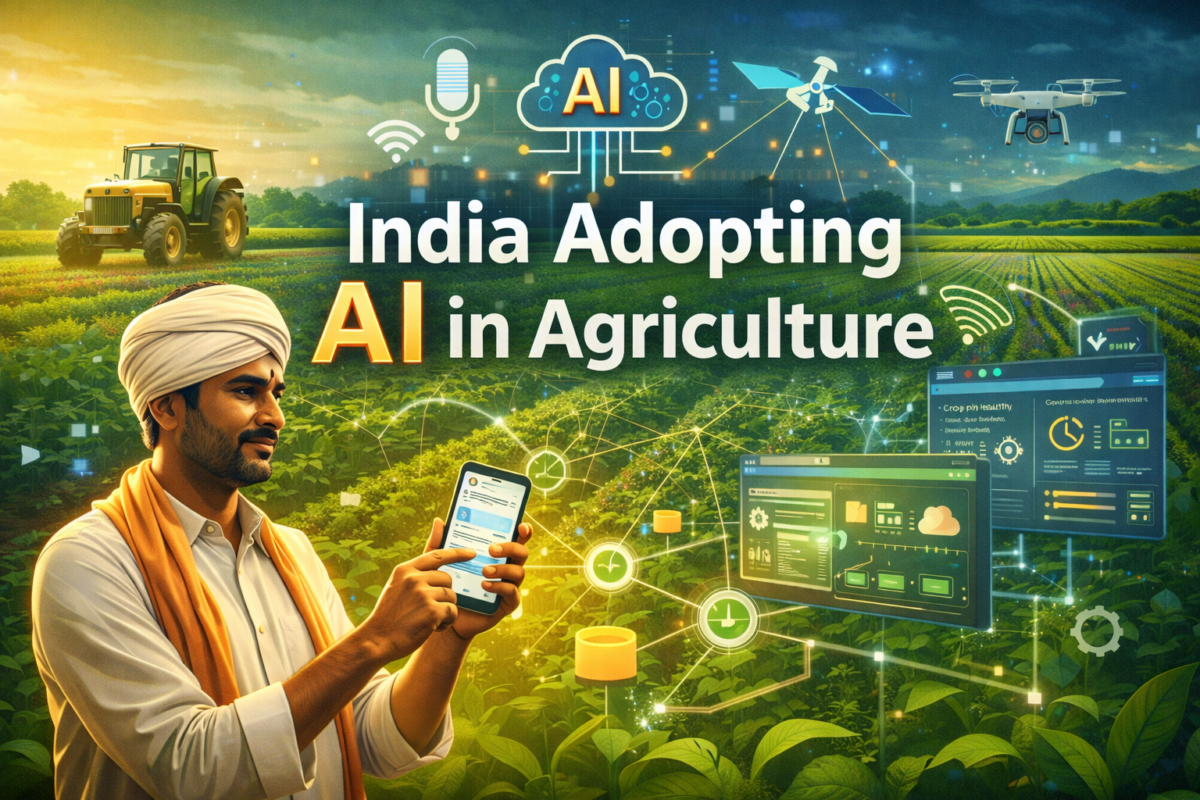
India is accelerating the adoption of artificial intelligence in agriculture as part of a broader effort to modernize farming, increase productivity, and reduce risks for millions of farmers. Through new digital platforms and AI-driven advisory tools, the government aims to transform traditional farming into a data-driven agricultural ecosystem.
The move comes as climate uncertainty, rising costs, and changing market conditions continue to challenge India’s agricultural sector.
Government Launches AI Tools for Farmers
One of the biggest initiatives announced in recent policy discussions is Bharat-VISTAAR, a multilingual AI-powered platform designed to support farmers with real-time agricultural guidance. The system integrates digital agriculture databases with AI to provide customized advice on crops, weather conditions, soil health, and pest management.
The platform connects with AgriStack, India’s digital agriculture infrastructure, which stores farmer records, land data, and crop information to support smarter decision-making.
By combining these systems, farmers can receive localized recommendations directly on mobile devices, reducing dependency on manual extension services.
What Is AgriStack?
AgriStack is a national digital infrastructure designed to build a comprehensive database of farmers and agricultural land. It provides features such as:
- Digital farmer identities
- Verified land ownership records
- Crop data and farm-level information
- Direct integration with government schemes
These digital records allow AI systems to analyze farm conditions and deliver personalized recommendations for each farmer.
The platform also helps simplify access to subsidies, crop insurance, and agricultural credit by linking farmer data with government programs.
How AI Can Transform Farming
Artificial intelligence is expected to improve agriculture in several key areas:
1. Weather and Crop Prediction
AI systems can analyze weather patterns and satellite data to predict rainfall, drought risks, and optimal planting periods.
2. Pest and Disease Detection
Machine learning models can detect crop diseases earlier using drone images or smartphone photos, allowing farmers to act before large-scale damage occurs.
3. Market Price Insights
AI-powered analytics can help farmers choose the best time to sell crops by forecasting price trends across markets.
4. Precision Farming
Smart sensors and AI models can monitor soil health, fertilizer usage, and irrigation requirements to improve yields while reducing costs.
These technologies can help farmers make more accurate and timely decisions, improving productivity and sustainability.
Focus on Small and Marginal Farmers
India’s AI strategy for agriculture is designed with a strong focus on smallholder farmers, who make up the majority of the country’s agricultural workforce.
Government and industry initiatives aim to build AI tools that work even in low-connectivity rural areas and support multiple Indian languages to ensure accessibility.
The goal is to ensure that advanced technology benefits farmers across rural regions rather than being limited to large agricultural businesses.
The Future of AI-Driven Agriculture in India
India’s push toward AI-powered farming reflects a broader strategy to build digital public infrastructure for agriculture. Experts believe this approach could improve crop productivity, reduce financial risks, and strengthen food security in the coming years.
As digital platforms like AgriStack expand and AI tools become more widely available, India could enter a new phase of smart agriculture driven by data, automation, and predictive analytics.
Source:
Economic Times – Artificial Intelligence in Indian Agriculture
https://m.economictimes.com/news/economy/agriculture/artificial-intelligence-in-indian-agriculture-the-bus-india-cannot-afford-to-miss/amp_articleshow/129168914.cms

SiliconeUpdate.com is a technology news platform that publishes updates and informational content related to silicon technology, software, artificial intelligence, and emerging technologies.
All articles published on this platform are attributed to SiliconeUpdate.com instead of individual authors. Content is presented in a neutral, informational format without personal opinions.
—
Content Publishing
SiliconeUpdate.com publishes news and updates based on publicly available information, official announcements, and industry developments. The focus is on clarity, relevance, and timely reporting.
—
Editorial Control
All editorial decisions, updates, and content management are handled at the platform level. No individual human or AI identity is presented as the author of articles.
—
Contact
For editorial communication or general queries, contact:
Email: neemasharma@gmail.com